

Southern Avenue: The language of love embraced the grammar of protest as some of the world's finest practitioners of Urdu poetry gathered in Calcutta to give voice and verse to the anger, outrage and disillusionment sweeping society.
Kathua, Unnao, gender discrimination and the plight of the marginalised either featured or were alluded to in several recitations during Sunday night's Mushaira Jashn-e-Bahar at Nazrul Mancha, organised by the West Bengal Urdu Academy.
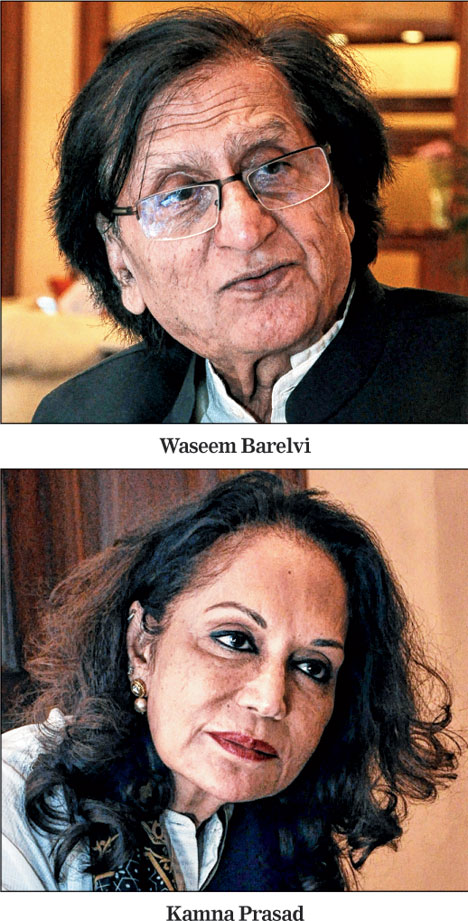
"Gunahgar to nazrein hain aapki, varna kahaan ye phool se chehre naqaab mangte hain (Your eyes are the culprits, otherwise these flower-like faces would not need veils)," Waseem Barelvi said of the oppressive male gaze.
According to Barelvi, whose lyrics had been extensively used by Anna Hazare supporters, Urdu isn't just a language. "It represents our composite culture," he said.
Two of his favourite lines among the many he has penned evoke the power of protest. " Usulon par jahan aanch ae, takrana zaroori hai; jo zinda hoon toh phir zinda nazar ana zaroori hain (When principles are threatened, conflict is imperative; if I am alive, I should be seen as one)."
Barelvi believes now, more than ever, is the time to fight for what is right. "India's lofty ideals are under threat and it is time to fight for them," he told Metro on Monday.
Kamna Prasad, Urdu activist and the organiser of the event, spoke of how a language steeped in romance had historically also been a tool for protest. "Urdu is known as the language of love. But when the need arises, it can be the language of protest. Urdu poetry like Ram Prasad Bismil's Sarfaroshi ki tamanna ab hamare dil mein hai were the benchmarks of sloganeering during the freedom movement. The incidents of rape in Kathua and Unnao have shaken the country's conscience. How can poets be immune to it?"
Jashn-e-Bahar, which celebrates all things Urdu, is in its 20th year. Each event brings poets from India and abroad - Bangladesh, Saudi Arabia, the US, Canada, and this time even Japan - together to unleash the force of their lyricism.
"This is the first time that we had a Calcutta edition," Prasad said.
Dipti Mishra, the writer and actress, recited a poem that she said was a woman's response to society stereotyping and objectifying her. " Chahe jis nazar se dekhlo mujhe, aks tumhara hai (Look at me in whichever way you want; it's your reflection)," the verse ends.
Mishra, who essayed the role of actor Madhavan's mother in the 2011 film Tanu Weds Manu and its sequel four years later, said India's treatment of women had deteriorated over the past five years.
Hussain Haidry, 32, was among the younger participants at the Mushaira Jashn-e-Bahar. An alumnus of IIM Indore, Haidry had left a corporate job to pursue writing full-time. His Hindustani Musalmaan went viral on social media last year. "Apne hi taur se jeeta hoon, daaru cigarette bhi peeta hoon; koi neta meri nas nas mein nahin, main kisi party ke bas mein nahin. Main Hindustani Musalmaan hoon (I live my way, I drink and smoke; there is no leader running through my veins, I am not controlled by any party. I am a Hindustani Musalman)," so goes the poem.
Scientist, poet and documentary film-maker Gauhar Raza said the country was at the crossroads. "It can plunge into fascism or come out stronger."
His recitation at the event told the story of a tortured girl and brought the audience to its feet. " Jism par zakhm hai, aankho mein lahoo hai meri; aaj to rooh bhi larzan hai meri (My body is wounded, my eyes are filled with blood; today, even my soul is trembling)."
Raza said poetry should be a tool to make society better. "Someone who doesn't react to what is happening in society cannot be a poet."
Pictures by Anup Bhattacharya