 |
It was a wrong turn that led Stephen Bosanquet down the right path as he took a left outside Taj Bengal on Friday morning.
“Shall we go in?” he asked wife Zoe as he spotted the National Library. As they strolled on the premises, he spotted the stately white Belvedere House and instantly recognised it from an old picture held in the family and passed down to his father’s sister.
“This is the same building where my great great grandfather, Augustus Rivers Thompson, lived when he was the lieutenant governor of Bengal (1882 and 1887),” he told Zoe excitedly.
He was right. The National Library (known as Belvedere House during the Raj) housed several lieutenant governors from 1854 to 1911, till the British capital shifted to Delhi.
The 56-year-old Stephen, in Calcutta from his hometown Princes Risborough (between Oxford and London), had no idea that he would discover a link to his past. “I wanted to go to Udaipur from Agra but my wife, who’s been putting together a family tree, insisted we stop in Calcutta. And to pick a hotel which was next door to where my forefather stayed has to be fate,” the soft-spoken gentleman told Metro.
But that’s not Stephen’s only link to the Raj. The grandfather of Stephen’s great great grandfather Augustus Rivers — that would be a mere seven generations before Stephen! — was George Nesbitt Thompson, secretary to Warren Hastings.
“Of the seven generations, five have been born in India. I feel like I’ve got a link with the past that I didn’t really know. I had no idea it went back so far and goes even further back,” said Stephen, as he took out a sheet of paper where he had carefully pencilled down the family tree. “I wrote this down last night,” he said, “I know my father and aunt would be interested and perhaps the generations after me.”
Bengal under the Lieutenant-Governors, a book by Charles Buckland, a copy of which is in the National Library, has an entire chapter on Augustus Rivers Thompson. “From what I read, he stood up against the Europeans being treated differently. He also played cricket and rode, it was unusual to do both, before he became a writer,” said Stephen.
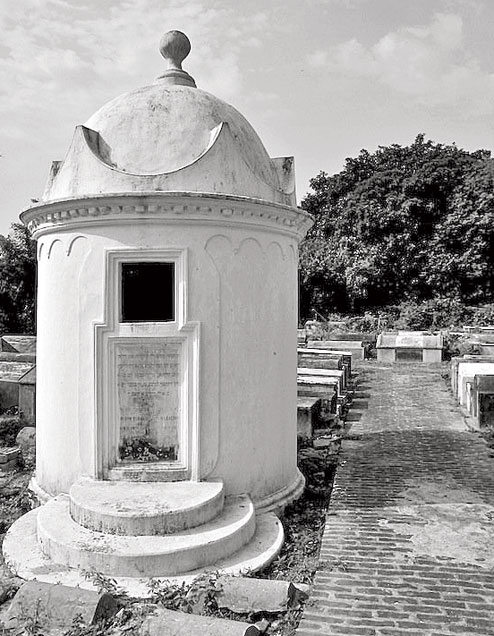
His tryst with the past did not end at the National Library. The concierge at Taj Bengal, David Aaron, arranged for a visit to the Park Street cemetery. “He came to me with pictures of his great great grandfather. I immediately knew who to get him in touch with. In the past too, as members of the Les Clefs d’Or India (Golden Keys), we have helped travellers with strange and challenging requests,” said David, who put Stephen on to Indu Elahi of Let’s Meet Up Tours.
“It was quite amazing. I went to the cemetery expecting nothing and discovered four memorials of my ancestors! Initially, I wasn’t emotional. We had been to Agra last week to see the Taj and we thought we’d go to the military cemetery to find some graves but it was completely overcrowded. So to come to this cemetery, which was so well organised, complete with a book with all the names listed, showed that there are people who still care. And I went around thinking, ‘Mmmm, I don’t think we’ll find anything and then you find one, two, three, four… even the curator who was helping was surprised because it’s so rare to find anybody. That was a moving moment,” said Stephen.
Tour guide Indu was witness to the special moment. “We spent almost an hour there with a lot of mosquitoes biting us and thankfully it didn’t rain. I could see in Stephen’s eyes that he was very emotional and he called his brother in England the very instant he found the graves,” she said.
Will he be back? ‘I think so,” said Stephen quietly. “It’s kind of incredible, sort of like time travel. To know it was real and it did happen. And that it wasn’t a story.”