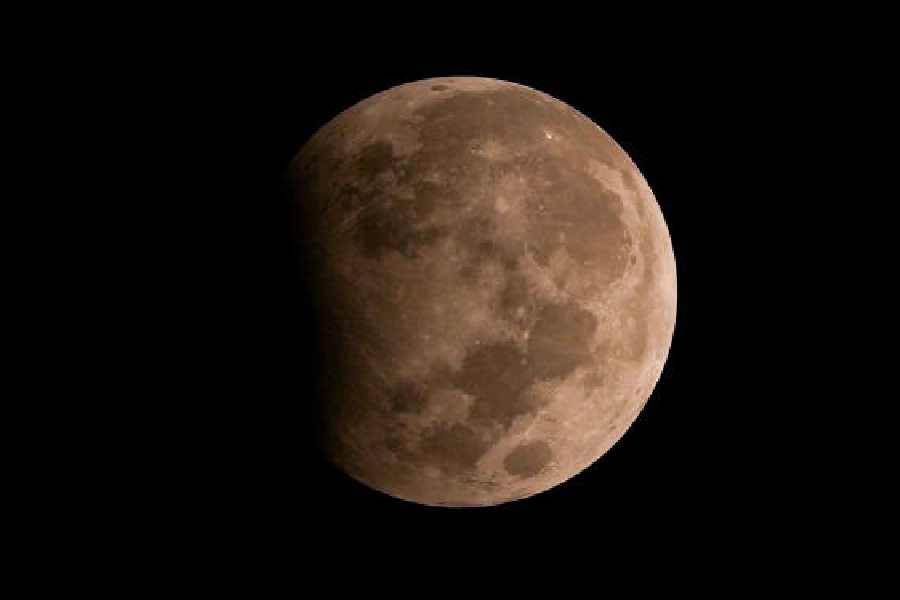
The city will see a partial lunar eclipse on Tuesday.
In the afternoon, the Moon will drift into the deepest part of Earth’s shadow, transforming into a glowing red sphere in the sky. A full-moon night will mark the festival of colours.
A total lunar eclipse happens when the sun, earth and moon line up perfectly on a full-moon night, and Earth’s atmosphere bends sunlight onto the moon, filtering out blue shades and leaving behind rich crimson and copper shades.
The total lunar eclipse will be visible from most of North America (except the eastern part), East Asia, Australia, New Zealand and large parts of the Pacific Ocean. Parts of Asia, including India, South America and Antarctica, will experience a partial eclipse of the moon. By a rough estimate, around six billion people worldwide will be under the total or partial eclipse.
For nearly 58 minutes, the moon will be fully covered in Earth’s umbra (the central, darkest, and innermost part of the shadow cast by Earth into space, forming a cone-shaped region where the Sun is completely obscured), creating the dramatic “Blood Moon” glow skywatchers love. The colour can range from deep red to rusty orange, depending on atmospheric conditions at the time.
The moon will start entering the Earth’s partially shadowed region, called the penumbra, around 2:14 p.m. Indian time. The partial eclipse will begin at 3.20pm, when the moon passes through the earth’s shadow and becomes partially eclipsed.
The total lunar eclipse will begin around 4:34pm, with the maximum eclipse, when the moon is deepest inside the shadow at 5.03pm, and the totality will end around 5.32pm.
Therefore, the penumbral eclipse, the start of the partial eclipse, the total eclipse and the moments of the greatest eclipse will not be directly visible from Calcutta because the moon will be below the horizon.
horizon.
From Calcutta, sky watchers can see the Moon will rise around 5.39pm and will be completely above the eastern horizon by 5.4pm, when the Moon will appear almost completely eclipsed (about
94%).
This will be the greatest magnitude of the eclipse for Calcutta, though not the true maximum point when the entire moon will be under the earth’s shadow and will look dark red, popularly called the “Blood Moon.”
In Calcutta, the partial eclipse will end at 6.47pm, and the penumbral eclipse, which is not always discernible to the naked eye, will end at 7.53pm Since the moon will be near the horizon at this time, go to a vantage point for the best view of the eclipse.
Try to enjoy this cosmic spectacle on the night of Holi, because the next total lunar eclipse won’t occur until three years later on New Year’s Eve, December 31, 2028.
Unlike a solar eclipse, a lunar eclipse can be seen with the naked eye. Do not be misled by the large number of suggestions flooding social media about what should and should not be done during the situation. These claims are not backed by science.