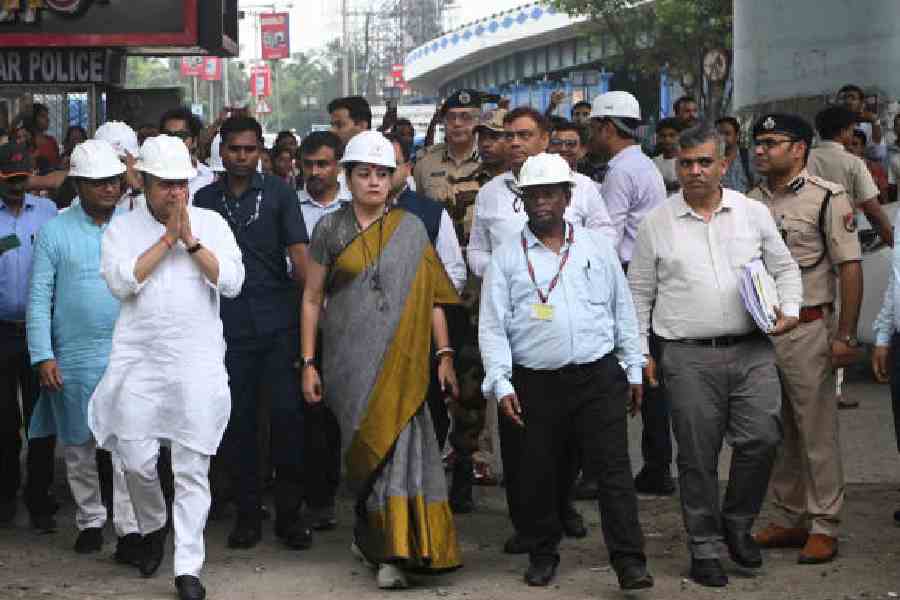
The stalemate over bridging the Metro gap on EM Bypass at Chingrighata for several years is a “classic example” of how the Mamata Banerjee government was “against any development,” Union railway minister Ashwini Vaishnaw alleged on Saturday.
“The TMC government stopped the project (New Garia-airport Metro) at Chingrighata. This is a classic example of how the TMC government was against any development,” he said, standing beneath the Metro viaduct laid on giant pillars across one of the city’s busiest intersections.
“We got tired of seeking permission for the Chingrighata work,” Vaishnaw said, hours after meeting chief minister Suvendu Adhikari. The new state government said it would address the land logjams that have stalled several key projects in Bengal.
“We had to move the high court. The court directed the state government to allow the Metro work, but the permission was denied. The TMC government moved the Supreme Court,” Vaishnaw said. “Even after losing the case in the Supreme Court, the TMC government did not give permission for the Metro work.”
The railway minister was flanked by new BJP ministers Jagannath Chattopadhyay and Agnimitra Paul.
“Within a few days of the new government being formed, such massive work was completed, and now the project is moving ahead,” Vaishnaw said.
Stuck since September 2024, the work of bridging a 366-metre gap at Chingrighata was completed on the morning of May 25, three weeks after the new state government was sworn in.
Senior engineers and officials of the Rail Vikas Nigam Limited (RVNL), which is implementing the Orange Line Metro project in Calcutta, completed the task with the support of police in two phases over six nights spread across two weeks.
Officials said city police had earlier given the impression that it would be impossible to enforce traffic blocks at the intersection for the project. With the gap bridged at Chingrighata, Metro officials are hopeful that the line connecting New Garia to the airport will have trains running up to Sector V by December-end.
Once that happens, the commute time between New Garia and Sector V, covering a distance of around 30km, will be 35-40 minutes.
“Kolkata Metro is a very important infrastructure. It really makes a big difference to the lives of common citizens, especially low-income and middle-class families,” Vaishnaw said.
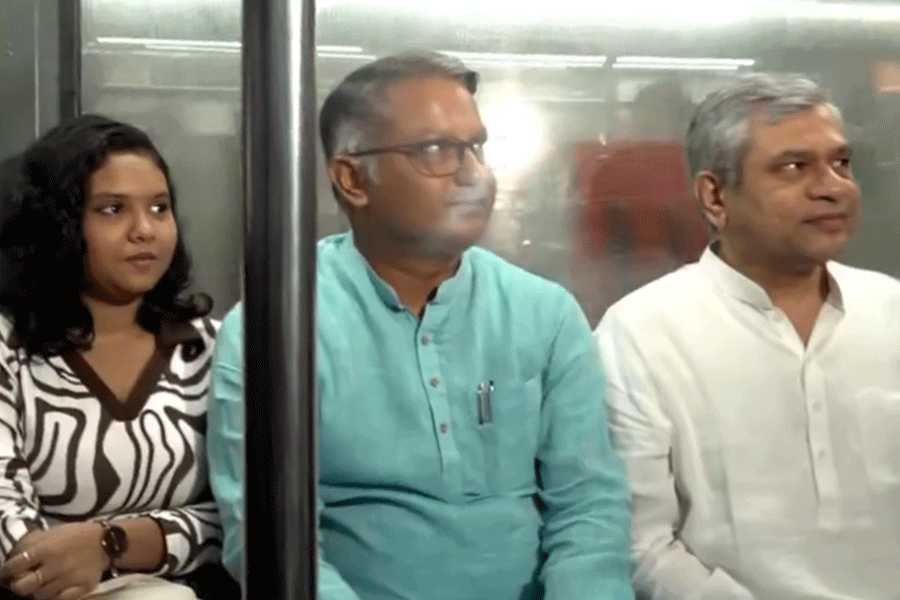
“This project started in 1972, and in the next 42 years, only 28km was added. Under Prime Minister Narendra Modi, 45km of work was completed in 12 years,” he added.
New-gen Metro
Vaishnaw said 60 new-generation Metro trains will be inducted over the next five years.
“Kolkata Metro will get new-generation trains... which will be inducted over the next five years,” he said. “The chief minister instructed the chief secretary, the commissioner of Kolkata Municipal Corporation, and the commissioner of Kolkata Police to remove any barrier that comes in the growth of Metro’s expanding network.”