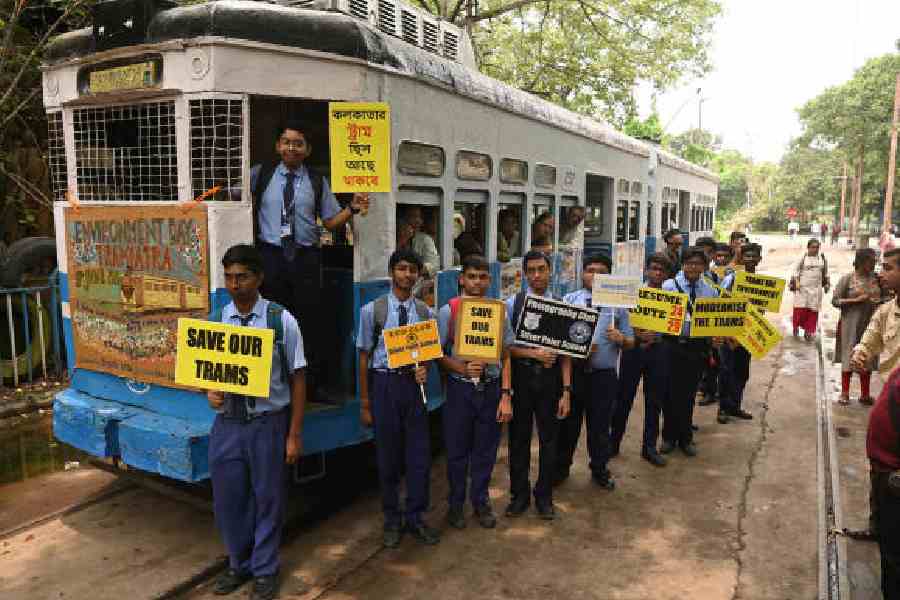
Trams will not be reduced to a mere symbol of heritage but retained as a mode of urban transport, BJP’s Rashbehari MLA Swapan Dasgupta said on Friday, raising fresh hopes that a change in government could reverse the fortunes of Calcutta’s trams.
Dasgupta, who attended Tramjatra, an awareness programme organised by the Calcutta Tram Lovers Association, said the state government would not view tram depots as real estate to be sold off but would plan ways to integrate trams into the city’s transport network.
His remarks stand in contrast to the approach of the previous Trinamool government towards Calcutta’s more than 150-year-old tram system.
Former transport minister Snehasis Chakraborty had said in February 2023 that trams would run on only “four or five routes” and that it would not be possible to run them on all routes as in the past. While acknowledging that trams were an environment-friendly mode of transport, Chakraborty said that the city’s roads were too narrow to accommodate them across routes.
Dasgupta rejected the idea of treating trams as relics of a bygone era. “Trams will not be reduced to a symbol of heritage. Trams are an aspect of urban transport. If required, the fleet needs to be modernised. Our government will definitely give a good thought to how to use trams,” he said.
“I did not like the attitude of looking at the properties of the tram company as valuable real estate and selling them,” Dasgupta said at the event.
Asked whether the BJP government would consider introducing more tram routes, Dasgupta said the issue required “detailed study”.
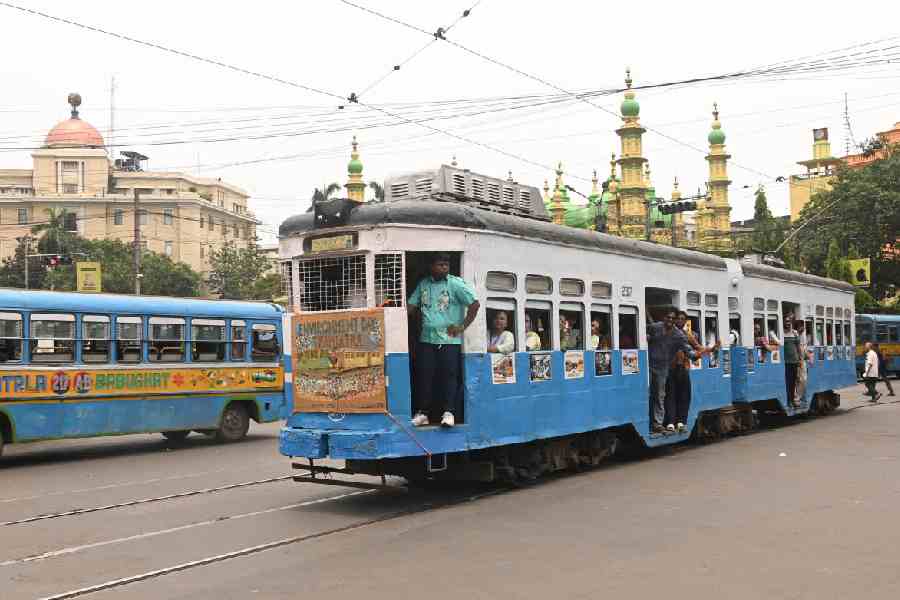
A tram that was part of the Tramjatra in Esplanade on Friday. Picture by Bishwarup Dutta
According to Debashis Bhattacharya of the Calcutta Tram Users’ Association, a citizens’ group campaigning for a wider tram network, Calcutta had more than 20 tram routes in 2011. Today, only two remain operational.
The surviving routes are Route 5 (Shyambazar-Esplanade) and Route 25 (Gariahat-Esplanade).
Route 24/29 (Ballygunge-Tollygunge) has remained closed because of problems along a 30-metre stretch near the Public Service Commission office in Tollygunge, Bhattacharya said.
“The repair was faulty and engineers felt trams might topple while passing through that stretch. It was never corrected, and the route has remained non-functional since August 2024,” he said.
Other members of the association said that tram tracks had been covered with bitumen at several locations.
Tram enthusiasts said that Calcutta already has the infrastructure needed to revive the network and restoration would not be difficult.
“At a time when many cities across the world are reintroducing trams, we were damaging existing infrastructure. I hope the new government revives trams as a mode of transport,” said a participant who identified herself as a tram lover.