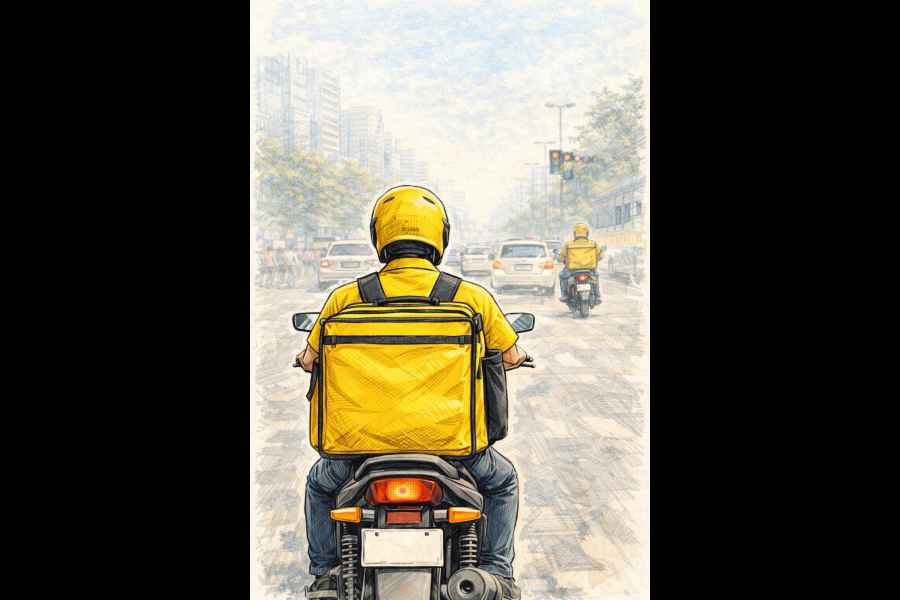
The Centre’s direction to quick-commerce platforms to drop delivery timelines from their branding will do little to improve rider safety, delivery partners and gig-sector activists said, arguing that the pressure to rush is built into the platforms’ operating models.
Even without explicit promises of 10-minute deliveries, riders said they are pushed to complete orders as fast as possible and immediately line up for the next one. Unlike traditional e-commerce or food delivery, quick-commerce operates within a much narrower radius, intensifying competition among riders stationed at the same hub.
“The direction to drop the 10-minute timeline means very little,” said Priyasmita Dasgupta, co-founder of Delivery Voice, an association of gig workers. “Quick-commerce platforms want a store every 2-3km. These dark stores are coming up at regular intervals across the city. Orders are assigned on a first-come, first-served basis, so riders have to finish one delivery and rush back to the store for the next.”
Incentives are structured in a way that rewards speed above all else, Dasgupta said. “The incentive slabs are high and only a small section of riders can reach them. The only criterion is how fast you can ride a bike,” she said.
Earnings on app-based cab or food delivery platforms also depend on the number of trips completed, but there is a difference. A cab ride from Ballygunge to Salt Lake cannot be completed in 10 minutes, and food delivery apps display longer delivery windows during peak traffic. Quick-commerce, however, is designed around rapid turnaround within short distances, creating pressure.
Riders also said there are far more delivery partners than needed for a fair distribution of orders from the delivery hubs.
A delivery partner operating from a quick-commerce hub on the southern fringes of Calcutta said the hub processes around 1,500 orders on an average weekday, and there are nearly 120 riders. In theory, that should mean 12 to 13 orders per rider. But incentives come in only after 18 orders. “I can earn about ₹500 after 18 orders, and up to ₹1,400 if I somehow manage 45 orders. For that, you need to spend 15 to 16 hours on the road. It’s taxing. Otherwise, there are too many riders competing,” he said.
A rider in north Calcutta shared a similar experience.
“I have been riding a bike for a year now. There are many expert riders who are faster,” he said. “I slog for around 10 hours a day but earn less than ₹12,000 a month.”
He works for a quick-commerce platform during the day and an app-bike aggregator at night.
The government’s intervention to remove timelines from platform branding came after gig workers’ associations went on strike on December 31, saying such delivery timelines were mounting immense pressure and increasing the risk of road accidents.
Following the government’s direction, Blinkit reportedly dropped its “10-minute delivery” tagline. Other platforms such as Zepto and Swiggy-owned Instamart are also expected to follow suit, according to a PTI report.
On Wednesday, however, the Blinkit app showed a “promised” delivery time of 9 minutes in Behala from a store 1.1 km away. At Chandni Chowk, the app indicated an 8-minute delivery from a store located 670m away.