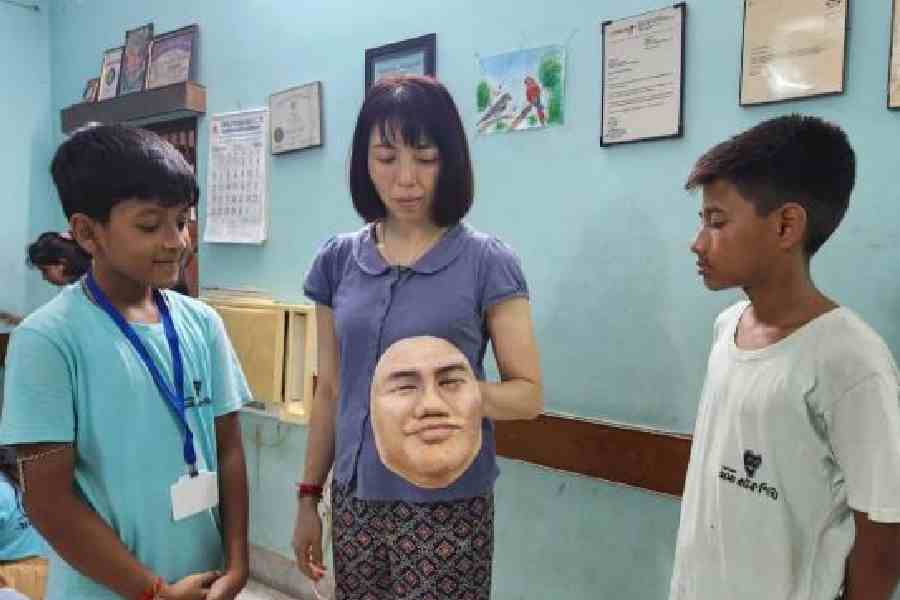
Eso Natak Shikhi, a Kestopur-based children’s theatre group, held a workshop with a Japanese puppeteer that drew around 50 children. This was a huge turnout considering that the workshop was held before the holidays began.
The event was conducted by Erina Saji, a puppeteer who has been living and working in Nepal for the past six years.
“I have worked in 30 to 40 countries and children are the same everywhere,” said Erina through her interpreter, another Nepalese theatre practitioner, Elina Nakarmi. “A child may be gifted, but if he does not pursue his talent, he will never master it. Equally, if you love an art form, you must keep working at it and not take detractors too seriously. When I was a child, no one told me I was good at performing arts, and here I am having made a profession out of it!”
Erina stressed that puppet theatre is no different from any other form of theatre — it has the same requirements —and so began with mime exercises.
The kids were divided into groups and given situations to enact. One team was asked to act as though they were entering a dark room. Unhappy with the initial performance, Erina asked them to shut their eyes and walk around the room for a bit. When they repeated the exercise thereafter, their body language had changed dramatically.
Another group was asked to enact crossing a desert. As the scene was monotonous, Erina had two younger children climb onto the backs of older participants and transform into camels. The audience burst into laughter, and the scene instantly became more engaging.
“The older children looked tired carrying them, and you could actually see how a camel might feel,” she said. “There was no dialogue, yet they communicated so much. Never forget that in English, drama is called ‘play’, because it is meant to be playful. So enjoy performing and make it interesting. At the learning stage, perfection is not important — trying is.”
Bunraku basics: Not dolls
Erina briefly explained Bunraku, Japan’s traditional form of puppet theatre, where the puppets are so large that they require three performers to operate them — one controlling the head and right hand, another the torso and left hand, and a third the legs, while a narrator provides the voice.
“Puppets are not dolls,” she told the kids. “Children enjoy puppet shows because they see inanimate objects coming to life. Your job is to make the audience believe the puppet is real.”
She taught participants how to create puppets using papier-mache and encouraged them to give their creations names, ages and personalities before developing stories around them.
“This art uses both the body and the mind. It encourages teamwork and creates something meaningful. That kind of experience touches the heart and brings lasting happiness, unlike the mindless mobile scrolling that has become a threat to childhood today,” Erina said.
The youngsters thoroughly enjoyed their time at the workshop. “I’m bunking school for this, but it’s worth it as I’m learning something new,” said Anagh Akara, a Class VII student.
Debdoot Guha, another Class VII student of Bidhannagar Municipal School in FE Block, said he enjoyed the papier-mache session the most. “We’re making a woman puppet and creating a backstory for her, which makes it fun. Erina ma’am gives great suggestions. Even in the mime exercise, she helped improve our desert scene,” he said.
Eso Natak Shikhi is a free theatre school for children and this workshop too was free. “Erina is doing this purely out of goodwill, her love for theatre and her desire to pass it on to the next generation,” said Tapas Das, who runs the institute.
“When I announced the workshop, some theatre veterans asked what the point was since theatre productions here don’t use puppets. I told them they don’t use puppets as they don’t know puppetry. If my students learn it, they will start asking me to include it in productions,” said Das.