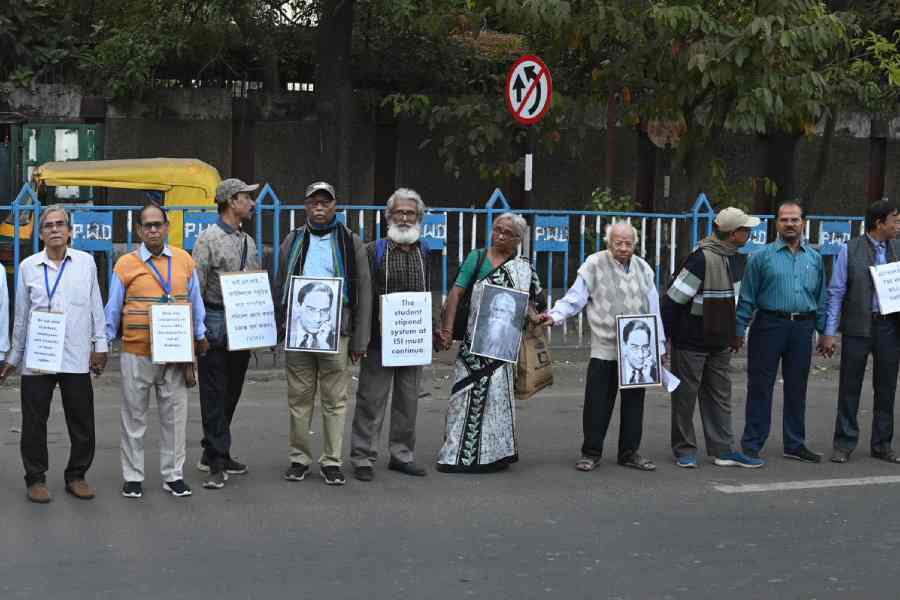
The teachers of the Indian Statistical Institute, Calcutta, have created their own FAQs (frequently asked questions) to highlight the flaws in those presented by the Union government to justify a bill that proposes to overhaul the institute’s existing governance structure.
The teachers have contested the contention of the Union ministry of statistics and programme implementation that the Bill seeks to “upscale the governance framework to align with the peer institutes of national importance”.
They have also dismissed the argument that the Bill will not affect the autonomy of the institute.
The teachers’ document follows the meeting of the council — its highest decision-making body — which appeared to be divided on the proposed Bill.
Sources told Metro that though ISI Calcutta was opposed to the Bill, certain other ISI centres were not.
The teachers have said: “The use of the word ‘upscale’ in the cover document of the first version of the draft Bill, in the context of the society-based governance of ISI compared to that of other INIs (Institutes of National Importance), should be noted with deep regret, as it clearly suggests that the present governing structure of ISI, under which it has performed competitively and excelled, is inferior to peer INIs. It sadly indicates a prejudiced mind working behind the draft.”
The teachers have written that views like “upscaling” that the ministry expressed in the forwarding document of the first Bill were “reiterated” in the FAQs that the ministry provided on its website on December 25.
The ISI, Calcutta, professors have defended the society-based structure, referring to how such a model of governance has allowed several international institutes of eminence to excel.
“Max Planck Institute (a German institute) is one of the foremost academic institutions of the world.... It is worthwhile to note that the Max Planck Institute is actually run by a society, which shows that society structure of governance need not be a hindrance to academic excellence,” the ISI professors have written.
According to the January 24 document, the Bill will not be able to preserve the institute’s autonomy because the principal policy-making body of the institute will be a board of governors (section 15 (1) of the Bill).
Now, the society sits at the top of the administration, followed by the council and the academic council.
“The board will be led by a chairperson... nominated by the visitor on the recommendations of the central government (clause (a) of section 15 (1) of the draft Bill. Thus, the leader of the principal policy-making executive body of the institute becomes a choice of the ministry with administrative control. Thus, the administrative control of the ministry turns into total control of the institute,” says the FAQ.
At present, the chairman of the council is selected through a simple majority in an election among the 33 members of the council.
The outgoing council, following the expiry of its two-year tenure, nominates a distinguished academician as the president of the ISI society.
The academic council consists of all the professors of the institute.
“If the members of the general body of the ISI society think, they can propose the name of another distinguished academician for the post. It leads to an election. But the ministry does not get to decide who will helm the council or the society. But the bill does away with this firewall or buffer that prevents the institute from coming under any control of the ministry,” said an ISI professor.
Partha P. Majumder, a former professor of the ISI and the national chair of science, said once the Union ministry gets to establish its stranglehold over the institute through the proposed board, it will control what is taught at the ISI.
“Just look at the kind of research that the IITs have undertaken over the past few years in the name of IKS (Indian knowledge system). ISI could prevent that because
of its inbuilt firewalls,” said Majumder.
Economist Abhirup Sarkar, a former ISI professor, had earlier told this newspaper that as the ISI deals with data, the Union government wanted greater control over the data and its interpretation.
Calls and text messages from this newspaper to Puja Singh Mondal, the additional secretary in the ministry assigned to look after the ISI for a reaction on the concerns raised by the teachers, did not yield a response. Mondal had attended Saturday’s ISI council meeting.
The ministry wrote on its website that the idea of the ISI bill was floated in a “brainstorming session” organised by the ministry in collaboration with the ISI in June 2025.
The teachers wrote: “However, no such proposal... was mentioned by the president of the ISI society or the director, both of whom were present in the brainstorming.”