
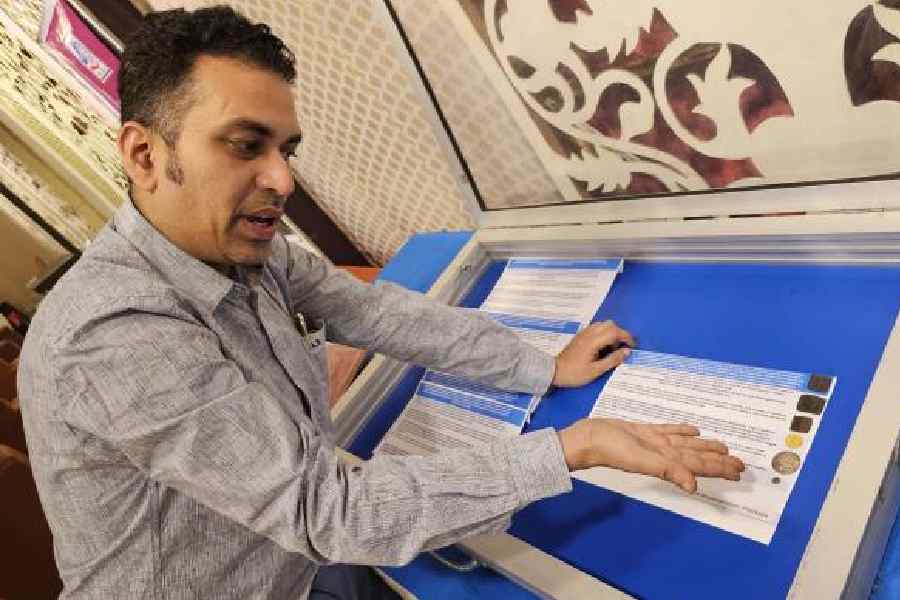
Biswaroop Ghosh was in the first year of college in 2009 when he chanced upon a copper coin from Emperor Akbar’s reign on sale in front of the General Post Office in Dalhousie Square. “The dealer quoted a price of Rs 400. I thought it was a counterfeit as in my mind, the price should have been a lakh or so.”
That curiosity led him to research coins and he realised that old Indian coins were still available and affordable.
Ghosh, now working as the home care wing manager at Manipal Broadway, had inherited a small collection of British India coins from his grandfather. “I used to exchange the duplicates with a school friend.” But it was his chance discovery of the Akbar coin that led him to start in earnest.
“The first coin I purchased was a Kushan-era copper while still in college. I spent Rs 1200 for it from my pocket money and did not tell my mother. The coin had the standing Kanishka on one side and Oado, the running wind god, on the other.” By then, he had studied coinage enough to have formed an idea about fair pricing.
At Mudra Utsav in Sreebhumi last month, organised by the Numismatic Society of Calcutta, Ghosh displayed his collection of ancient Indian coins, starting from punchmark coins of the 6th century BC till the 12th century BC and the start of Muslim rule. “Symbols like conchshell, boat and wheel were used as royal punch marks before scripts came into use and inscriptions replaced punch marks. The choice of these symbols indicated that trading was along the river,” he said, pointing to his 6th-century BC Banga janapad coin, which was the earliest among his exhibits. “The punchmark indicates this to be a Gandhar janapad coin,” he said, explaining that the Banga janapad covered the swath of land from Chandraketugarh (present-day Haroa) up till deep into present-day Bangladesh.
Another coin on view was what he calls a lucky purchase during the onset of Covid — a Gupta-era gold. “It was my first gold coin that I got for Rs 53,000. Its current value is Rs 1.5 lakh. I have had offers for it but have no intention to sell,” he said, showing the Chandragupta II archer type.
Coins as evidence
Explaining the importance of coins in history, he said there were rulers, the only evidence of whose existence is the coins from their era. “The Gupta king Ghatotkachagupta, for instance, is known only through his gold dinara and silver units. It would be a collector’s dream to lay hands on one.”
Among the three rare coins he exhibited was a mule coin of Azes (Mule coins are created when a mint accidentally uses another coin’s design when striking one side of a coin). They were issued by Indo-Scythian (Shaka) rulers from the Kabul-Gandhara region, who are linked to the Three Wise Men visiting baby Jesus,” he said. (Scholars speculate that one of the Magi could have been an ambassador sent by King Azes) “I saw it with a dealer in 2023 and realised that I had not seen it before.” Ghosh sent a picture to a Canadian scholar, who endorsed its rarity.
There were two other coins in his display that he is proud of. One is an ancient Taxila one with a three-arched hill with a moon from the post-Mauryan period. The other is a medieval age copper unit of Prithvivarman Deva, a Chandella ruler. Coins of this era rounded up the time period he covered.
Other exhibits included coins from the Kushan rulers (1st to 4th century CE) and the tribal republics that used to circulate their own coins from the 2nd century BC to the 1st century CE as well as coins of the Satabahana kingdom in central India, who were almost contemporaries.
A coin indicates a region’s prosperity. “Gold cons indicate the highest degree of prosperity. The Gupta period was a golden era, with beautiful detailing in their ashwamedha or lion-slayer coins. The Kushan rulers too issued gold coins,” he said.
Ghosh insists that continuous study is imperative for a collector and he makes time in spite of keeping tabs on home-visit schedules of nurses and paramedics, and coordinating with doctors.
“We get to know of new coins and new rulers frequently from the ONS Journal published by the Oriental Numismatic Society. Every excavation may throw up new numismatic discoveries. For instance, who knew a Gupta gold coin horde could be found near Kalighat!” he said, speaking of the 200-odd Late Gupta era coins that a fisherman found in 1783 and which were later gifted to Warren Hastings.
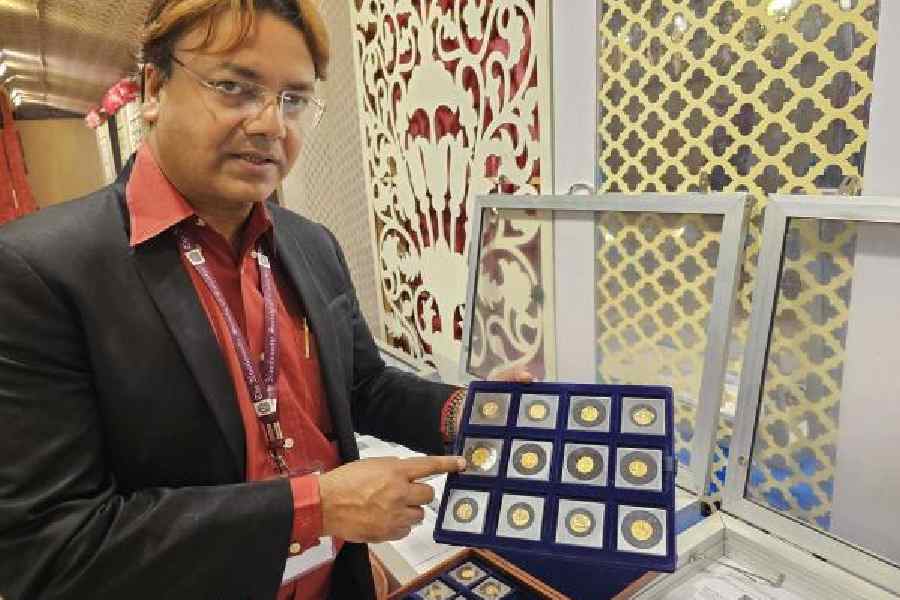
Dr Ujjwal Kumar Saha points to a gold coin in his collection at the exhibition at Mudra Utsav
One has read of Alexander the Great’s invasion of India in 326 BC in history classes. Those who visited Mudra Utsav at Divinity Banquet Hall in Sreebhumi over a December weekend also got to witness a coin that the Greek emperor had issued for his Indian kingdom.
“I had bought the gold coin from a jewellery shop in 2018. Its valuation has reached a crore now,” said Dr Ujjwal Saha, pointing to the prized item in the locked glass case. To eliminate all risk, he took his coins home daily once the viewing hours ended.
The head of business development at Joint and Bone Care Hospital in DD Block has over 100 ancient Indian gold coins in his collection. “I have collected from Alexander’s first gold coin till the issues of Chandel, Chol and Kalchuri dynasties of the Hindu medieval age, which ended with the invasion of Bakhtiar Khilji in the 13th century,” he said.
Dr Saha has exhibited at the Indian Museum, the Asiatic Society as well as several universities. “India is a treasure trove of coins with so many rulers striking a variety of coins down the ages. They keep getting discovered with excavations taking place.”
Earlier, coins of precious metals would be melted for their value as metal. However, the Antiquities and Art Treasures Act of 1972, which aims to regulate the export, sale, and dealing of items over 100 years old, has raised awareness in this regard, he pointed out.
The general physician, who had started collecting coins in school with foreign currency procured from his father’s friends, switched to old currency after passing Class XII in 1998. “I started buying from dealers on the General Post Office and Indian Museum pavements. In 2001, I became a member of the Numismatic Society of Calcutta. And in 2003, I bought my first gold coin.”
Saha was so keen on his hobby that he completed research in numismatics from a London institute between 2009 and 2015. Even now, he frequents the British Museum, which has a rich store of Indian coins. He has also lectured on coins in Kuala Lumpur in 2014 and in Boston in 2020.
His collection received a massive boost in 2018 when he inherited a store of guineas from his father-in-law, who belonged to the Dutta family of Garanhata. “The pick of this inheritance was a Samudragupta coin issued to mark the conquest of Bengal. It is one of seven pieces known to exist. You can imagine my excitement on spotting it. There were Gupta and Kushana-era coins too.”
Though he has so many gold coins, Saha points out that the value of a coin depends on rarity, not material. “A Chandragupta I lead coin is as valuable as a gold coin,” he said.
He admits the chance of falling counterfeits. “I stay abreast of auction rates. There was no internet when I started, so I read up as many books as I could, attended seminars and coin exhibitions. I also visited the office of the dealer J.P. Sau, who had several books.”
The doctor does not do private practice outside his hospital duty to make time for his hobby. “The new collectors, who are picking up this hobby, are not very serious about the academic side of numismatics. We need to give more importance to this hobby, which is so deeply linked to our cultural heritage,” he insisted.