 |
Academicians, women’s rights activists and students came together on Tuesday in search of a way forward for the movement to end violence against women.
The meeting took place at Jadavpur University, with participants spilling onto the steps in the aisle.
One of the speakers was Taritmoy Ghosh, a philosophy teacher from Derozio Memorial College, where the slain girl from Kamduni was a student.
It was a poignant moment as he recalled that the girl, a first-generation learner, had philosophy, education and Bengali as her subjects.
Ashok Ranjan Thakur, the first vice-chancellor of West Bengal State University under which Derozio College falls, spoke of the eagerness of people in the district to learn despite facing many problems.
“Like the Derozio College girl whose dream was cut short by the brutality, there are many girls in the 450-500 colleges of Bengal who overcome daily hardship in the hope of improving their lot through education. In this moment of supreme crisis, we have to reach out to and stand beside them so that they do not cower before the perverts who seem to be on the rampage now,” he said, voicing the meet’s keynote.
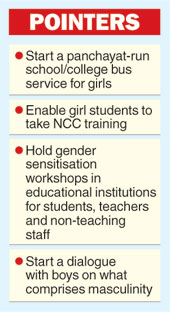
Sukanta Chaudhuri, professor emeritus of Jadavpur University, addressed the basic problem of reaching aspiring girl students to educational institutions in times of such insecurity. “The panchayats should start a transport system to carry them to school or college.” He pointed out that there would be a pool of unused buses which could be used for this purpose as not all buses on a route are pressed into service daily.
“With the panchayat elections coming up, this might be a good time to raise the demand,” he said.
His second suggestion was ensuring scope for enrolment in the National Cadet Corps (NCC) for girls within easily commutable distance. “Many girls, it has been reported, say that they feel safe in the uniform. Perhaps women’s organisations can help bridge the gap between school authorities and the NCC,” he said.
Sarmistha Dutta Gupta, founder-secretary of Ebong Alap, who was among those rounded up by the police for protesting lack of security for women a fortnight ago, pointed out how girl students in North 24-Parganas travel all the way to Calcutta for NCC classes, so eager they are for the training. “The state needs to provide basic facilities like bus routes and street lights. These steps would go some way in ensuring their safety, not death sentence for rapists.”
Sipra Mukherjee, who teaches in West Bengal State University in Barasat, urged for punishment for rape and for rape and murder to be delinked. “Otherwise, there would be a rise in the tendency to kill the rape victim,” she said. Anchita Ghatak of Parichiti expressed concern about the increase in lynch mob mentality which seeks to dispense justice bypassing the law.
The other point raised was the need to involve men. “Men have to take the lead. It is time for self-reflection for them as to what comprises masculinity,” said Kavita Punjabi of the department of comparative literature, JU. “If we start with 10 male teachers and 100 students who will start brainstorming on the campus about how to talk to young men on this subject, this will have a ripple effect elsewhere,” she added.
College teacher Soma Marik, a member of Maitree, suggested a list be drawn up of high schools and colleges where workshops on gender sensitivity could be held.
“With women’s education coming under threat, we met to take stock of the situation and listen to suggestions. This meeting allowed those who could not attend Friday’s rally to voice their opinion,” said Supriya Chaudhuri, professor of English, who steered the meeting.