 |
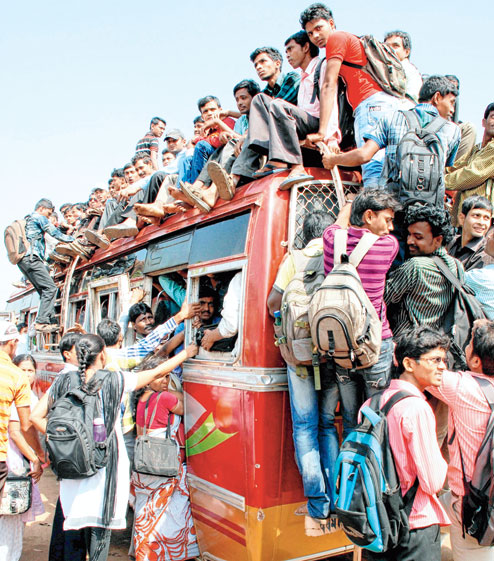
| The underdogs of the society do, of course, have many shared interests and concerns, but to mould them into a defining political identity requires political organization of a kind the need for which is much easier to see than are the ways and means of actually achieving it. And yet there is ground for hope, given the general vibrancy of democratic practice and social movements in India |
Sustainable Development
If development is about the expansion of freedom, it has to embrace the removal of poverty as well as paying attention to ecology as integral parts of a unified concern, aimed ultimately at the security and advancement of human freedom. Indeed, important components of human freedoms — and crucial ingredients of our quality of life — are thoroughly dependent on the integrity of the environment, involving the air we breathe, the water we drink, and the epidemiological surroundings in which we live. The opportunity to live the kind of lives that people value — and have reason to value — depends among other things on the nature and robustness of the environment. In this sense, development has to be environment-inclusive, and the belief that development and environment are on a collision course cannot sit comfortably with the recognition of the manifest interdependence and complementarity between the two.
The Centrality of Education
In a powerful diagnosis, Rabindranath Tagore said: ‘in my view the imposing tower of misery which today rests on the heart of India has its sole foundation in the absence of education’. The remark is somewhat extreme, in separating out just one factor among many problems that India faces. And yet Tagore offers a judgement that is deeply insightful.
The role of basic education in the process of development and social progress is very wide and critically important. First, the capability to read and write and count has powerful effects on our quality of life: the freedoms we have to understand the world, to lead an informed life, to communicate with others, and to be generally in touch with what is going on. In a society, particularly in the modern world, where so much depends on the written medium, being illiterate is like being imprisoned, and school education opens a door through which people can escape incarceration.
Second, our economic opportunities and employment prospects depend greatly on our educational achievements and cultivated skills. The ability to understand written information and to keep track of the numbers involved in particular tasks can be necessary qualifications for even simple jobs, especially with increasing specialization in production and distribution. The need for education has particularly expanded in the world of globalized trade and commerce, and the success of economies like China has been based substantially on the ability of a reasonably well-educated workforce to meet the demands of quality control and skill formation involved in producing goods and services for the world at large.
Third, illiteracy muffles the political voice of people and thus contributes directly to their insecurity. The connection between voice and security is often underestimated. This is not to deny that democracies can be effective even when many people are still illiterate: that point certainly needs emphasizing because it is missed in the deeply reactionary argument which is often aired, that an illiterate population has no use for democratic rights. It is nevertheless the case that the reach of people’s democratic voice can be much greater when political opportunities are combined with social empowerment, including the ability to read newspapers, periodicals and books, and to communicate with each other.
***
The quality of higher education is hard to judge (and cannot but raise controversies), but if we go by the list of 200 top-ranking universities prepared by The Times Higher Educational Supplement in October 2011, an overwhelming proportion of the leading institutions of higher education in the world are based in the United States. Indeed, the top five are all in America: Harvard, Caltech, MIT, Stanford and Princeton, in that order. The British follow just behind, and in the top ten we also find Cambridge, Oxford and Imperial College, London.
What is, however, really arresting in the list is the preponderance of Western establishments in the entire list of 200 top universities. There are none from Asia in the top 20, and while some elite universities in Asia do get in below that, including Hong Kong, Tokyo, Pohang, Singapore, Peking, Hong Kong University of Science and Technology, Kyoto, Tsinghua, and a few others, together they form only a small minority of the top universities on the globe. It is particularly striking that there is not a single university in India in this list of the top 200 in the world.
***
The problems of Indian universities, including academic arrangements and facilities, recruitments and emoluments, can be critically assessed — and should be. The limitation of intake is, however, a major drag on the reach and performance of Indian higher education, and to improve this it is crucially important to reform, indeed to remake, the entire system of school education in the country.
 |
| It is hard to think of anything more important than health for human well-being and the quality of life. And yet, health is virtually absent from public debates and democratic politics in India |
India’s Health Care Crisis
Sometimes the most important things in life are least talked about. For instance, it is hard to think of anything more important than health for human well-being and the quality of life. And yet, health is virtually absent from public debates and democratic politics in India. To illustrate, the coverage of essential aspects of health and health care in the mainstream media is extremely limited. This applies not only to what can be called, without intending any disrespect, India’s relatively lightweight newspapers, but also to the most seriously engaged parts of the media. In our previous book, we found that even in India’s best newspapers — with a creditable record of coverage of social issues in general — issues of health were rarely discussed. For example, among more than three hundred articles published on the editorial page of one of India’s finest dailies between January and June 2000, not one was concerned with health. We examined this issue again recently, by scrutinizing all the articles (there were more than five thousand) published on the editorial pages of India’s leading English-medium dailies during the last six months of 2012. There were some signs of improvement compared with the situation 12 years earlier, but the overall coverage of health issues in editorial discussions remains minuscule — about 1 per cent of the total editorial space (even if we adopt a very broad definition of health-related matters).
***
So what is the way out of the health crisis which is perhaps the biggest adversity facing India today? The problems are large, but rather than being overwhelmed by their enormity, we should identify the ways and means of overcoming this adversity, drawing both on the analyses... of the factors that have contributed to this crisis, and also — closely related to that investigation — on the lessons that have emerged from the experiences of other developing countries which have dealt with these problems much better than India has. There is also much to learn from the better performance of those Indian states (Kerala and Tamil Nadu in particular) which have taken care of the health of the people a lot better than the rest of India. As far as the rest of the world is concerned, the countries that offer immediate lessons for India include — most importantly — China, but also Brazil, Mexico and Thailand, among others. Perhaps the first — and the most crucial — thing to appreciate is the importance of the commitment to universal coverage for all in a comprehensive vision of health care for the country as a whole. Thailand, Brazil and Mexico have got there in recent years, and transformed the reach of health care for their people.
Changing the Reach of Indian Democracy
If India needs a new democratic politics, that requirement is closely connected with the necessity of paying much greater attention to the interests, demands and rights of the most deprived (as opposed to the ‘relatively disadvantaged among the more advantaged’). The political parties will have a natural interest to change course if and only if the deprivations are more clearly recognized, more extensively brought into focus, more widely talked about, and reflected in active agitations as well as critical discussions.
This is far from easy to accomplish given the prominence of other — quite different — issues that have a strong hold now over political parties. These other issues may vary from furtherance of Hindutva to sectarian caste politics, from the pursuit of pro-business advocacy to blind support for public-sector unions, and they can crowd out the possibility of the kind of political change that is badly needed. In one way or another, there is plenty of identity politics in the existing priorities, and this may not be easy to compete with. The underdogs of the society do, of course, have many shared interests and concerns, but to mould them into a defining political identity requires political organization of a kind the need for which is much easier to see than are the ways and means of actually achieving it.
And yet there is ground for hope, given the general vibrancy of democratic practice and social movements in India. Aside from familiar illustrations of popular movements before and just after independence, a wide range of more recent initiatives and agitations have contributed to bringing more justice and more critical reasoning into Indian politics. Some of these have also succeeded, often against considerable opposition, in bringing about constructive change. For instance, the last decade alone has seen the enactment of a series of social legislations that have been introduced in response to popular movements and demands: not only the well-known Right to Information Act and National Rural Employment Guarantee Act, but also laws concerned with the right to education, social security for unorganized workers, domestic violence, and the property rights of traditional forest dwellers, among other issues that matter a great deal to the underprivileged.
 |
| The problems of Indian universities, including academic arrangements and facilities, recruitments and emoluments, can be critically assessed — and should be. The limitation of intake is, however, a major drag on the reach and performance of Indian higher education, and to improve this it is crucially important to reform, indeed to remake, the entire system of school education in the country |
An Uncertain Glory India and its Contractions
By Jean Dreze and Amartya Sen
Allen Lane (Penguin Books) Hardback/448 pages
Special price in India Rs 699