 |
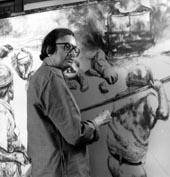
| Bikash Bhattacharjee at work. File picture |
Bikash Bhattacharjee and I are coevals. I have been familiar with his name from the early 1960s, when we both began our careers. He used to win awards and so did I. I met him first at the Academy of Fine Arts around 1959-60. He knew that like him, I too was a good student of art. He was a favourite student of Arun Bose, who later used to teach in America.
Then I went to Paris and, thereafter, to Madras and Delhi. But I would visit Calcutta from time to time and by that time Bikash had already established himself as an artist. He became famous at a young age. I was aware of his paintings of the Naxalite period and also that he had won an award from Lalit Kala Akademi.
He had mastered the realistic style of drawing figures and his skill was of a very high order. In Calcutta, he was definitely the most powerful artist where figure drawing and portrait painting were concerned. He was also deeply involved with the problems of Calcutta, its social life, art and art politics. Unlike now, in those days artists used to passionately discuss these issues among themselves. The lawlessness let loose during the Naxalite movement, police brutality and the elimination of students through encounters were powerfully reflected in his works.
No other artist has surpassed his depiction of life in Calcutta from high to low, its tramlines, houses, prostitutes, labourers, sea of humanity and political leaders. He created a personal fantasy which was closely related to the oil colours he used. Gradually he created a style of his own.
He did not go in for realistic tones but used exaggerated highlights and metallic effects at certain points, and eyes with a strange expression. From the late 1960s till his illness, his exhibitions have been praised all over India. His works were included in the collection of Chester Herwitz, now in Peabody Essex museum.
I got to know him better when he was invited to paint a medium-sized (4x3ft) portrait of former President Sanjeeva Reddy. As curator of Rashtrapati Bhavan, I had to invite him.
We used to meet and talk for hours at Bengali Market. He had diet restrictions because of his diabetes. He drank karela juice but ate rosogollas. He made sharp, incisive comments on the art and art politics of Calcutta. They cannot be repeated but his plain-speaking was a great quality.
Incidentally, Bikash’s mother, who like my family was from Kotalipara in Faridpur, was a distant relative of mine.