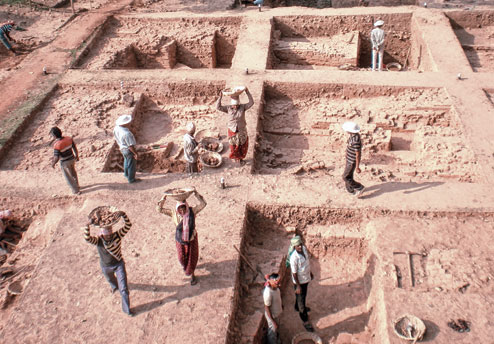

The site of the excavation with a view of the trenches. Pictures by Suparno Dutta

Close-up of a votive seal with late Brahmi script with mantra typical of Buddhist sites

A terracotta seal with inscriptions and stamps with which such seals are made

Broken fragments of decorative black basalt sculptures, possibly icons. A fragment shows the lower portion of a figure seated on a lotus

Remains of the votive stupa

A stucco face before cleaning

A stucco figure found during earlier excavation
The state archaeology department has resumed excavations at the Sakhisena mound of Moghalmari village in West Midnapore's Danton in end-January and has already unearthed several structural remains that reassert the presence of a Buddhist monastery complex under the mound.
The protected mound across 440sq m is around 400m from NH60 and holds many secrets from the late Gupta and pre-Pala eras in 6th Century AD.
The site has been excavated twice in the past - from 2004 to 2011 by a Calcutta University team led by late archaeologist Asok Dutta and in 2013-14 by a team from the state archaeology department led by late Amal Roy, then deputy director. Both excavations have presented ample evidence of a Buddhist monastery complex.
Last year, the north-west corner of the mound had revealed a sanctum, a circumambulatory path, five cells for monks, a wall with rare in situ stucco designs that can rival those found at Nalanda, Vikramshila, Paharpur, Karnasuvarna monasteries, an imposing staircase, coin and pendants of mixed metal and gold from the reign of Samachardeva, a monarch from an independent post-Gupta dynasty who sponsored the monastery and stupa trying to match the Gupta glory in decorative patterns of coins and pendants. Craftsmen adept in working with stucco may have been brought from elsewhere to embellish the walls of the stupa and monastery.
This year excavation is in progress on the north-east side of the mound. Eighteen trenches have been dug and already several structural remains have been uncovered that reassert Moghalmari's claim as an important Buddhist site.
'We came across two distinct phases of activity - one dating back to 6th Century AD and another some time later. The way older bricks and stucco have been reused to build new structures across existing features seems to suggest the later people were less affluent and sophisticated,' said Prakash Chandra Maiti, who along with Binoy Moni, Sumita Guha Sarkar, Ganesh Pal and a few others is conducting the excavations.
'It is now hard to say what the structures were. Once the walks (used to move across the site) are removed, the plan will be clearer. But foundations of two massive walls - 25m long and 3.5m wide - suggest something large,' Maiti said.
Some antiquities have been found, too - broken fragments of decorative black basalt sculptures (possibly icons), a fragment showing the lower part of a figure seated on a lotus, a broken bowl of basalt, terracotta and ivory beads, seals and sealings, a copper bangle and a ring, sprinklers, lamps of various shapes and sizes and remains of a votive stupa 2.58ft in diameter and a stucco head. Even though it will be some time before it can be cleaned and restored, a similarity can be seen with the stucco figures found at the north-western side (now on display under a shed the department hopes will protect it from the elements).
'The stucco head was found near the outer wall, in fact most antiquities seem to have surfaced along the outer walls. This time we have fewer antiquities to show because we are working closer to the middle of the mound. At this point it is more important to uncover as much of the underlying structure as possible to understand the entire plan of the monastery,' Maiti said.
'Even after all these years, only 20 per cent of the mound has been uncovered. Who knows what else will be found,' said the state director of archaeology, Piyali Sengupta.
Additional director Pravakar Pal said the budget for this year's exploration and excavation is more than Rs 12 lakh as against Rs 9 lakh in 2013-14. Excavations will continue till April 15, when a fresh allocation will be made.