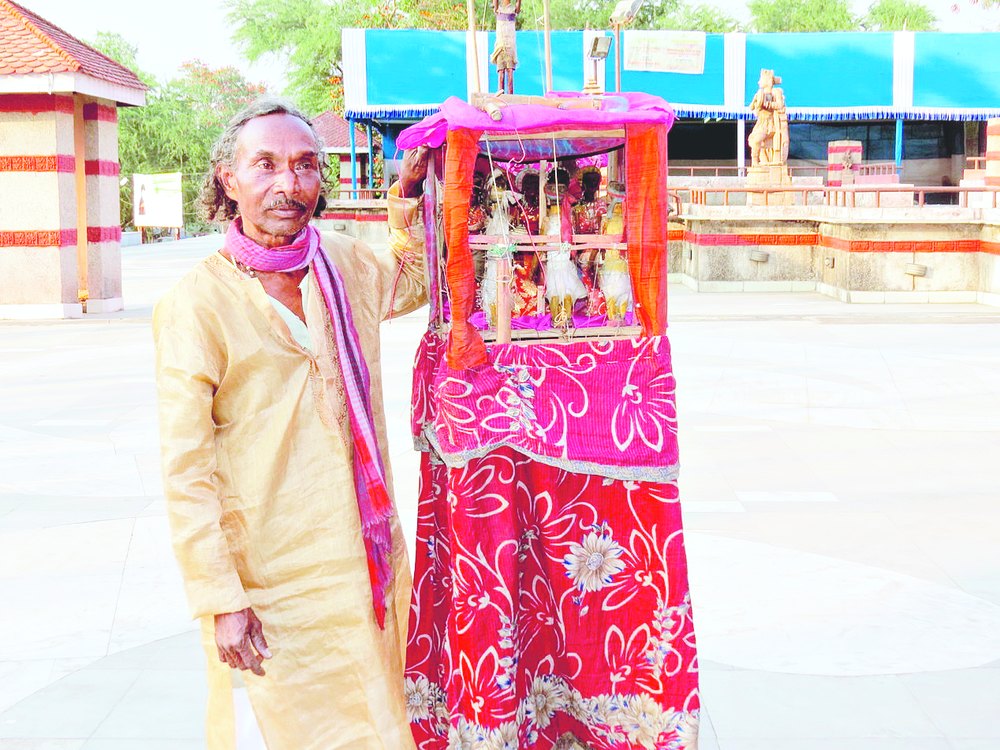

The diminutive man with a weather-beaten face has one companion as he walks from village to village. It's a tall wooden structure with folding stands that, when upright, is head to head with him. Inside the top tier, open on all sides, are two sets of wooden dolls, male and female, standing in rows facing one another. On top is a single puppet that at the pull of a string does somersaults.
This is Chadar Badar, a form of rural puppetry that is facing extinction in West Bengal. Daman Murmu, aged around 57, might be the only living practitioner in the state.
He lives by himself in Mahanandapur, a village in North Dinajpur. "I can't go out every day but when I do, I cover four villages on foot. People give me grains on seeing my show. The little money I get from some is enough to buy me salt and oil," he says, taking the cover off his Chadar Badar. Murmu, a carpenter, has stitched the cover himself. The structure and dolls are his handiwork too.
Murmu was recently invited to Calcutta for Parampara, a tribal and folk festival organised by NGO Sambhav, in collaboration with the Anthropological Survey of India, where he was felicitated. The scant audience present at the Bharatiyam Cultural Complex in Salt Lake witnessed a rare performance. Alone on stage with his Chadar Badar box, Murmu started singing in a plaintive voice. There was no knowing what the words were - it was a Santhali song - but the melody seemed to drift from across our rural heartlands. As he sang, he kept his face close to one side of the box with the puppets, his hands manipulating strings, invisible to the audience, that made the dolls inside and the one on top move.
Speaking after the show, Murmu said he started with Chadar Badar rather late in life, some 14 years ago. His wife was still alive. They had three daughters and he was not being able to make ends meet. He had seen an itinerant group from Dumka (now in Jharkhand) perform with such puppets as a 13-year-old in his uncle's home in Parbatipur, another village in North Dinajpur.
His uncle, Chhotka Tudu, was a carpenter and inspired, started making puppets. Learning the craft from him, Murmu also made Tagore, Vivekananda and Vishwakarma dolls.
Years later, when selling wooden and palm leaf dolls was not enough anymore, he remembered the Dumka puppeteers. "It took me a month to make the box. Without the box, the puppets would in the open and anyone can see the show free. Making the puppets was even tougher."
Murmu added some embellishments on what he had seen in his boyhood. "I added the dresses, painted the dolls, created tiny earrings and bangles for the female dolls."
The songs came from a Santhali book titled Kajal Sanatan and clearly belong to another era. One bemoans the loss of land grabbed by the king. Another is a call to be brave in the face of adversity. "If we can survive Ram-Ravan's war, we can conquer Ram's throne again," go the lyrics. Another brings news of a fight against the British.
Murmu is now building a bigger box with double the number of dolls so that he can draw more people for a single performance. Another dream is to make his dolls battery-operated.
But he becomes crest-fallen when talking of the future of his craft. "There are so many unemployed youths. But none come to me to learn. They are scared of the labour."
His Calcutta visits confound him. " Barigula eto unchu je dekhte gele pagri porey jay," he exclaims, recalling the experience of having to keep bending his head to look up.