 |
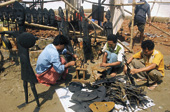
| Chhattisgarh artistes carve out Bastar figurines at Bosepukur Sitala Mandir. (Below) Yashoda Devi from Orissa works on Madhubani paintings. Pictures by Sanjay Chattopadhyaya |
 |
On a plot of land off Biren Roy Road (West), spared so far from the clutches of the concrete giant, the pandal of Barisha Yubak Brinda is coming up. Boys from the locality are busy shouting out suggestions to each other on how best to decorate the mandap with the handfans ? yes, haatpakha ? that are the main design component of the Behala puja this year. Silence reigns in the adjacent clubroom, accentuated from time to time by a murmur, as five pairs of frail hands stitch or paint with mechanical regularity.
These women are from Jojonga village in Kendrapara district of Orissa, here to lend colour to the visual feast our grand autumnal festival is. There are others like them, come from afar, toiling away in other pandals of the city.
It is perhaps a toast to the inclusive spirit of Durga Puja in this part of India. The festival has embraced residents of every caste and creed in this increasingly secular carnival. Now, with increase in scale and scope of the Puja, the doors are also opening for unsung rural artistes from beyond the bounds of Bengal to come and lend a hand and take home the rewards of toil that would ease their life a little for the rest of the year.
Twenty-four-year-old Kedozo knows that. Which is why the youth from Kohima is so happy to have escorted 10 fellow Nagas from the remote Okha district to the Ajeyo Sanghati pandal in Haridebpur. Carving wood and weaving grass with great gusto, the men from Angami and Ao tribes speak little else than their native tongue. But the look of satisfaction and the laughter that trickles through the beads of sweat tell it all.
?The Rs 240 a day that they are getting here is considerably more than what they earn back home, building wooden houses for neighbours. That?s why they all want to come back,? smiles Amar Sarkar, who travelled all the way to the troubled state, talent-scouting for his Naga dream.
Money is what has brought Tijuram and Rajendra Baghel to Bosepukur Sitala Mandir as well. But the two from Bastar district in Chhattisgarh are swelling with pride at the ?fabulous display? that their ironwork art is poised to get. ?We have been to workshops at Swabhumi and CIMA gallery but nowhere has there been such a massive exhibition of Bastar work,? they say.
The pandal will utilise more than 10,000 figurines, with the highest standing 8-ft tall at the gate. ?There was so much to do that craftsmen of eight-nine villages worked on this since August.? The bigger pieces were transported from there while Tijuram and six others came down to carve the smaller pieces. ?People back home have asked us to bring back photographs ? kaise sajavat hua, kitne log aaye?? Tijuram smiles. They are staying back to see it all as well as set up a stall near the pandal for sale and demonstration of their age-old craft.
The women from Orissa at Yubak Brinda would also get to catch a glimpse of the goddess before they board the train on Saptami. They are the five lucky ones among the 55 women registered with the Orissa Rural and Urban Producers? Association working with golden grass, typical of Orissa fields. Weaving the grass into mats for the ceiling and walls of the pandal, Swarnaprabha Swain, the team leader, recalls the ?holla? (excitement) as word spread about their Calcutta coup. Though Swarnaprabha has come to Bengal earlier to attend a chutney workshop in Madhyamgram, it is the first journey out of Orissa for the other four.
The team of six from Jitwarpur village in Madhuban district, Bihar, at the Nabamilan puja in Beleghata, however, is not staying back. ?We have to be back for the Durga Puja in our village,? smiles Raj Kumar Lal. But they have put in a request to see the idol being created elsewhere before they leave.
This team is better-travelled and exposed than the groups from other states, thanks to central handicraft board projects. Team leader Yashoda Devi is one of the best-known living names in Madhubani art. A state awardee, the 62-year-old has learnt her craft from her chachi, Jagadamba Devi, a legend who received the President?s Award in 1975 and the Padmashree in 1975. ?Madhubani is compulsory to decorate the kohbar (the bridal chamber) in our villages. It is a matter of prestige for the bride?s family. So all of us, especially the women, pick up the painting from our elders,? Yashoda Debi explains, as brother Kamal Kumar Karn continues with the pencil.
Nabamilan will put up panels depicting scenes from Ramayana, with mehndi lining the Madhubani sketches.
?Earlier, we would use only natural extracts as colours. But with Madhubani being used for so many other things, we have started using bright artificial colours on the client?s request,? Lal says.
Deviation from tradition, to some extent, is something that is happening at Bosepukur?s Bastar citadel as well. ?We are doing some new designs for the Puja to portray our lifestyle.?
The traditional tribal motifs, for the uninitiated visitor, would be Raodevi (a horse) and Sandhyarao (a warrior on a horse with sword unsheathed). They are placed ?at the boundaries of villages to keep happiness and sorrows from spilling over?. And then there is Marekhamba, a pillar with etchings dedicated to a man after his death, highlighting his life?s work.
?It does cost the Puja committees quite a lot to bring over these workmen from afar. But we need them to lend the authentic touch to our pandals,? explains Sarkar.
And rural art also needs such a boost. ?If people like what we are putting up, perhaps they will buy more Bastar work from the shops,? muses Rajendra. Adds Karn: ?A Japanese man, who is buying Madhubani art from our villages for his museum, says in 20 years people will have to travel to Japan to see what Madhubani is. We want all the help to prove him wrong.?
Durga Puja organisers are doing more than their bit to ensure that our art and our artistes are talked about here and now.