Early on December 27, a group of men barged into the rented accommodation of Mainul Sheikh, Habijul Sheikh, Khoshu Sheikh and Rajib Sheikh in Odisha’s Ganjam district, accused them of being Bangladeshis, threatened them and ordered them to leave the state before daybreak.
Petrified, the four men, who have been working as hawkers in Odisha for 5 to 12 years, packed their belongings and left for their home in Murshidabad’s Shahjadpur village before dawn on two motorcycles, covering 800km in 19 hours.
“After midnight on December 27, some people forcibly entered our rented accommodation in Ganjam. They said we were Bangladeshis and threatened us with dire consequences. Then they asked us to leave the state by daybreak. We stuffed some of our belongings into bags and before the crack of dawn, left on two motorbikes,” Rajib, who is yet to shake off the trauma of the attack and the uncertainty over his livelihood, said on Tuesday.
“Fearing for our lives, barring a few small breaks for food and fuel, we rode continuously and reached Krishnanagar at 11pm on December 27. We took a short break and decided to brave the biting cold and set off for our homes. We reached Hariharpara, where Shahjadpur village is located, around 3am the next day,” he added.
The ordeal of the quartet, aged between 35 and 42, mirrors the constant fear and agony that has gripped migrant workers from Murshidabad in Odisha in the face of a sharp rise in targeted assaults on Bengali-speaking Muslims in the BJP-ruled state in the past fortnight. Hundreds of migrant workers, engaged mainly in construction and informal-sector jobs across Odisha, have begun returning home in panic.
The migrants said the communal hostility had increased following the lynching of a Hindu labourer, Dipu Chandra Das, in Bangladesh on December 18 and the renewed political controversy surrounding the proposed Babri mosque project in Murshidabad announced by suspended Trinamool Congress MLA Humayun Kabir on December 6.
“The situation in Odisha has changed alarmingly over the past few months, and especially in the last two weeks after the Babri mosque project was announced on December 6 and the murder of the Hindu labourer in Bangladesh on December 18,” said Saharul Sheikh, 40, a migrant labour contractor and construction worker from Bhagawangola who quit his job in Odisha and return home on December 29.
Saharul, who had employed around 40 construction workers in different parts of Barapally in Ganjam district, said: “For the past two weeks, all of us have been facing intimidation.”
“Local violent groups suspect us to be Bangladeshi Muslims and even rebuke us over the Babri mosque construction issue in Murshidabad. I realised that no Muslim worker from Murshidabad is safe there anymore,” he added.
Migrant labourers said their presence in Odisha has increasingly been portrayed as a security threat after the BJP came to power last year, with Hindu fundamentalist outfits allegedly branding workers from Murshidabad “Bangladeshi” or “Rohingya” Muslims.
Many say this labelling has become a pretext for violent reprisals, particularly in the wake of the developments in Bangladesh and the fresh political rhetoric around the mosque controversy.
The most brutal instance, according to returning workers, was the killing of 21-year-old construction labourer Juyel Sheikh from Suti. Juyel was beaten to death in Sambalpur last week by a group that suspected him to be a Bangladeshi. Two of his colleagues suffered critical injuries.
On December 25, Rafiqul Sheikh, a 50-year-old migrant worker from Bhagawangola, was allegedly assaulted by members of a Hindu outfit in Bhubaneswar. Severely injured, Rafiqul fled Odisha after initial treatment and was admitted to the Bhagawangola block hospital on December 28.
“He cannot summon the courage to go back to Odisha,” a family member said, adding that they feared he “would not return alive if he ventured to the neighbouring state again for the sake of livelihood”.
Local sources estimate that nearly 1,000 migrant workers have returned to Murshidabad from various parts of Odisha in recent days, many vowing never to go back despite the loss of livelihood.
The refrain among them is “life is more precious than money”.
“Suspicion and hatred have increased rapidly. Muslims from Murshidabad are being singled out. Anyone seen on the streets or at work is being called a Bangladeshi or a Rohingya refugee. The police are not providing any protection. They are acting as silent spectators. We had no option but to flee,” Saharul added.
At least 20 masons from Shahjadpur village of Hariharpara who worked in Odisha have returned home after facing harassment.
Nazimuddin Sheikh, who worked in Gajapati district, first travelled to Durgapur before taking a bus back to Hariharpara.
Nazrul Islam, 45, a hawker from Uttar Chachanda village in Shamsherganj who worked in Jharsuguda, had a similar story.
“Youths in saffron attire came to my rented home and asked what I eat and where I come from. They forced me to chant ‘Jai Shri Ram’ and ‘Jai Gomata’ and told me to leave Odisha. I was compelled to board a train the next day without any reservation and reached home on December 28,” Nazrul said.
Sari seller Mainul Sheikh, 42, from Shahjadpur, had been working in Odisha for over a decade. He said it was never so scary in the state.
“The situation is unprecedented. I have been selling saris in Odisha for 12 years, but I had never felt so insecure and threatened,” he said.
“The atrocities started in the last two weeks. Muslim hawkers and masons are being targeted. One night, they tried to stop my motorbike and beat me, giving me a final warning to leave Odisha overnight. I ran away the same night,” he added.
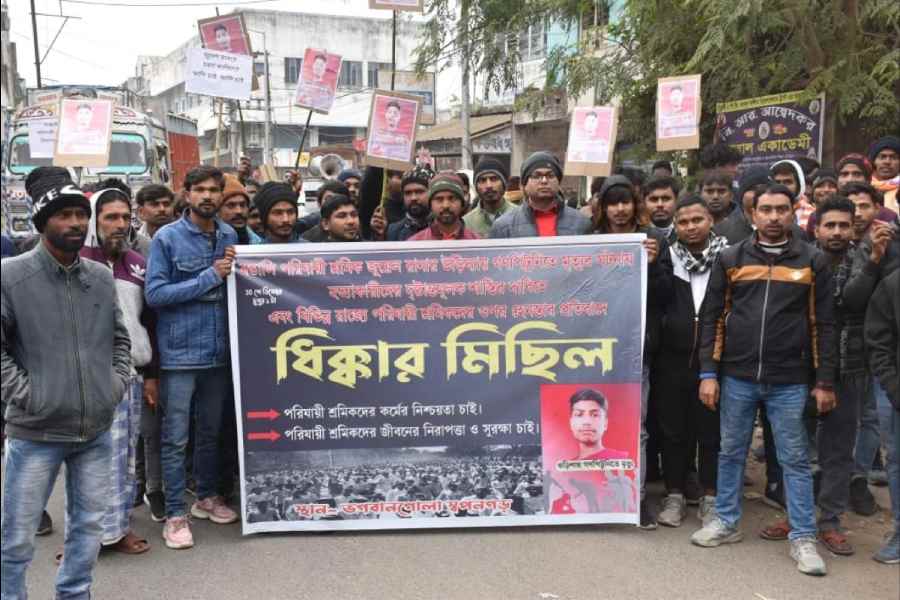
On Monday, around 400 migrant labourers staged a protest rally in Bhagawangola, demanding an immediate end to attacks on migrant workers in Odisha and justice for Juyel. Protesters said the violence in Odisha reflected a broader pattern of attacks on Bengali-speaking migrant workers in BJP-ruled states, where they are often portrayed as illegal immigrants and targeted on communal lines.
Murshidabad district magistrate Nitin Singhania said he had heard about the incidents in Odisha and the state government stood firmly with migrant workers.
“The government is always with migrant workers and stands by them,” he said.
“If they register under the Mahatmashree scheme (formerly Karmashree), they will receive a grant of Rs 5,000 per month. Many workers are already receiving it. If anyone has been harassed in Odisha, they should inform the district administration, and the complaint will be forwarded to the concerned authorities.” Rajya Sabha MP and chairman of the Migrant Workers Welfare Board, Samirul Islam, said Bengal was the only state to have a dedicated welfare board for migrant workers.
“BJP-ruled Uttar Pradesh and Bihar have the largest number of migrant workers in the country, yet no such measures exist there,” he said. Senior Congress leader and former Berhampore MP Adhir Ranjan Chowdhury said he had raised the issue directly with Prime Minister Narendra Modi.
“I met the Prime Minister (on Tuesday) and told him that migrant workers from Bengal are being beaten and tortured in various states, especially BJP-ruled states,” he said.
“I have appealed to stop these atrocities. I have gone to Panipat in Haryana earlier, and I will go to Odisha as well. If necessary, I will even gherao the Odisha Vidhan Sabha. I will stop the atrocities on migrant workers.”
However, the police in Odisha promised to look into such incidents if they receive any complaints. “We have not received any complaints regarding such attacks,” said a police officer in Bhubaneswar.