Traders near the Bangladesh border in Bengal hope that the formation of an elected government in Dhaka would restore stability in the neighbouring nation and repair strained bilateral trade ties with India.
Bangladesh went to the polls on Thursday — the first national poll since the fall of the Sheikh Hasina government following the July 2024 uprising.
The ouster of Prime Minister Sheikh Hasina in August 2024 after large-scale unrest that claimed nearly 1,400 lives marked a turning point in India-Bangladesh relations. What had long been described as a robust partnership entered a phase of uncertainty. Despite a high-volume trading relationship worth $12.9 billion and $14 billion in 2023-24 — with Bangladesh remaining India’s largest trading partner in South Asia — the past 18 months have witnessed infrastructural disruptions, administrative disconnect and a slowdown in growth.
Against this backdrop, exporters, transporters and clearing agents operating through land ports across Bengal said the two-day suspension of export-import activities because of the Bangladesh election would cause only marginal losses — which they described as “affordable” — provided a stable government emerged in Dhaka and re-established functional coordination with
Indian counterparts.
Trade activities at key land ports — Petrapole and Ghojadanga in North 24-Parganas, Mahadipur in Malda and Hili in South Dinajpur — remained suspended from Wednesday following a prior notice issued by Bangladeshi authorities.
Anticipating the disruption, exporters refrained from booking entry slots through the Suvidha portal to prevent harassment and avoid damage to goods, particularly
perishables.
Dhiraj Adhikari, former secretary of the Hili Exporters’ Association in South Dinajpur, said exports from Hili had already stopped from February 10.
“As the dates were announced earlier, we did not export any perishable items during these days. Some of our trucks are stranded in Bangladesh because of the election and closure, as the goods have not been unloaded. We hope the trucks will return soon,” he said.
In Petrapole, there were literally no export-bound cargoes found waiting.
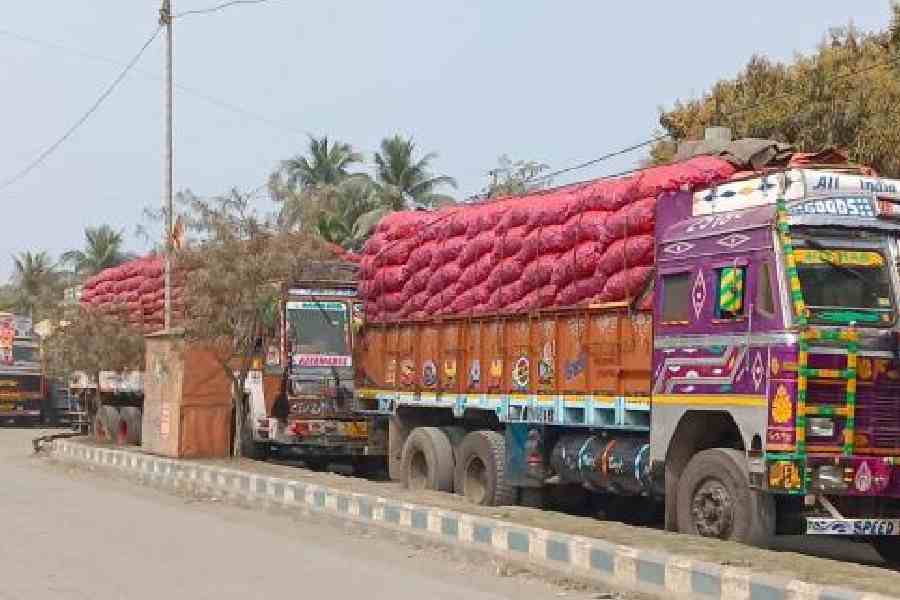
At Ghojadanga, cargo-laden vehicles were seen waiting in queues, while in other sectors, transporters halted the movement of export-bound goods in anticipation
of delays.
Kamlesh Saini, manager of the Land Port Authority of India at Petrapole, said: “Normal trade will resume from Saturday.”
Kartick Chakraborty, secretary of the Petrapole Clearing Agents Staff Welfare Association, said: “It appears that we have been trying to survive while sailing a sinking boat for the past 18 months.”
“There is hardly any interaction with our Bangladeshi counterparts at the administrative level or at the level of traders and their associates. Earlier, we used to sort out issues through instant discussions near the zero point, but since the fall of the Sheikh Hasina government, there is no one to take care of any problem or to offer a solution,” he added.
Joydeb Sarkar, an exporter in Ghojadanga, said: “If an elected government comes to power in Bangladesh, traders and those associated with export and import will get rid of the recurring tension. We will be able to begin talks with representatives of the Bangladesh government. During the last 18 months, we could neither convey our message to the Bangladeshi administration nor get any solution from them. We have been operating under constant risk. Once a government assumes power, officials will not be able to escape their responsibilities. During the last one and a half years, officials of the interim government hardly responded to our problems.”