
Bonnie was at the airport, waiting to check in with the Indian women's football team leaving for the 1998 Asian Games, when he was told he had been denied permission by the All India Football Federation to leave for Bangkok.
An ultrasonogram conducted ahead of the trip had established that the 17-year-old, who was then Bandana Pal, was male.
"My life changed that moment," says Bonnie. Since then he had been on the run, trying to escape into anonymity. Until a year ago, when he was appointed football coach at Kishalaya - an orphanage for boys run by the Bengal government in Barasat in North 24-Parganas.
A film, says Bonnie, changed his life. I Am Bonnie (2015), a documentary film, was shot over three years and directed by Farha Khatun, Satarupa Santra and Sourabh Kanti Datta. A moving narrative, it follows Bonnie closely as he moves frantically from one place to another, as much in search of acceptance as of a livelihood. It won the best film award in the national documentary film category at the 2016 Kolkata International Film Festival. This year, it won the National Award in the non-feature film on social issues category.
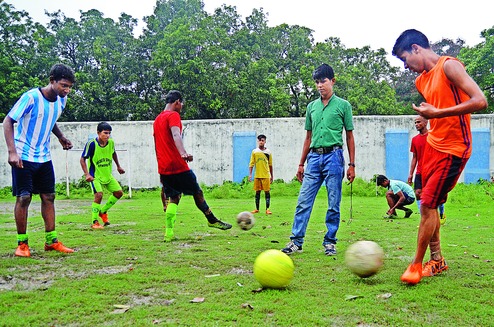
Sitting in the sports room at Kishalaya, set up by him with the help of the boys at the orphanage, Bonnie looks happy. The walls of the room, called Khela Ghar by Bonnie, have been painted in bright colours with football scenes and lively motifs. The cupboards are full of football boots - the boys have what they need. Bonnie is getting paid, a luxury in itself, and he does not mind the fact that he is on a contract. "I never dreamt that I would be this fortunate," he says.
As the boys mill around him, he proudly claims that some of them will be national-level football players - "If they keep to the path." They have also watched the documentary and love it.
Before that cancelled Bangkok trip, Bonnie's sexual identity had not been an issue. He had been raised as a girl and that was it. He had risen to be a star of the Indian women's team. He was largely responsible for Bengal winning the 1994 National Football Championships. All that he dreamt of was football.
"After I was sent back, not only were my dreams shattered, I learnt from newspaper reports that a sex test had been conducted on me and, according to it, I was a male." He adds, "I sometimes felt I should die - from hopelessness, from shame."
His siblings did not want him to live with them at their home in Gobardanga in North 24-Parganas. He ran away from his home to Krishnagar in Nadia district. This was the first time he tried to escape into anonymity; there would be many other attempts, though Bonnie talks only about his major shifts.
In Krishnagar, he turned to idol-making, a profession the district is famed for. This is also the time when he started to dress like a man and introduced himself as Bonnie.
"I took my name from a Hindi film, the name of which I cannot remember now," he says. He earned good money - Rs 180 every day - almost all of which he saved. He knew he had some major steps to take. "All day long I kept thinking - who am I? who am I?"
The ultrasonogram had mentioned features that were unusual in a woman. But who was he really? The thought was tyrannical. It would not let him be. "Am I a man? Am I a woman," Bonnie kept asking himself. He was barely 20 at the time.
In Krishnagar, where nobody knew him, he kept playing football. He also began to feel attracted towards girls.
After much thought, Bonnie met gynaecologist Baidyanath Chakraborty at his clinic in Salt Lake. Tests proved that Bonnie had the XY chromosomes, the "male" chromosomes. He now had a choice; he could go for reconstructive surgery - and choose to be either male or female.
"Finally, something inside me said I ought to become a man," he says.
In 2007, almost a decade after his dismissal from the national women's team, Bonnie underwent surgery. Then began another series of frantic journeys for Bonnie.
The year after, he got married to his neighbour, Swati, from Krishnagar. She has been the only still point in Bonnie's life.
After his surgery, when the two were madly in love, they made a secret trip to Darjeeling. Bonnie had to know if he could perform the sexual act like a man; otherwise it would not be fair to his spouse.
After marriage, Bonnie and Swati settled down in Matigara in Siliguri, where Bonnie worked as a coach for the district under-17 men's football team. The salary, however, was a problem and he turned to making idols again. He and Swati were happy to live like a regular heterosexual couple when another storm hit them.
In 2012, track athlete from Bengal, Pinki Pramanik, was accused of being a man. In the wake of the controversy, Bonnie was spotted in Matigara. "A reporter saw me at an event and I was identified again. 'Bandana Pal found in Siliguri,' the headlines read.
Bonnie was then working on the pandal of a local Durga Puja. He fled once more. This time, he and Swati went to Darjeeling, where he took up a job at a small hotel.
The last scene of the documentary shows Bonnie standing at the edge of what looks like a precipice. He could have hurtled down.
From there, it has been a remarkable journey back. "All this was possible because of the film," says Bonnie. He and Swati have been accepted by his family; the couple lives with them at Gobardanga.
"It is a great thing to know that our film has been able to make a difference to our subject's life," says Sourabh Kanti Datta, one of the directors of the film.
"I have never been so happy before," Bonnie says.
His new life is precious to him. He scrupulously maintains all rules at his workplace, not allowing for the slightest deviation. But then Bonnie had not broken any rule ever. The rules were not made for someone like him.