 |
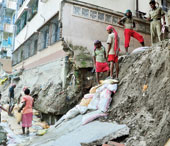
| Labourers place sandbags in the gap between the buildings and the Hooghly on Thursday. (Ananda Das) |
Sandbags and a bamboo gabion wall were placed on Thursday on the erosion-hit buffer strip between two four-storey apartment blocks, a Red Cross clinic and the Hooghly in Chandernagore.
The riverbank soil on the 26.5m strip between the houses and the river began to sink over a week ago, making a 15ft-deep trench and exposing the concrete pillars of the building foundations.
Though the Chandernagore civic authorities had asked the occupants of River Palace and Ganges Valley to evacuate, 21 of the 37 families in the two apartments were staying put.
These families have pooled in money to buy more than 5,000 sandbags to fill the trench.
“We have collected Rs 10,000 from each family in the twin apartments to check the erosion. We will collect more money if needed. We cannot sit back and do nothing,” said Jibon Saha, a fire service officer and resident of River Palace.
The irrigation department chipped in with gabions made of bamboo scaffoldings filled with bricks.
River experts said such ad hoc measures were standard practice in erosion control.
“A spell of heavy rain could undo all the efforts. Temporary steps are not strong enough to check a river in spate. The authorities must build a concrete embankment that goes six to seven metres below the riverbed. No one can take a chance where human life is at stake,” an expert said.
Kabi Bharat Chandra Road, leading to the buildings, was abuzz with activity on Thursday as government officials reached there to take stock of the situation. A large contingent from the Chandernagore Municipal Corporation was at the site since morning.
A three-member team from the Geological Survey of India spent an hour in the afternoon while representatives of the land and land reforms department, too, visited the spot.
Senior geologist Prasun Jana and his GSI team reached the riverbank around 3.30pm armed with a battery of devices. They collected soil samples and measured the distance between the base of the buildings and the river.
“We will test the soil to ascertain its strength. This will also reveal the stability of the buildings,” Jana said.
Experts said permanent structures should be built at least 200 to 300m from the waterfront because rivers often change course and floods could happen anytime during monsoon.
“The concave bank gave Chandernagore its name but is proving to be its bane too,” one of them said.
Politicians made a beeline for the riverside and their one-upmanship was evident from the ward councillor’s claims before an audience of onlookers that he informed irrigation minister Rajib Banerjee, whose department is putting the bamboo scaffolding, about the erosion.
Chandernagore mayor Ram Chakraborty blamed the sand quarries at Bhatpara in North 24-Parganas on the opposite bank of the Hooghly for the crisis. He alleged that 300 truckloads of sand were being quarried every day and taken to different locations.
River engineers, however, doubted the mayor’s theory of linking the erosion at Chandernagore to sand quarrying on the other bank.
Nevertheless, land and land reforms officer Dipendu Roy Chowdhury promised to convey the mayor’s allegation to additional district magistrate Ayesha Rani.
A municipal engineer said the ground has stopped sinking over the past 24 hours. “It’s a good sign, full of hope.”