
Calcutta: Thursday is the 125th birth anniversary of Panchanan Chatterjee (1892-1963), the renowned surgeon who had played a role, perhaps inadvertently, in Subhas Chandra Bose's escape from his Elgin Road residence.
Subhas, following his hunger strike in prison, was allowed to stay at the Bose family residence on Elgin Road towards the end of 1940, as the British authorities were afraid that the state of Bose's health could kill him and they did not want his blood on their hands, says Krishna Bose, educator and former MP.
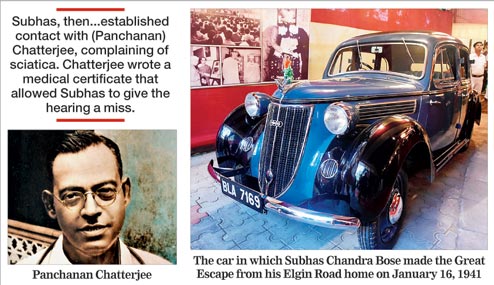
Krishna Bose's husband and Subhas Chandra's nephew, Sisir Kumar Bose, had driven him away secretly from the family house to Gomoh, now in Jharkhand, on the night of January 16, 1941. The journey allowed Subhas to go abroad, secure the help of Germany and Japan and consolidate the Indian National Army.
Subhas's departure, now famous as the Great Escape, had required great planning but most people had been in the dark about Subhas's plans. Chatterjee was one of them, says Krishna Bose.
Though allowed home stay, Subhas would be summoned to the court for hearings for organising protests against the British authorities. Reluctant to appear in court, Subhas would ask his regular physician, M.N. Dey, to write certificates saying that his health would not permit him to venture out of the house. Dey, a family friend, would be accompanied by Sunil Bose, another of Subhas's brothers and a doctor.
A few days before the escape, Sunil, who was not aware of the plan, suggested that Subhas's non-appearance in court did not look nice, says Krishna Bose.
Subhas, then, without informing either Dey or Sunil, established contact with Chatterjee, complaining of sciatica. Chatterjee wrote a medical certificate that allowed Subhas to give the hearing a miss.
After Subhas left on the night of January 16, 1941, he was summoned to court again on January 20. But then, no one except Sisir and two of his cousins knew that he had left. To keep up appearances, Sisir and the cousins were frantic to contact Chatterjee, to get him to write a certificate for Subhas again, without however, him meeting Subhas. "They had planned to tell him that Subhas was so ill that there was no need for the doctor to visit him. Chatterjee could just write the certificate," says Krishna Bose.
But Chatterjee was not to be found, neither at his Beadon Street residence, nor at Medical College. So Sisir finally requested Subhas's legal adviser's help, who pleaded with the magistrate for an exemption from appearing in court for the last time.
The next date of hearing was on January 26; by that time the news of Subhas having disappeared was public.
Chatterjee's family is proud that he played this role in Subhas's life. The rest of his career is pure eminence.
Born in undivided Bengal, in 1912, Chatterjee, though a student of arts, was admitted as a special case to the Medical College, Bengal (now Calcutta Medical College and Hospital). He passed the MB (Bachelor of Medicine) examination securing the highest marks in surgery. He was sent to the UK by the government of Bengal and became a fellow of the Royal College of Surgeons (FRCS), Edinburgh. Back in Calcutta, he joined Medical College, Bengal. He was appointed professor and head of the department of surgery from 1947, one of the first Indians to hold this exalted position. He retired in 1952.
He practised a wide range of surgeries, including cleft palate and lip surgeries during 1950s and 1960s. He is remembered not only as an accomplished surgeon, but also as a brilliant teacher. He encouraged his juniors to specialise in various fields.
He was mentor to Anjali Mukherjee, the first Indian woman to obtain the MS degree.