 |
 |
The King is dead, long live the King.
Let me start by saying I shall never be ashamed to say I loved and admired MF Husain. He was a genius and, in my books, a Bharat Ratna, for the yellow brick road he, inspired by Jamini Roy, singlehandedly laid for the future of contemporary art in India. As in Elton John’s famous refrain, ‘it’s where the dogs of society still howl’.
Rabindranath Tagore’s simple brilliance as a painter would never have been canonised if he hadn’t been shown alongside the abstract genius of Wassily Kandinsky. So too, Maqbool Fida Husain would never have become society’s passport to acquired aesthetics if he hadn’t shared a room with the incredible Pablo Picasso in Sao Paolo. These were the turning points in the lives of both these artists. They made us sit up and take notice; recognise greatness.
Recently, I was asked to inaugurate an art exhibition in Calcutta. I qualified for the job as an old lover of art and a small collector. The two major works on display were a bloody interpretation of Left Rule in Bengal and the other of a sari-clad lady leading a long line of human-animal hybrids who were following their leader like sheep and goats. I knew that 50 years ago contemporary art was neither fashionable nor expensive. Only one name commanded a price and he was calling it by the square inch.
I took the opportunity to refer to Hokusai’s painting of the WAVE because it haunted me as I watched the horrific images of the tsunami that had struck Japan. The WAVE, painted more than 150 years ago, remains the most reproduced work of modern art in the world. Without premeditation, I then spoke about Matsuo Basho who lived along those very shores in Hokkaido and unconsciously predicted the same disaster in his most famous and most translated Haiku that ends with, ‘a splash: sound of water’. Surrounded by the buzz of a successful art show, I was overcome by a strange sadness. I couldn’t help but think of Husain. So I talked about him.
My appeal for understanding and forgiveness was drowned in giggles and whispered exchanges about hairstyles and fashions, and that age-old need to match paintings with walls and curtains and upholstered love seats. I remembered Husain chuckling over a comment by a gushy admirer who couldn’t afford any more paintings but whispered in his ear that she owned “a Husain”.
The people I was addressing were willing to invest hundreds of thousands of rupees in contemporary art. Yet the liberator of modern art in India, who painted nude gods and goddesses and horses and lesbians and pagan mothers and musicians and politicians with a vitality and colours and style that will never be matched, was living in self-imposed exile, in Dubai and London and Qatar.
It was in 1948 that the Goan Souza took the young Bohra painter who had just joined their group, to visit the President. It was there that Husain first saw the sculptures of Mathura. There was a rhythm in the stillness of the stone images, a stylisation in the body language of the sculpted men and women and animals that became the primary influence in everything that Husain would paint from that day on. It was a distinctly Hindu influence that lent form and imagery to the precise geometrical forms of Islamic art and calligraphy that Husain had studied in Iraq and also loved deeply and so portrayed consistently throughout his life.
Yet while Souza and Reddy and Raza all left India and settled in different parts of the world, Husain remained true to the kindred points of heaven and home and remained proudly and distinctly Indian. His festivals, his monkeys, cows, his delving into mythology and folklore and his oft-repeated motifs and themes were a fusion of Islamic and Hindu forms and shapes. I would hazard to state with some confidence that Husain has painted and sold more paintings of Hindu gods and goddesses, in India and worldwide, than all his peers put together.
When one associates pricing by square inch with Husain, one forgets that that was the scale he used as a painter of hoardings where he charged by the square foot for cinema billboards. The joke transformed into a statement of arrogance and soon a lot of artists began to charge by the square inch and the validity of art became puerile.
But through all this, Husain carried on regardless of derision and criticism. There can be no doubt that Husain remains India’s most successful painter, of all time. He had cash registers ringing around the globe while other artists were rubbing pennies together for an existence. For those who think of him as a show-off, let me point out that this famous man (who covered his shyness and humility with a mask of confidence and almost aristocratic indifference) would quietly skip town when everyone was expecting him at the opening of his show, he would slip away unnoticed from places he disliked or felt uncomfortable in and he always had the last laugh when it came to social hypocrisies that he pretended not to notice.
He was extremely generous and I have seen him entertaining guests lavishly at famous restaurants in Jama Masjid and Nizamuddin and Bombay surrounded by eight to 10 invitees who had nothing in common with each other except for the fact that we were honoured to be Husain’s guests and knew that he knew his parathas, raans and kebabs like few other connoisseurs did.
Husain also wrote poetry that was contemplative and layered with meanings and emotions. Yet, like in his Golden Bear Award winning film, Through the Eyes of a Painter, the images in his poetry were almost abstract, but ingrained with a life and an energy that you surprisingly discovered for yourself. Not a word was misplaced and yet you had to ponder on its belonging there, juxtaposed with a thought that apparently conflicted with it.
His was a tricky and complex mind that refused to unravel its mysteries for easy and lazy comprehension. You have to have a very open mind when you read Husain and you have to give yourself plenty of time to luxuriate in its richness and diversity of abstract thought processes. When you have solved the puzzle he created, you feel quite elated and chuffed.
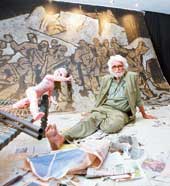
Husain designed and made his own furniture and sat on it and ate off it with a joy that was infectious. He rolled around naked on canvases, with two beautiful girls rolling beside him, all of them covered in paint, under the open sky and created art that was hilariously attractive.
He slept with dirty feet on clean bed sheets, adored his children and lived every moment for his family, loved beautiful women as much as they were drawn irresistibly to him, made asses of rich sycophants by dumping unsaleable junk on them with élan, treated millionaires like tramps if they betrayed his trust and, through it all, never ever lost his sense of humour.
From ancient times India, and Hindus, have had an interpretation of hedonism that is virtually unique. It encompasses female sexuality and a form of liberation that can only emerge in intellectually and morally advanced societies. Tantrism is at the very core of our Shaktism in Bengali society. We above all others should find it in our hearts to try and understand what drove Husain to depict deities in ways that we consider abhorrent.
At the turn of the last century, Victorian values and western interpretations of morality became fashionable amongst the elite. But our rural folk never sacrificed truths at the altar of retrograde evolution. Khajuraho and Konarak are ordinary peoples’ and ordinary artisans’ works of art that liberate and purify and sanctify the presence of Brahman within us.
I am deeply saddened that Husain died ostracised by an unforgiving Mother India — his Ma, his Mati and his Manush. May his restless soul and playful imagination paint patterns in distant worlds who will never understand where such notions came from, light years away — where the dogs of society will howl once again.
Who do you blame for MF Husain being hounded out of India?
Tell ttmetro@abpmail.com