 |
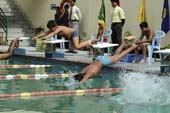
| Over 250 students took part in The Heritage School’s annual inter-House swimming gala on July 26 and 28. Apart from the usual races, there was a water ballet on the first day. Among the juniors, the best performers were Tushar Khemka, Prithusha Sikdar, Sanidhya Jain, Ishan Jain, Sujhan Das, Tanya Khanna and Bhavik Singh. The best among seniors were Abhinav Prakash, Vedika Agarwal, Avishek Dutta, Rusha Chatterjee, Shivangi Mussaddi, Karan Kaushik, Sarvesh Kajaria, Somrita Banerjee and Vanshika Tibrewal. Picture by Sanat Kumar Sinha |
A group of 16 teachers from various institutions in the US started their three-day tour of the city with a visit to the Indian Institute of Cerebral Palsy (IICP).
They spent their first morning in the city learning about the institute’s work in schooling, counselling and therapy. The tour was arranged by the United States Educational Foundation in India, with the Americans travelling to India under the Fulbright-Hays Seminars Abroad programme. The teachers were introduced to the students and staff of the institute, from pre-school toddlers to older students taking vocational courses.
For many teachers in the group, the trip to India was a first, as Robert McHugh, a high school history teacher from Millbrook, New York, confirmed. “This is the first time I’ve been to a developing country, so there has been a lot to take in. I’m looking forward to taking a look around the city.” Joyce Millman, an art teacher from Philadelphia, Pennsylvania, added: “I’m especially interested in the use of textiles in the art classes here. I hope to take back some new techniques for my classes in the States”.
The tour culminated with a presentation by Ankur, a Calcutta-based advocacy group, which campaigns for the rights of people suffering from cerebral palsy. The visit was rounded off with biscuits and cakes baked by members of the institute. The guests gifted several books to the institute. The next port of call for the visitors was St John’s Diocesan Girls’ High School.
Patrick Pringle
 |
 |
| Auditions for television dance show Boogie Woogie took place at a city mall on August 3, 4 and 5. The recordings will be judged in Mumbai. Picture by Sanjoy Chattopadhyaya; (below) Actors Saswata Chatterjee, Chandrayee Ghosh and Sabyasachi Chakraborty at the launch of Alo, an integrated school, where physically and mentally challenged children can also study. Picture by Aranya Sen |
Founder’s day
St Thomas’ Day School celebrated its 62nd founder’s day on July 26 with a special prayer service at the St Paul’s Cathedral. A host of dignitaries, students, parents and teachers of the school were present. The service began with the processional hymn, followed by readings from The Bible. The school choir Incarnith presented many hymns. Mellifluous renditions by the junior school choir (nursery and KG students) were much appreciated. The Bishop in his speech called for today’s youth to be more compassionate towards the poor. The service was then closed by singing the school hymn and the national anthem.
Danish Khan,
Class XII, St Thomas’ Day School
 |
| Abhijit Gupta |
Famous fibber
This week, Only Connect pays tribute to George Psalmanazar (1679-1763), one of the outstanding liars of all time and creator of a virtual persona so successful that three centuries of research has failed to uncover his real name.
Enlightenment Europe crawled with charlatans and con men, but none as notorious as Psalmanazar who burst upon London society in 1703, in the identity of a native Japanese Christian. In reality, he might have been born to Catholic parents in France in 1680s but this has never been conclusively proven. He arrived in London in the company of a Scottish chaplain, who claimed that he had converted this heathen and christened him George Psalmanazar, after the Biblical Assyrian king Shalmaneser.
Not satisfied with this rather tame imposture, Psalmanazar soon revealed the full scope of his mendacity. He claimed to be a native of Formosa (modern Taiwan) who lived on raw flesh, roots and herbs. He gabbled volubly in an invented Formosan and even presented catechism in it to the Bishop of London. In 1704, he published An Historical and Geographical Description of Formosa, an Island subject to the Emperor of Japan, which was so convincing that he was invited to teach Formosan in Oxford.
 |
| George Psalmanazar |
Psalmanazar laboured hard to make his imposture credible. He publicly ate raw flesh — though heavily spiced — and slept in a chair with a lamp burning, which he claimed was common practice in Formosa. The chattering classes in London were completely bowled over. Samuel Johnson practically sat at his feet and declared that he’d rather disbelieve a Bishop than doubt Psalmanazar.
Psalmanazar’s description of Formosa was a farrago of such nonsense that one wonders how so many people fell for it. He stated that Formosan men wore gold or silver codpieces and ate their wives for infidelity. The staple diet was a serpent hunted with branches while the hearts of 18,000 young men were sacrificed yearly to various deities.
Not everyone believed Psalmanazar’s fables. He was challenged by astronomer-royal Edmund Halley while speaking at the Royal Society. This had no effect whatsoever on his reputation and he continued to be lionised by the beau monde. Eventually he called his own bluff and confessed, first to his friends and then to the public.
The rest of Psalmanazar’s life was spent in miscellaneous literary activities, including a real history of Formosa. But one secret he never let on: the true identity of the man who challenged our notions of the virtual and the real. Three centuries later, the mystery still abides.