 |
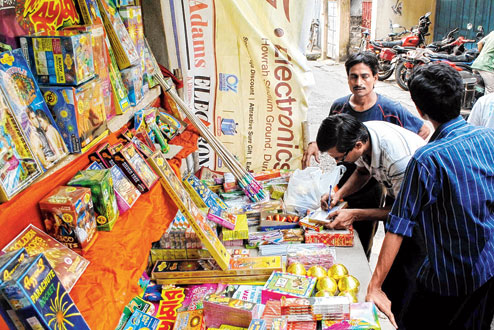
| Customers can clandestinely buy sound producing crackers from vendors at the markets |
Cocking a snook at the 90 decibel level ban for firecrackers, manufacturing units in Uluberia’s Khalisani have been producing crackers with decibel levels ten times more. Sound-producing crackers manufactured in Khalisani’s Malopara are supplied in both town and the rural areas of Howrah and parts of South 24 Parganas bordering Howrah through Sankrail’s Manikpur ferry ghat.
“Before every Kali Puja, police conduct raids. But these raids remain largely ineffective because a section of the policemen of Uluberia police station are in connivance with the firecracker manufacturers and alert them in advance. On the day of Kali Puja these firecrackers cause noise pollution in both town and rural areas,” said a local resident who did not want to be identified. He said that for the last 50 years the residents of Khalisani’s Malopara eke out a living by manufacturing and selling firecrackers.
“Along side firecrackers, the residents of Malopara also make fireworks like tubri (flower pot), rang mashal, phuljhari (sparkler), charki (Catherine wheel) and few other things. But that is only an eyewash, just a show. They mainly make firecrackers, ” said another resident of Khalisani. The residents of Malopara were mostly poor. Most of them used to eke out a living as day labourers. A few of them also sold firewood. Local people said that nearly 50 years back they first started manufacturing firecrackers and soon they found a thriving market. “All over the year demand for firecrackers is high. People burst firecrackers after their favourite teams win in cricket and football matches, while taking out immersion processions and even during marriage ceremonies. Margins of profit are also good,” said an owner of a firecracker workshop.
Most of the firecracker manufacturing units are run from the houses or on the open plot adjacent to the houses. These units do not even have a licence. Young men and women can be seen working in a small stuffy room covered with chemical powder. There are no fire safety measures at all. People manufacturing firecrackers do so risking their lives. “In Khalisani, firecracker units are like small-scale industry. Almost every household is engaged in making firecrackers and there are people who eke out a living by making firecrackers for two generations. They have to risk their lives because they do not have any alternative job in the village,” said a local resident.
In October 1996, 23 labourers of a firecracker unit in Haturia died in a blast while they were making crackers. Most of the labourers were young boys and girls of the same village.
“We are aware of the illegal firecracker manufacturing units in Khalisani. We have conducted several raids and recovered a few kilograms of firecrackers from Khalisani,” said Indra Chakraborty, additional superintendent of police, Howrah (rural). He said that 53 quintals of firecrackers had been recovered from the rural areas of Howrah. Among them 51 quintals of firecrackers were recovered from Domjur alone. However, local people say that the police are hand in glove with the firecracker manufacturers. “Most of the senior police officers of Uluberia subdivision often buy crackers from these units during Kali Puja,” said a source who would not like to be named. “We have to keep the police in good humour because we have to manufacture fire crackers without licence. We have applied for licence several times but the applications were rejected each time,” said one of the unit owners.