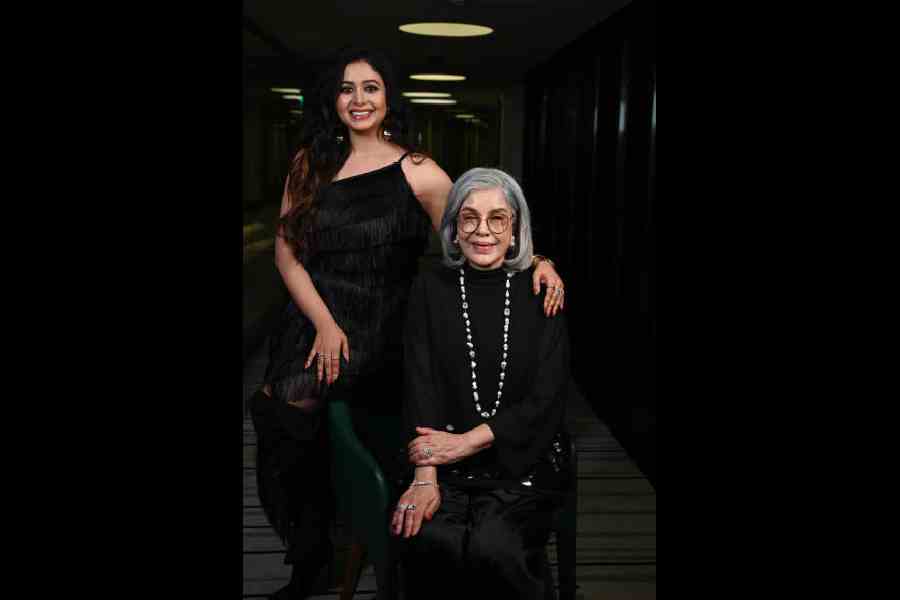
Zeenat Aman, dressed elegantly in all-black, with just the right amount of shimmer, a mix of statement and sleek jewellery thrown in, dewy skin, subtle make-up, the refinement of her silvery greys complementing her poise, was everything we women wanted to be, when she walked in at the Novotel Kolkata Hotel & Residences’ terrace for the launch of Ritabhari Chakraborty’s annual calendar on Wednesday evening. The spark that set many a heart ablaze, across generations, is still very much alive. In her self-assuredness and in her intelligence. Now, top that with genuine warmth and kindness, and you get a cocktail that makes it irresistible.
That was the septuagenarian who spoke candidly about her journey, iconic films like Satyam Shivam Sundaram and Yaadon Ki Baaraat, motherhood, the patriarchal set-up of the Indian film industry, the pitfalls of fame and success, the freedom and joy that comes with letting go of the need for validation, millennials, how some of her roles made her cringe in hindsight and the importance of being the main character in your life.
That was also the theme of Ritabhari’s calendar this year. The actress, who was equal parts nervous and excited to have her icon beside her for the launch of the seventh edition of her calendar, chose a fringe dress by Rimi Nayak India, in sync with the mood of the evening.
Ritabhari drew up a bunch of questions for the glamour girl of the ‘70s and ‘80s, all of which Aman answered with utmost clarity.
In her stellar career, she has been the female protagonist in “over 80 films”, besides cameos, but when she walks into a room even today, it was always “just the woman walking in”. Not the star. “The way you see me, the way you give me titles like icon, heroine… but it’s nothing like that,” smiled Aman, who wanted to be a linguist and work at the United Nations when she was a student.
Fate definitely had other plans. She started working as a teenager, and the pathbreaking Hare Rama Hare Krishna (1971) “catapulted” her to “stardom”. “I got my first Bengal Journalist Award from here, from Calcutta, where I was celebrated as an actor. So, this city and this place, all of you are very special to me because of that. It was early in my career,” said Aman, who has starred in films like Don, Insaf Ka Tarazu, Laawaris, Dostana, Heera Panna, The Great Gambler, and Qurbani, among others.
Ritabhari and Aman spoke about the joys of being unique. “I started when I was 15. I tried to fit in for a few years for sure, but then in my journey, when I met people who celebrated my uniqueness, it was actually nice to be different, and I never wanted to be like anyone else again,” said Ritabhari. “I think that sometimes being different makes people more interested in who you are,” agreed Aman.
Satyam Shivam Sundaram (1978), a film still so relevant for its holistic beauty debate, saw Aman play a disfigured Roopa and wear a burn patch as part of the prosthetics, a process she described as “challenging”. “Sticking it on the skin with that hard glue… by the time I finished shooting that film, I think my skin was totally damaged in that area, but it was worth it. It was an experience of a lifetime. We shot over a period of a little over two years. I have shot films that have taken eight years. Uss zamane mein there was no immediate feedback. You shoot and look at the monitor and see the work. We were shooting in Pune, and then the rushes would go to Mumbai, be developed. That would take two-three weeks, and Raj Kapoor (director) would look at those rushes and see what is to be done,” said Aman, a complete director’s actor, who said she neither had a favourite co-star nor an actor. “It’s different people in different performances. It didn’t matter to me who my co-star was. It always mattered to me who my director was and what my role was. You know, like Shah Rukh Khan once said, that he could romance a tree. Maine pehle bhi kahaan hai, ke jo romantic gaane hote the un dino mein, for those two-three days, I would have a little crush on my hero, and then we would move on,” she smiled.
Aman was brutally honest when she said, “It was very much a patriarchal set-up back then (in the Hindi film industry). Honestly, the girls had nothing to do. Just sing a song, look beautiful, and that’s it. But, you know, nothing succeeds like success. When you succeed in a particular format, it’s a business, right? So, your producers want to repeat you in the same way. I did get some opportunities to do different kinds of roles, whether it was Insaf Ka Tarazu or Satyam Shivam Sundaram. It’s been a very interesting journey. Not planned at all, but I’m very grateful for it,” she smiled.
She goes on the speak about how back in the day there were no vanity vans. “We would sit in these old khatara make-up rooms, you know, with the ripped vinyl sofas and the stained mirrors. There was absolutely no entourage besides what was essential: hair and make-up. And of course, your driver brought you to work. And that was it. And for many years, till recently, two years ago, I was still doing that. But now I have a sonager (her son is her manager),” she smiled.
With success comes fame. Were there moments when success couldn’t protect her, asked Ritabhari. “Of course, because success is a very external thing. You’re recognised because of the kind of work you do. It’s a profession. You’re an actor, so people know you, people know your work. And I mean, show business constitutes fame. But the person is still the person, which is not related to fame at all. So yes, when you interact with people and you care about people, then the equation of fame does not come into play. So, there is vulnerability there, which I’m sure you’re aware of,” replied Aman.
She also spoke about the only thing that fame took away from her. “It was the perception of people, which is largely formed by what is said in the media, sometimes right, sometimes wrong, and what they see of you on screen. So, they assume that you are that person, which you are not. You know, you have a personality that has nothing to do with the work that you have done or what has been written about you in the media. So, it becomes very difficult to break through that perception and start from ground zero in a new relationship,” she said.
Over the years, Aman has gone from being a “people-pleaser” to not giving a damn. “I used to want to please everybody and would never express my opinion. I was, I still am, an introvert, except when the camera is on. I think after my children grew up — and I was raising them on my own — and I reached middle age, I realised okay, I don’t have to please everybody all the time. I can express my opinion. I can make my decisions. I can agree to disagree. And it was freeing. I’m well into my 70s now. And frankly, my dear, I don’t give a damn,” she laughed to huge applause. She was absolutely okay with people not liking her. “Because nobody likes somebody all the time. And there are a lot of haters also. Not that I have experienced it. I have found nothing but love,” she smiled.
Aman spoke fondly of motherhood. “I feel very fortunate that I’ve had the opportunity to have a very full life, whether it’s with my work, fame, success, or then the quietude of motherhood, you know, of being with my children, raising my children, having a family, which meant a lot to me. By the time I had my children, I was away from the limelight. And I did not miss it at all because my days were full. And the idea is to find joy in what you do, and to do it to the best of your ability at the time. I really enjoyed them when they were little, and it was my mission to make them travel all over the world when they were small. And I really enjoyed them. Now it’s a different equation. We’re adults, we’re friends. And it’s true that they parent me. Life has come a full circle. They treat me like I’m eight years old, both of them,” she smiled, her son Zahaan looking on lovingly.
She enjoys interacting with the younger generation. “This generation of actors is extremely talented. Look at the energy, the desire to do things, the ambition. I just feel that they’re under a lot of pressure because of social media. We didn’t have social media. We just had the gossip magazines. There were stories that were really untrue, but eventually I made my peace with them. I said, this is not me that they are talking about,” said Aman.
Her one mantra to live by is being the main character of her life. “You are the main character in your own life. Your thought, your perception, your voice, your ideas. So, I think it’s important to sustain that, to have that, to hold on to that. As you grow older, you don’t need validation. It’s very freeing not to need that validation because you come to terms with who you are, and you accept yourself as who you are, and you realise that life on this planet is just so fleeting. I am just so grateful for every day, for every moment, truly,” she said.
As the chat wrapped up with Aman’s retreating figure disappearing into the elevator, the only thought that stayed with me was “they don’t make ‘em like that anymore”. Evergreen.