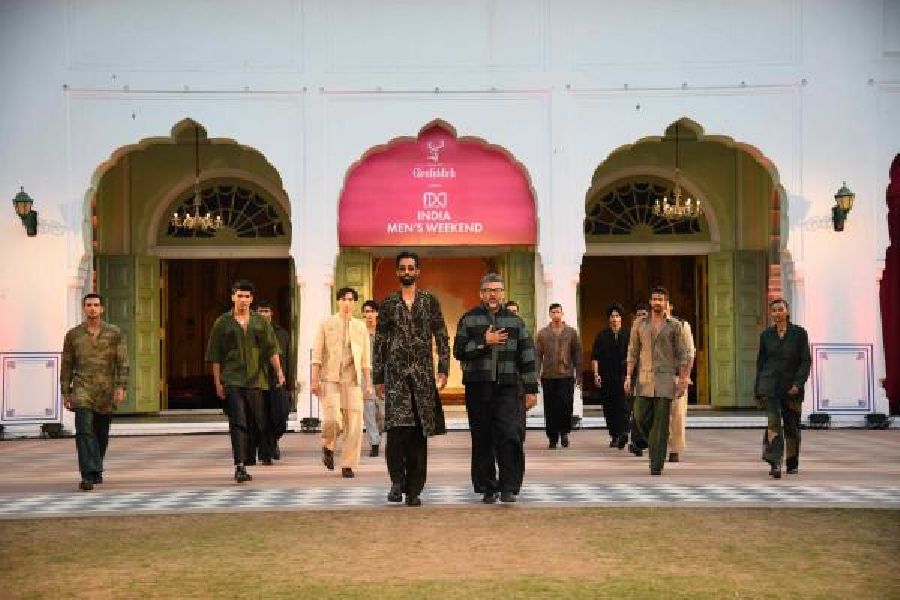
Designer Mani Shanker Singh’s presentation of the Spring/Summer collection of his label Son of a Noble SNOB at the House of Glenfiddich presents FDCI India Men’s Weekend was all about blurring the lines. With military prints and jersey stripes, Singh crafted his collection ‘Contra’ with a unique aesthetic that challenged traditional design categorisations. For a label known for their graphics and prints, embroidery was a new addition this season. A t2 chat with Singh on the collection he presented at Diggi Palace in Jaipur, the influence of contemporary geopolitics in his designs, the evolving landscape of menswear in India and more:
Contra is a wonderful name. What inspired the collection?
The idea was to break stereotypes. For breaking the stereotype, we need to relook, reimagine and then repurpose. As a label, we are inherently inspired from art and athletics. Contra is a mix of sport, military, grunge and sophisticated streetwear, along with a mix of Indian and Japanese influences. A mishmash of culture, art, music, cinema or food always brings out something new. With Contra, we tried to mix, innovate and evolve with something fresh and new.
Globally, the design language now is about blurring the lines, breaking norms and seamlessly blending concepts. What made you choose the two timeless fashion inspirations — military prints and jersey stripes ?
We wanted every look to be different from one another and still maintain the tightness of a collection, while touching upon different genres. For me, inspiration is not mechanical. It comes naturally in bits and pieces at different times. So, the camouflage is created from the outline of a world map which is hand-embroidered. Another military camo is created by using Sashiko, the Japanese hand-embroidery technique. The rugby stripes for instance are a power representation of sport and we transformed this into a kurta with frayed edges and kantha highlights. The geometry in our work helps us in binding inspirations together. We love to pick up basics and push ourselves to come up with something new and fresh. Our design process defies logic and is more organic and instinctive.
Could you share a little bit about the silhouettes you chose?
Jackets, bundis, shackets, kurtas and hybrids. The collection has a wardrobe approach where each look is different from its counterpart. Our kurtas have a global vibe, to be consumed by progressive men who are well-travelled and understand modernity. What’s most important for me as a designer is sharing energy with my customers when they get into SNOB and feel the power we infuse in our weave.
The statement India jacket lingers in my memory. Was it a conscious interpretation of our socio-political reality expressed through your design language?
In these troubled times where the geopolitics is at its low, I believe as a designer it is my responsibility to bring the world together through my creation. The India jacket opened the show because I am extremely proud of where I come from. To me India is an emotion. So, be it a cricket match or the tariff war, our country’s men and women are on a high that I have never smelt before. We are a lot stronger, united and confident. Our belief is infectious, and in the times to come, India will be going places like never before.
The inclusion of embroidery in this collection was a slight shift from SNOB’s signature prints and graphic patterns...
I won’t call the embroidery usage a shift, rather I will call it an extension and a fresh perspective that we have translated and infused into our existing graphic language that is very deep-rooted to the brand and to me. So, while there are many prints, the usage of our embroidery is very modern and new-age. It is just the label in a new avatar!
Men’s fashion in India has evolved enormously in the last one-two years. What is inspiring this change and what hopes does it bring for you as a menswear designer?
The consumption in style and culture is changing and evolving rapidly. It is more visible now through social media, world travel and accessible shopping. With strong microclusters that are more prominent with the GenZ, the consumption is varied and at the same time very personal.
FDCI Men’s Weekend has provided a platform to menswear, too, like never before. Today designers can share their voice through this brilliant initiative, spearheaded by Sunil Sethi, chairman of FDCI. Menswear as a category needed this support and ecosystem to make our fraternity’s work more visible and accessible. It is a community of designers from all across India where we share great comradeship between one another.
I fear that the expectation for newness, both in design and in content, from any brand, is a lot more than it should be. The question ‘Naya kiya hai?’ (what’s new?) needs to be relooked. The pause for every creator is something we all need to answer for ourselves to prevent a burnout. We are not AI, and we need to remember that as humans.