One location. Fifteen days. And somewhere between the biting cold of East Midnapore and the echoing corridors of an old Rajbari, Phool Pishi O Edward stopped feeling like a film shoot and started feeling like one long, unforgettable picnic. Directors Nandita Roy and Shiboprosad Mukherjee chose the historic Mahishadal Rajbari as the principal location for the film — Windows’ 25th film in its 25th year. Nestled in East Midnapore, barely 19 kilometres from Tamluk — the Rajbari seemed to breathe history from every wall. And what history it carried.
The story of Mahishadal Rajbari dates back to the 16th century, when the area now known as Geokhali was called Jibonkhali. The estate was founded by Janardhan Upadhya. Generations later came Rani Janaki Devi, who took charge of the Mahishadal Estate between 1770 and 1804 after the death of Anandalal Upadhya. It was she who built the famed Madan Gopal temple, following which the celebrated Rathayatra of Mahishadal began in 1776. Even today, stories of Rani Janaki seem to float through the corridors of the Rajbari like whispers refusing to fade away.
Naturally, many wondered if staying there would mean encountering the supernatural. After all, ancient houses come bundled with ghost stories whether one asks for them or not. But nothing spectral really happened. The unit stayed in hotels in Haldia and travelled every morning to the shooting spot instead.
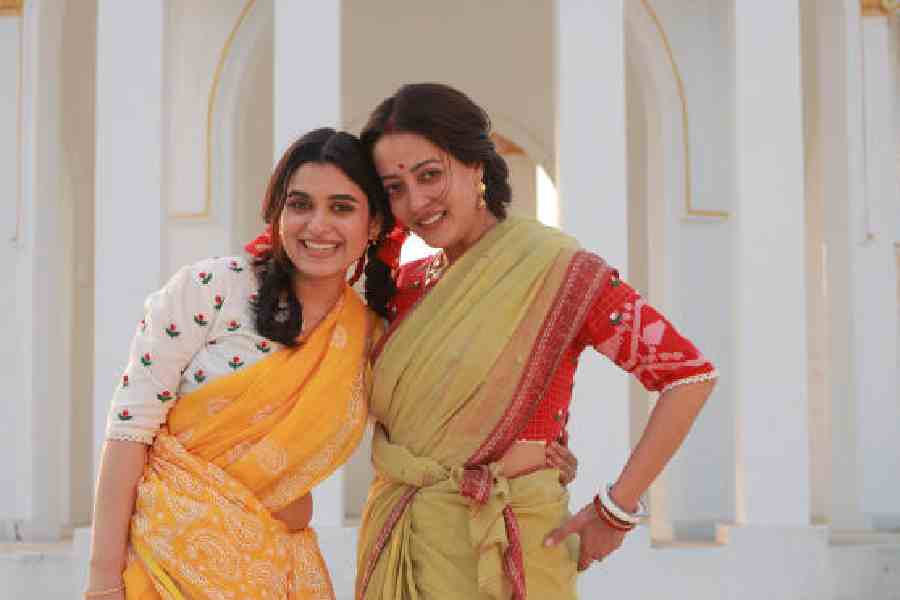
The shoot began on a freezing winter morning. A complete newcomer, Shyamoupti Mudly, stood before the camera opposite the formidable Sohini Sengupta, walking with a bicycle while delivering her lines. What was astonishing was her continuity. Every gesture, every movement of the cycle, every pause in dialogue remained exactly the same, take after take. Not a word misplaced. Not a movement altered.
Curious, I walked up to her after the scene and asked how she managed such precision despite facing the camera for a film for the very first time. Shyamoupti laughed and said television had trained her well — she was used to last-minute dialogue changes and sudden improvisations. Here, she felt secure because she knew exactly what she was saying. Honestly, I was bowled over.
Much later, as the shoot progressed and people began discovering each other beyond the camera, I remember spending an entire evening listening to her talk about her love story with her now husband, Ronojoy Bishnu and the preparations for their impending marriage. That first day was also when I met Soumya Mukherjee and Rishav Basu for the first time and sensed their hunger for meaningful roles. Phool Pishi O Edward came loaded with firsts.
For the first time in Windows’ 25-year journey, Nandita Roy and Shiboprosad Mukherjee were directing the enigmatic Raima Sen, veteran actor Arjun Chakrabortyy, and younger actors like Rishav, Soumya and Shyamoupti. At the same time, they were also directing stalwarts like Anamika Saha, Rajatava Dutta and Ananya Chatterjee together in a single film. With Sohini, Koneenica Banerjee and Shahebb Chatterjee they had collaborated before, but somehow the unit never felt unfamiliar. It felt as though everyone had known each other forever.
And then there was Raima. Without question, the naughtiest member of the unit. She invented ghost stories, staged fake anger, played endless pranks and then, the moment the camera rolled, transformed entirely into her character. The film’s costume designer Anupam Chatterjee — who also happens to be my personal chatterbox — once fell asleep in her makeup room only to wake up with a generous mound of Vicks spread across his nose. His punishment for snoring!
Raima kept the women endlessly entertained with stories while sharing her makeup room with Sohini and Anamikadi. By the end of the schedule, she and Anamikadi had become inseparable. In fact, on the final day she even argued with me over who Anamikadi loved more. I still refuse to reveal the answer. She also started the rumour that the ghost in her hotel room was actually Shahebb, who partied every night after shoot pack-up — and astonishingly, many believed her. The day her shoot wrapped, Raima treated the entire unit to her favourite food, specially flown in from Bangalore.
Meanwhile, Ananya Chatterjee was battling severe knee pain and was supposed to travel to Chennai for surgery when Phool Pishi O Edward happened. She chose the film over the operation. Watching her dance through unbearable pain purely out of love for performance was deeply moving. And then there was Rajatavada. After almost every shot, he would check the monitor and quietly begin perfecting himself again. His face seems capable of producing a thousand expressions at will. Watching him work felt like watching someone continuously sharpen an already perfect craft. Konineeca, on her part, would still seek validation despite delivering a powerful performance.
Neither Anamikadi nor Arjunda would rest even when shoots stretched till unearthly hours. One particularly unforgettable night involved the elaborate wedding sequence where Arjunda’s character — dressed as the groom — faints and his son, played by Soumya, desperately administers CPR. The scene itself was emotionally charged. But between takes, I could barely stop laughing. Arjunda, covered in tears, saliva and water streaming down his face while surrounded by anxious family members, told me later that night: “With so much water on me, I was finding it difficult to die! And on top of that, Soumya nearly broke my rib cage doing CPR. Haven’t you told the method actor to go slow?”
The cold, however, was merciless. So merciless that the cricket gloves I had carried — and been thoroughly mocked for — soon became the most coveted objects on set. I remember wearing one glove myself while handing the other to Aritra Mukherjee. Woollen gloves had completely failed against the freezing wind, and suddenly everyone wanted cricket gloves instead. People found their own ways to survive the cold. The directors’ team even organised a cricket match against the technical crew — and lost.
Amid all the chaos, laughter and noise, Sohini mostly remained to herself. Despite us being friends for long, she carried a quiet reserve I had once observed in her mother, the legendary Swatilekha Sengupta, during the shoot of Belashuru. I still remember Swatilekhadi affectionately telling me in Santiniketan, “I will speak to you after returning to Calcutta!”
And then, just four days into the shoot, reality struck. Mother (biologically Shiboprosad Mukherjee’s, but I call her that) was hospitalised with septicemia. I had to rush back immediately to deal with the medical emergency and only returned towards the end of the schedule. That night, after the hospitalisation, it was Rishav who drove me home from Haldia. I remember being deeply moved by that gesture. Because if you are lucky, somewhere inside a shooting unit, between lights, cold mornings, unfinished tea and endless retakes — you don’t just make a film. You find a friend. We all found more than one.