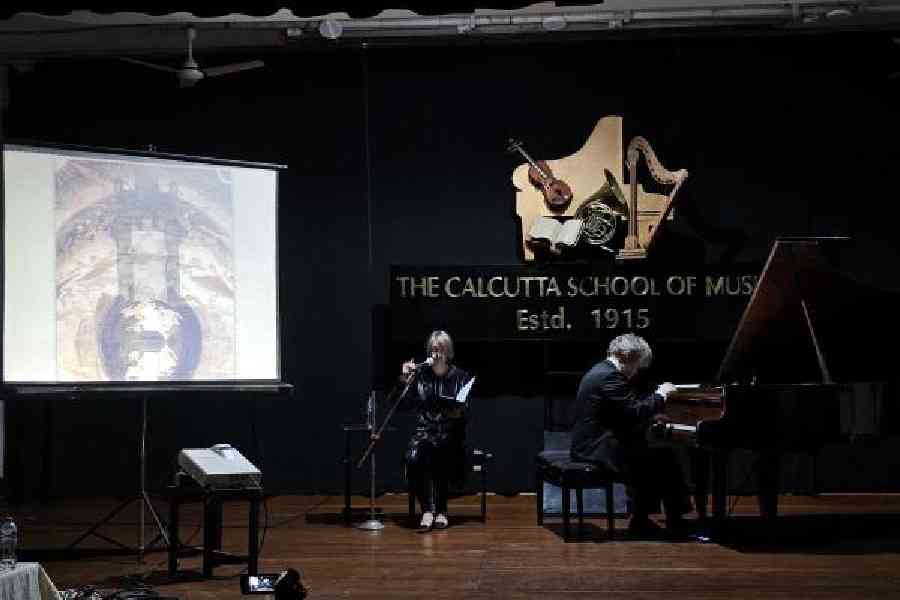
Sandre Hall at the Calcutta School of Music recently received a musical gift from Lithuania on World Pianist Day. On the occasion of 150 years of the birth anniversary of the Baltic nation’s national icon of music and visual arts, Mikalojus Konstatinas Ciurlionis (1875-1911), a piano duet was presented by Duo Zubovas.
The music was presented by Ciurlionis’s great-grandson, Rokas Zubovas, and his wife Sonata. The experience encompassed not just his music, but his paintings and his writings as well, through a simultaneous screening of his art, matching the mood of the piece being played and intermittent readings from his work, including his diary and letters.
“This is a unique opportunity to immerse oneself in a great mind. Ciurlionis is to Lithuania what Tagore is to Bengal and India. He laid out the foundations of modern Lithuania’s artistic identity, both in music and in the visual arts. Unfortunately, he died at the age of 35. Whatever he left is a huge legacy for Lithuania. His birth anniversary has been inscribed in the Unesco’s commemorative list for the year, to be celebrated worldwide,” said the ambassador of Lithuania, Diana Mickeviciene. The international airport at Vilnius, the capital of Lithuania, has been renamed after the icon on the occasion, she added.
The diplomat, who had started her career teaching South Asian history and Indian culture and history at Vilnius University, had spent the morning in Tagore House in Jorasanko, along with the pianist couple. “Over three hours that we spent there poring over his art, photographs and other documents, we also got to constantly hear his music. This will be a similar three-dimensional immersive experience,” she said.
The year, Mickeviciene pointed out, also marked two milestones in Lithuania-India relations — 400 years of the first known Lithuanian stepping on Indian soil (Andrius Rudamina, a Jesuit priest who landed in Goa in 1625), and 130 years of the first known Indian to visit Lithuania (Dr Jivanji Jamshedji Modi, a professor from Bombay University who went to Kaunas in 1895).
This is a hectic year, understandably, for Duo Zubovas. Their three-city India tour commenced right after their return from Brazil after touring five countries in Europe and the United Arab Emirates. “We are off to the United States next week,” Rokas told t2 later.
He said he used to believe his great-grandfather was unique in the world of arts for expanding his self-expression in three different horizons. “But after spending time in Tagore House, I realised that there are two of them.” Rokas was particularly impressed by reading in the accompanying captions that Tagore started painting when he was 60. “On being asked about his style, Tagore has written that he could not say much beyond that he painted intuitively for the pleasure of following form, colour and life,” recalled Rokas, drawing a similarity with the motivations of Ciurlionis. “They were similar souls working on opposite sides of the world around the same time.”
Ciurlionis started composing music when he was in his 20s and started painting at the age of 27. At 34, he was exhausted and went into depression. The next year, when he was recuperating at a sanatorium, he went for a walk one day. It was raining. He caught pneumonia and died, cutting short a productive life in which over 300 musical compositions, including two major symphonic poems, 400-odd paintings and sketches and several works in prose and verse, including essays on music and art, were created.
The listeners that evening were treated to a multimedia concert titled ‘In Pursuit of Soundscapes’, in three modes of expression. For instance, in the section on The Sea, a soul-soothing symphonic poem Seascapes on the Piano was played as a canvas of swirling blue was displayed on screen.
Piano of note
Along with the two award-winning pianists, who concluded by playing a four-hands piece, the third star of the evening was the piano itself. “Around that time, in the end-19th and early 20th century, the tradition of performing symphonic music on piano four hands was very much prevalent in Europe. Composers were trying to make their symphonic works come alive. Even Verdi would make his operas performable for piano four hands. You could pretty much participate in the opera without going to the opera by singing along with the piano score. Operas and symphonic orchestras were a rarity. Ciurlionis never heard a single note of his symphonic music being played in his lifetime,” Rokas said.
The chance to play on a Bosendorfer piano that evening made Rokas feel “emotional”. “In the early 20th century (around the time when Ciurlionis was composing), we would have this piano from the late 19th century and we would sit in the hall with friends and family and listen to the newest compositions from the world over,” he said.
The Calcutta School of Music authorities were happy with the compliment. “This is an instrument of Austrian make, which we procured in 1955. The bill came to ₹23,950, including transportation cost and import duty. It would have been beyond our means, had the Birla Trust not stepped forward with some help,” recalled president Jyotishka Dasgupta.
Describing the programme as “a canvas concert”, he noted how the experience excited almost all of one’s senses and thanked the “very very competent pianists” for the beautiful music. “We take pride in the fact that when we come for a concert, a glance at the programme is enough for us to know what kind of compositions will be performed. This is the first time I have heard a composer whom I have not experienced before,” he said.
Sudeshna Banerjee
Pictures by the writer