I am a Woman, an amazing tree of life
a stunning follicle of immensity
fruit, flower and foliage of being and un-being
of all that breathes inside and outside
I am a Woman of wise wistfulness
a re-building after all erosion and sighs
the rage and calm of the flowing river
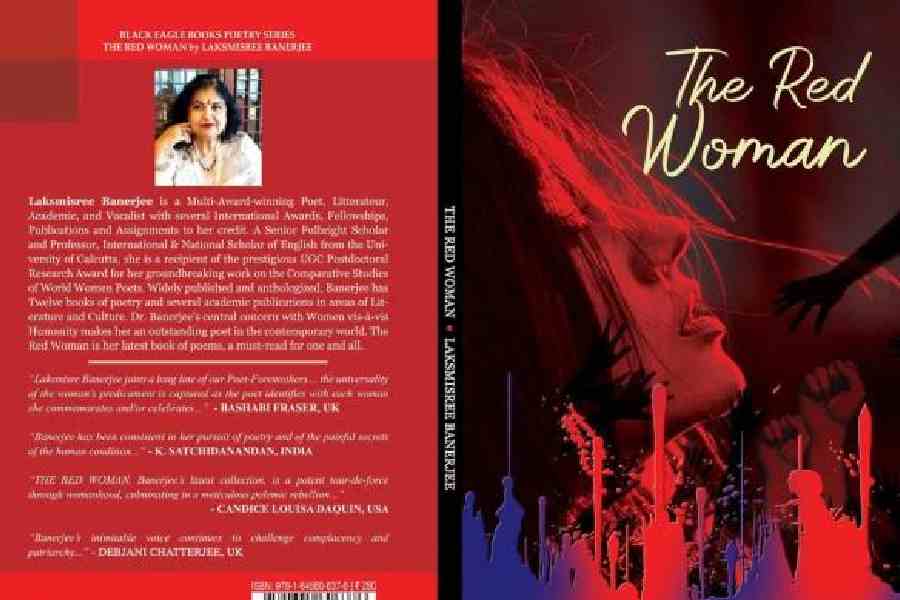
Laksmisree Banerjee is a well-known poet with a following among peers and academics, and an enviable repertoire. Articulate and carrying a rich treasure of Western and Indian erudition of mythologies and histories, in this, her twelfth collection, The Red Woman, she continues her resolute battle with masculinist domination and brutality.
“I believe all literature/poetry is autobiographical,” she told me in an interview, adding, “Specifically, this book took its birth from two horrendous rapes and murders in 2024 in Calcutta, and 2012 in Delhi. I have dedicated it to the Abhayas and Nirbhayas of the world. My keen eye deciphers and can read into our social fabric and the subterranean way in which patriarchy still invades almost every woman of every segment of our society, which actually creates the poetic fury which inspires my writing in a regulated literary way. Patriarchy to me is all-pervasive in both overt and covert ways, and almost all women are afflicted by it.”
Unabashed, straight-talking and a firebrand feminist who writes with faith in justice of treating women with humanity and respect, she posits: “It is not just brilliant men but almost all men are essentially cruel in their ill-treating (sic) of women, because patriarchy in its varied forms remains till date, as all-encompassing as the air we breathe and I strongly believe that from the personal to the universal, the toxicity of patriarchy, most tragically remains. From the streets to the police stations, from jungles to elite lounges, from kitchens to bedrooms, from salons to brothels... every speck of dust is infected by it.”
Professor Emerita Bashabi Fraser, who is the director of the Scottish Centre for Tagore Studies, wrote in her foreword to this book: “Laksmisree Banerjee brings patriarchy to account in her new collection of poems, The Red Woman. In her impressive career as a poet covering three and a half decades, Laksmisree’s distinctive voice is evident.”
So, how is Banerjee able to market old wine in new bottles? Perched precariously on the paradigmatic geography of the fire and pestilence of the colour red, which denotes the unbound sexuality of the woman from the red light district of Sonagachi, and the marked woman like the one who wears the scarlet letter, as in Nathaniel Hawthorne’s 19th century novel, the trope of the red has been used ad infinitum. Yet, in Banerjee’s hands it receives a new impetus of hope and light.
Women poets have written movingly about prostitutes — their exploitation, survival under difficult conditions and dehumanisation — but Banerjee addresses all these concerns, and more. She steps into a field of excellent women poets. Note Meena Kandasamy’s How They Prostitute a Poem, Sagarika’s Bride or Prostitute, and Thabitha Marakalala’s She Prostitutes. The Red Woman’s poems mirror Christina Rossetti’s Goblin Market, which carries the burden of themes of temptation, sacrifice, and redemption for fallen women.
Dangerously stymied as a subject that keeps looking back at generations of women who have suffered the indignities, wounds, brutality, and death by masculinity and patriarchal domination, it is only an adept poet like Banerjee who uses the ambiguous colour red to further the vision of entrapment and murder, and resilience and strength, and standing up to a male dominated social system.
Debjani Chatterjee, MBE, fellow of the Royal Society of Literature, gives a glowing tribute: “Laksmisree Banerjee’s The Red Woman proves that even in this twelfth collection, she has lost none of her energy and passion but has rather gained in maturity and confidence. Banerjee’s intimate voice continues to challenge both complacency and patriarchy. Fire and the colour red are powerful symbols that burn in her poems and remain intensely personal, while also connecting with the reader because of the universality and immediacy of the issues raised.”
Banerjee adds: “In this book, which is my most powerful, heart-wrenching and spontaneous ode to womanhood, I do not talk of just the brutalisation and traumatisation of women but also of their courage/fortitude beyond the trauma. I celebrate here the strength and resilience of women who are both warriors and hapless victims who silently or openly rebel and stand up with light, hope and love.”
Where is the “red woman” of her imaginaire located? She states, “Her image of the red woman (though globally influenced) is more rooted in the Indian ethos. The Indian rituals of sindoor and aalta used by both women as a bridal mark or shameless symbol of patriarchy and also on the idol of the mother Goddess Durga (just before her immersion into the river, converting her to a floating carcass) shows the tragic incongruity of our traditions in which red is both the colour of love and of blood and violence so easily meted out to most/all women either overtly or covertly.”
In the poem Sky, Banerjee’s lines, “Where the storm/broke in,/she/looked through/at the outside/ jettying in,” evoke an intersection of inner history and the universal history of womanhood at the hands of a violent patriarchal climate. Seizing the world of nature, she crafts her own language to explain the never-ending fight between oppositional forces. There are a couple of jarring notes. Instead of objet d’art, the poet writes object de art, and elsewhere she writes “the sprit killed,” when she means “spirit.” Still, the poet rises to the worthwhile cause, in the fashion of Maya Angelou, who said, “and still I rise.”
Dr Julie Banerjee Mehta is author of Dance of Life about resurrection of Cambodian culture after the genocide and co-author of the bestselling biography of Cambodian prime minister, Strongman: The Extraordinary Life of Hun Sen, with historian
Dr Harish Mehta. She has a PhD in English and South Asian Studies from the University of
Toronto, where she taught World Literature and Postcolonial Literature. She currently teaches Masters English at Loreto College, and curates and anchors the monthly Literary Circle of the Rising Asia Foundation, of which she is founder trustee. She is a literary columnist for t2