OCD follows the journey of Shweta, a dermatologist confined to an asylum for a crime she committed as a result of unresolved childhood trauma. The narrative unfolds in a slow-burning manner, gradually peeling back the layers of Shweta’s psyche as she recounts her story to a lawyer. We see her as a young girl, raised by her overtly protective thamma (grandmother), who instils in her an intense fixation on cleanliness and order.
While rooted in love, this upbringing shapes Shweta’s thoughts and behaviours in ways that ultimately lead her down a path of destruction. As the film progresses, the devastating impact of Shweta’s childhood trauma on her adult life becomes increasingly apparent. Her aversion to physical touch, her possessiveness toward her grandmother, and her gradual descent into psychological instability are not mere quirks but symptoms of a deeper emotional wound. Ghosal’s direction masterfully captures the complexity of Shweta’s character, never judging her but presenting her as vulnerable, fragile, and profoundly human.
The film’s narrative resonates with Sukanta Bhattacharya’s iconic poem Chharpotro, which speaks of offering a newborn child a healthy environment and a better world to inhabit. The philosophy of the poem seems to echo in the director’s vision — a recognition that the world we inhabit is often hostile to its most defenceless members. Shweta’s story stands as a testament to this failure; her trauma is not born in isolation but shaped by a society that could not protect her.
In today’s world, where children are increasingly marginalised and where trafficking and abuse remain disturbingly prevalent, OCD feels painfully relevant. Ghosal’s film becomes not just a character study but a searing indictment of societal negligence.
Technically, the film is equally compelling. The sound design is brilliant, the restrained use of low lighting enhances the atmosphere, and the experimental framing adds to the pervasive sense of unease and claustrophobia. The cinematography is deliberate and measured, mirroring Shweta’s spiralling anxiety as she revisits her past.
I was particularly struck by the initial shot where Shweta, wearing gloves, meticulously cleans a window pane and gazes at the bright moon outside. She attempts to clean the spot on the moon — a poignant visual echo of the Bengali saying “Aalor niche ondhokaar”. Even the brightest people/things have flaws. As the title appears, the moon transforms into the “O” in OCD, becoming a powerful metaphor for Shweta’s own imperfections and inner turmoil. It is a masterstroke that sets the emotional tone for the film. The haunting background score lingers long after the credits roll. Arghyakamal Mitra’s editing is seamless and complements the narrative beautifully; the deliberate fragmentation of scenes mirrors Shweta’s fractured psyche.
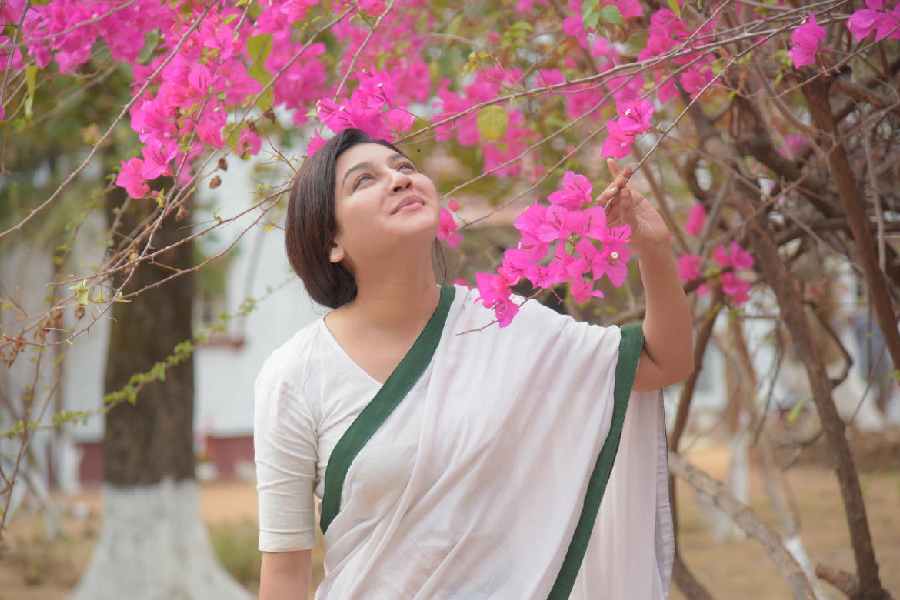
Jaya Ahsan delivers a remarkable performance as Shweta, bringing extraordinary depth and emotional nuance to the role. Her eyes alone communicate volumes — pain, longing, fragility. Anushua Majumdar is compelling as the borderline obsessive grandmother, while Shreya Bhattacharya and Kartikey Tripathi are effective in their respective roles. Koneenica Banerjee and Koushik Sen add authenticity with their natural performances. Arshiya Mukherjee, as young Shweta, leaves a lasting impression.
What resonated most deeply with me was the chemistry between Shweta and her thamma. Having shared a close bond with my own Dida, I found their relationship profoundly moving. The film beautifully portrays how Shweta’s obsession with her grandmother functions as both attachment and coping mechanism. The scene where she breaks down over rust forming on her grandmother’s photograph is heartbreaking. Equally poignant is the sequence where she returns to her old house and gazes at the plant gifted by her thamma, now bearing flower buds — perhaps real, perhaps imagined. It becomes a tender metaphor for Shweta’s own life, hinting at the possibility of renewal.
The character of Shayan adds another intriguing dimension. The conversation with Shweta about sexuality is handled with notable sensitivity, highlighting the fluidity of gender and the complexity of human desire. The name “Shayan,” which can belong to any gender, may be a deliberate choice, reinforcing the film’s layered exploration of identity. More than a clinical depiction of Obsessive Compulsive Disorder, OCD is an exploration of the wounded child within Shweta — and within countless children shaped by adult silences and societal neglect. Soukarya Ghosal has consistently demonstrated sensitivity in portraying children in his earlier works, and here his direction is both assured and compassionate.
The film prioritises atmosphere, layered characterisation, and gradual narrative progression — a rarity in contemporary cinema. The slow-burning treatment may unsettle, but it does so with purpose, compelling us to confront uncomfortable truths. OCD is a film that demands to be watched — not only for its thematic urgency but for its cinematic finesse. It reminds us that cinema can serve as powerful social commentary, and it urges us to build a world that is safer, kinder, and more nurturing for its children.