It did not arrive like a film; it unfolded like a quiet ache. There was no urgency to impress visually, no glitter to distract, only a steady, unflinching gaze into the fragile architecture of human emotion. My first encounter with Pradipta Bhattacharyya's work was through Pinky I Love You years ago. It is, on the surface, a simple story, yet one that attempts to articulate something impossibly complex. His frames breathe — raw, unvarnished, almost hesitant, as if afraid that too much beauty might betray the truth. And in that restraint lies their beauty.
The performances never feel performed. They tremble, falter and linger like words left unsaid. Bhattacharyya's characters are not sculpted; they are weathered — flawed, ordinary people navigating private labyrinths of longing, doubt and quiet despair. There are no heroes here, only shades of grey trying to survive.
The protagonist exists somewhere between thought and action — a distant echo of Hamlet, trapped within the paralysis of his own mind, where courage is imagined but never lived. The woman, meanwhile, recalls Ophelia: tender, wounded, carrying love like a wound that refuses to heal. The world around them feels rooted and earthy, far removed from urban clamour. Dusty roads, silences and landscapes seem to breathe alongside the characters. The music never intrudes; it seeps gently into the narrative, deepening both emotion and place.
In the end, nothing resolves. What remains is not closure but a hollow tenderness that slips through your fingers just as you begin to hold it. Perhaps that is Bhattacharyya's quiet act of defiance — leaving the story unfinished so that it may continue within us.
Much like the ending of Bakita Byaktigoto, Bhattacharyya remains fascinated by the spaces where reality dissolves into desire. A documentary filmmaker, in search of "true love", hears of a mythical village called Mohini, where anyone who enters inevitably falls in love. Intrigued, he and his crew set out to find it, blurring the line between investigation and obsession.
Their journey unfolds through fragmented interviews, staged reenactments and nonlinear memories. At the centre of it all is a woman whom the filmmaker encounters repeatedly, each time as someone different, yet carrying the same inexplicable presence.
As reality fractures, he loses his grip on what is documented and what is merely felt. Mohini remains elusive — perhaps a place, perhaps a state of mind. He never truly finds it again. The final encounter survives only through conflicting versions that resist certainty, much like love itself. Bhattacharyya leaves the ending open, inviting interpretation while preserving the privacy of longing. In his world, perhaps only lovers remain alive, condemned and blessed to fall in love with one another again and again.
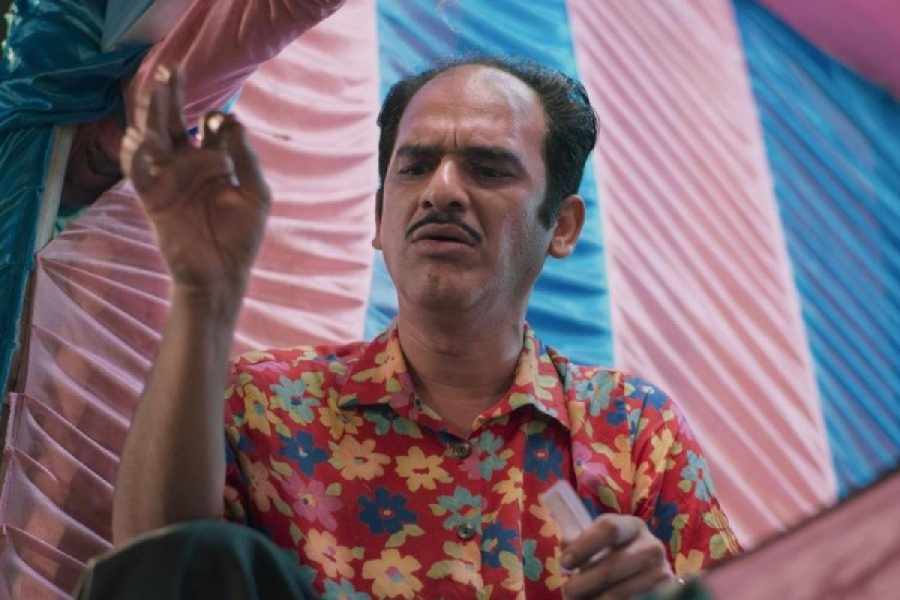
Similarly, in Nadharer Bhela, Nadhar — a middle-aged man known for his impossibly slow, almost sloth-like movements — drifts into a travelling circus on the fringes of rural Bengal. What begins as refuge gradually becomes spectacle, as his slowness is transformed into an attraction for curious audiences.
Within the transient world of the circus, Nadhar forms fragile human connections even as he is quietly exploited, reduced almost to the status of an exhibit. Moving at his own unyielding pace, he becomes both participant and observer, watching a world that rushes past him.
Set against the textured landscape of rural Bengal, the film evolves into a meditation on time, dignity and the fragile line between care and commodification. One is reminded of Marina Abramović and her explorations of endurance, vulnerability and the uneasy relationship between performer and audience. There is a profound sense of suffering here, one that feels intimately familiar. We cry with Nadhar because his pain belongs to all of us.
Yet Bhattacharyya never allows suffering to become a spectacle. Nadhar emerges as an unlikely hero, his resistance embedded within his apparent passivity. His revolt exists within his stillness. When Nadhar expresses his wish to be set adrift on a raft — believing himself useless and dispensable — the film reaches its emotional core. Is he truly abandoned, or is he needed precisely because he embodies a purity that others cannot? Does the female protagonist need Nadhar because no one else is capable of loving with such innocence and truth?
Bhattacharyya refuses easy answers. The ambiguity lingers, carried by a haunting score and an existential melancholy that strikes at a visceral level. The film leaves us suspended between despair and hope, certainty and doubt. Rajlokkhi O Srikanta is, in many ways, an intertwined love story about two couples. Here, both men are Srikanta and both women are Rajlokkhi, existing in another space and time while carrying the same tragic fate. Some loves do not end; they simply transform into something quieter, heavier and impossibly permanent.
The Srikantas drift not merely across places but through the unfinished corridors of themselves. The Rajlokkhis do not wait; they endure. They reshape themselves against time, loss and a world that constantly demands reinvention. Love is not a destination here. It survives in pauses, in glances that say more than words, in spaces where time has already passed. Between these characters exists a fragile truth: some relationships are never resolved, only carried. They no longer belong to one another, yet neither is entirely free from the other.
The film exists somewhere between what could have been and what is. Bhattacharyya leaves it to the audience to decide which ending offers greater comfort, or perhaps greater sorrow. Throughout his cinema, the boundary between reality and possibility dissolves effortlessly. His films move like watercolour paintings in which sea and sky merge so completely that one cannot tell whether it is dusk or dawn. Narratives drift from one reality to another without announcing the transition, carried instead by fluid storytelling and deeply felt performances.
Even his music seems to understand this philosophy. It never overwhelms the narrative; it brushes against it gently, organically, giving life to emotion rather than dictating it. The songs speak of spiritual longing, suffering and transcendence, often all at once. They are simple and profound in equal measure.
His world is earthy, ordinary and profoundly humane. Its inhabitants are flawed, damaged, impoverished, vulnerable and utterly real. They speak the language of lived experience rather than cinematic artifice. There is no attempt to elevate them into symbols or heroes. Their humanity is enough. Bhattacharyya's storytelling possesses a rare honesty — one capable of evoking emotions so pure and elusive that they resist explanation. His films do not seek resolution. They linger instead, like memories half-remembered, dreams half-forgotten, quietly continuing long after the screen has gone dark. Perhaps that is why I hesitate to explain them any further.