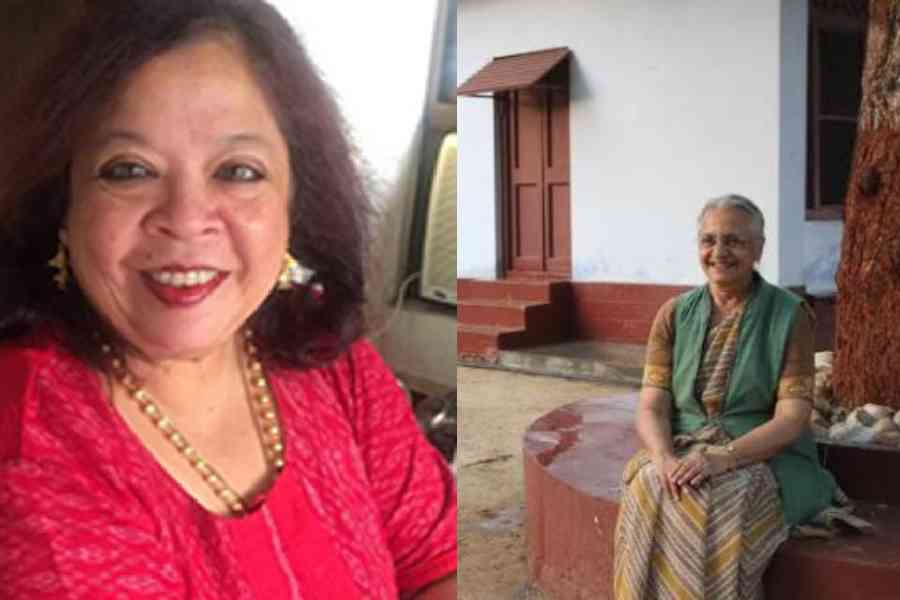
Prized in an academic world that is constantly in the midst of rough and tumble with many competing scholars spending years in understanding and analysing a global genius like Rabindranath Tagore, Uma Das Gupta is untouchable. I witnessed how she won hearts and minds among scholars at New College at the University of Toronto at an international conference on Tagore with her lucid presentation. As a much younger scholar, I was thrilled to be presenting a paper at the same conference and remembered her humility and prodigious knowledge when the book Rabindranath Tagore: Reclaiming a Cultural Icon, a collection of our papers edited by Joseph and Kathy O’Connell, was published by Visva-Bharati Publishing Department. Her peers and students worldwide, I found, have only extended their regard when I put together an international conference in 2022 to launch her book A History of Sriniketan.
It is undoubtedly Das Gupta’s intimate lived experience with Tagore, through her parents, that makes her latest book, A History of Santiniketan, unputdownable. There is no other story told with such gusto and insight as this one on Santiniketan. And because Das Gupta is a highly compassionate person herself, she shares with Tagore and his works a remarkable kindred vision for the human condition.
The author of A History of Sriniketan (2022) and A History of Santiniketan (2025) admits that the writing of the Sriniketan history was tougher than the most recent one on Santiniketan. Sriniketan got forgotten as a pioneering project and lost in today’s memory because society at large may not have taken it seriously that a poet, a writer, a Nobel Prize awardee at that, the scion of an aristocratic family, could have felt so deeply for the miseries of the village people and could have given his life to that onerous work. Tagore acknowledged that 300 villages surrounding his Santiniketan school stared him in the face, so taking up just a few would hardly matter. He still decided that he must make at least a beginning with the work. Das Gupta, in her interview with me, says that even if one single village could be given fulness of life, that single village would be his India.
A tete-a-tete with Das Gupta...
With your knowledge and litany of works on Rabindranath Tagore, is your newest book, A History of Santiniketan, the most rewarding and challenging so far?
Santiniketan, unlike Sriniketan, is not forgotten and is even very popular in today’s society as a pleasant place to visit and stay for a little holiday. However, very few or perhaps none engage with the history of how the place began and how hard the poet worked to fulfil the idea of an alternative and holistic education by starting from a school at the turn of the last century and adding an international university within the next 20 years. He named the university Visva-Bharati, meaning international culture, or international learning. Colonial education followed from British rule, but that education had no connection with India’s history and culture. There were no institutions of universal thought and culture. Tagore concluded that the consummation of his own life lay in a deeper realisation of the true spirit of humanity in harmony with the surroundings of nature. Writing a history of Santiniketan was of different exercise.
Tagore wished to establish a type of education whereby the children would creatively appropriate and enjoy the teaching given to them, assimilating it in a living manner. He himself believed intensely in freedom and desired the children to have as much joy and freedom as possible. School was not to be divorced from life itself. As for Visva-Bharati, the idea came to him as he travelled the world. He felt the need to bring the world closer; he felt there was a need for a meeting place of the East and the West. And where else but at Santiniketan could that meeting place be? The university he was adding was not going to be a conventional one for giving degrees, but would have to function as a centre where the minds of the East and the West could meet in a common fellowship of life, and the study of each other’s histories and cultures.
Your father’s reputation as a Tagore scholar and his closeness to Tagore shaped your scholarship. Readers would love to hear of your stories about Tagore, which you might have heard when you were very young.
Yes, I came to know of Tagore and got a glimpse of his life’s work in my formative years due to my parents’ association with Santiniketan and Sriniketan. It all began with my father’s invitation from Tagore to serve in Sriniketan, and my mother also went along with their baby boy, who is my elder brother, named Sumit by Tagore. The family came close to the bard while they stayed and worked in Sriniketan during 1936 and 1937. They left after two years when my father joined the civil service. He was an agricultural economist trained in the UK and held the Dartington Fellowship established by Leonard Elmhirst for the Sriniketan work.
My parents were, in a real sense, pioneers of the Sriniketan work. I remember being told of some of their early experiences, one of which was about queuing up at dawn along with the others living in Sriniketan each and every morning to fetch their requirement of potable water from the old village well.
Later in life, when my parents came to visit us in Santiniketan during the 1970s, he remarked that the Visva-Bharati administration deserved credit for the plenitude of water, thanks to the laying of pipelines. My parents used to visit us often when we stayed at Santiniketan during 1973-83, and of course, they had lovely memories of the place from their stay in 1936-37. My mother would often reflect on her perception of Tagore as a ‘Suryadev’, such was his shining presence to her.
Disillusioned with nationalistic politics, Tagore turned inwards into himself and his own experiences to establish an institution based on his founding philosophy, which was inspired by an ancient Indian forest hermitage. In your research, did you find a growing voice of criticism about Santiniketan being a step out of time, out of step with scientific development?
True, there were not many takers for Rabindranath’s ideas from his own society, even from his own milieu. Some of the nationalists considered his ideas to be nothing more than “a poet’s whim”. Even then, I would not agree with you. Some of the leading men of our society were attracted to the idea of Santiniketan, like scientist Jagadish Chandra Bose, writer Rajsekhar Basu, and journalist Ramananda Chatterjee. They were exchanging letters to discuss the idea with Tagore. And within the nationalist leadership, Gandhi and Nehru greatly admired the Santiniketan work. Gandhi described Santiniketan as “living poems” and called it a “pilgrimage” whenever he visited. Nehru found the seeds of a secular future for India in the Santiniketan philosophy and visited the place from time to time to talk to Tagore.
Some globally famous men associated themselves with Santiniketan, such as Japan’s Okakura Tenshin, who was known for his The Book of Tea: A Japanese Harmony of Art, Culture, and the Simple Life. Okakura sent a young Japanese scholar of Sanskrit to Santiniketan a year after the school had started. Shitoku Hori came to Santiniketan in 1902 and kept a diary. And of course, some led the work of Santiniketan and Sriniketan on the ground — academically, artistically and compassionately. Scholar Kshitimohan Sen, Pundit Vidhu Sekhara Sastri, painter Nandalal Bose, musicians Bhim Sastri and Dinendranath Tagore who taught and led the Sangit-Bhavana, Nakuleswar Goswami of the Vishnupur Gharana who came to teach the surbahar at the Sangit-Bhavana, the agricultural scientist Leonard Elmhirst to lead the village work along with Kalimohan Ghose, not to forget Rathindranath or Rathi Babu who carried his father’s entire work with love and faith on his head and shoulders, and the saintly Charles Freer Andrews who made Santiniketan his home.
You dedicate this book to your son, Amil. How do you feel about bequeathing such a magisterial body of work to him and the new generation of Tagore scholars?
Yes, and it is not out of any dream of mine for the book to find a place among the next generation and beyond. Amil belongs to the book in his own right. He spent the first nine years of his life in Santiniketan’s pastoral surroundings and acknowledges to this day how that has given him something special in his life.
When you were a child, did you ever imagine you would live the dream of being one of the greatest scholars on Tagore?
It was much later in my life that researching Tagore’s ideas of an alternative and holistic education came to me as a beautiful surprise and not as anything pre-planned. It began when I was looking for a post-doctoral research project after finishing my doctoral degree in history at Oxford University. In this, there were two lucky breaks for me. One was that we came to live in Santiniketan as a family when my husband Professor Ashin Das Gupta, was invited to be chairperson of Visva-Bharati’s history faculty by the then vice-chancellor, Professor Pratul Chandra Gupta, also an eminent historian. The other lucky break was when our son was only about six months old, and I was very willing to leave my teaching job at Jadavpur University and accompany my husband to Santiniketan so that we could be there as a family, raising our child in Santiniketan’s pastoral environment. So we did. We lived there happily for 10 years at a stretch from 1973 to 1983, and it was then that I started my post-doctoral research, which resulted in these books of mine referred to in your first question.
Julie Banerjee Mehta is an author and currently a professor of English at Loreto College. She also translated Tagore’s Dak Ghar, which was performed in Toronto’s Berkeley Street Theatre to critical acclaim, for which she was awarded the title of One of Sixteen most influential South Asians in Canada. She has a PhD in English and South Asian Studies from University of Toronto, where she taught World Literature and Postcolonial Literature. She also curates and anchors monthly Rising Asia Literary Circle.