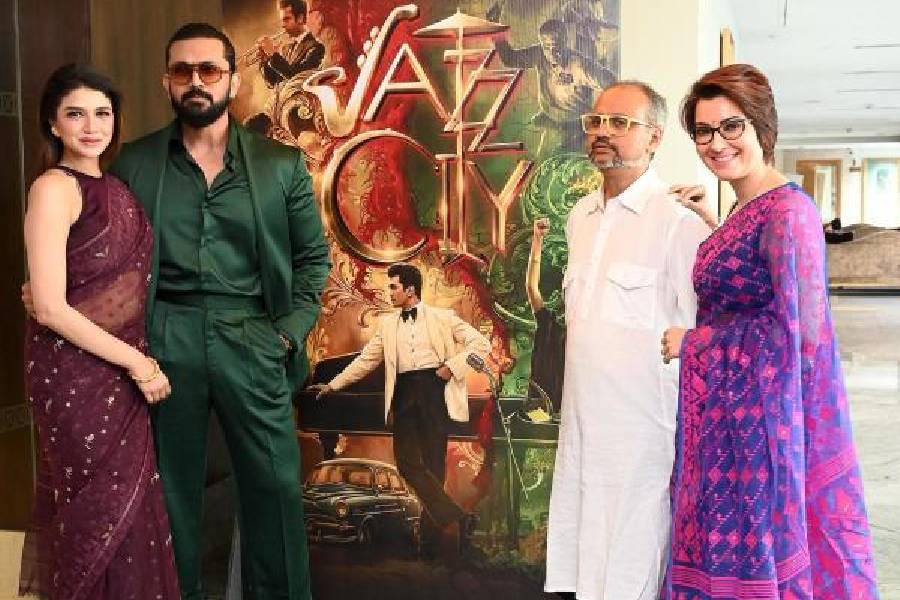
In 1971 Calcutta, a jazz club becomes the backdrop for a revolutionary awakening as music intertwines with language, identity and the birth of a nation during a pivotal historical moment.” That is the intriguing synopsis of Jazz City. The 10-episode series, that drops on SonyLIV on March 19, is directed by Soumik Sen, with a strong ensemble cast led by Arifin Shuvoo and Sauraseni Maitra, and is produced by Arpita Chatterjee’s Studio 9. With the team recently in the city for its launch, t2 chatted with Soumik, Arifin and Sauraseni at The Lalit Great Eastern Kolkata.
Soumik, what is it about Jazz City that has made you dedicate seven years to it?
Soumik Sen: Jubilee (that he co-wrote) also took seven years. I created Jubilee because I was unable to make the Kishore Kumar biography. As an artist, you are only competing with yourself. I asked myself: “Can I top Jubilee?” This is what led me to Jazz City. I can very boldly and safely say that Jazz City is my creative peak. I don’t think I can make anything like it ever again. A lot of the time, we treat the work that we do as the first thing we are doing as well as the last thing we will ever do. If Jazz City turns out to be the last thing I ever did, I am good to go. I have done a lot of study and research for Jazz City. To take a look at history and then fuse it with entertainment is not easy, but I believe we have done it well in Jazz City.
Also, it is very personal to me. Calcutta is the city I grew up in. For me, Jazz City is born out of St. Xaviers College, out of Park Street....
Arifin and Sauraseni, in what ways is Jazz City a first for you?
Arifin Shuvoo: I had to emote in a couple of different languages which are not my native. Also, our director (Soumik) doesn’t believe in saying “cut”. At times, you could be enacting a few pages at a time. As an actor, one had to be ready with the whole scene. We couldn’t say things like: “I have only prepared these six lines.” That could be true for any scene, be it in English, Hindi or Urdu. At any point, we would have 50 juniors in a scene along with five-six principal actors. Doing every scene was a masterclass for us.
I have been acting for nearly 20 years now and I have done a fair amount of work, but I hadn’t played anyone like Jimmy Roy (his character in Jazz City) before. I don’t think I will get this kind of a layered character again.
Sauraseni: The story of Jazz City popped up in this man’s (gestures towards Soumik) head seven years ago. He trusted me with Sheela’s character. Now when I hear him say that he has reached the pinnacle of creativity with Jazz City, I feel humbled to have been part of his vision, of his brainchild. The responsibility has increased. I also have the reassurance that if my director is trusting me with such a special project, I know that I can do it... I have to! Working under Soumikda’s direction has made me believe more in myself as an artiste. I am more vulnerable yet I am confident. I don’t know whether I will ever be given a character like Sheela Bose again or whether I will be able to do justice to it. I don’t know if I have done justice to the character in Jazz City... that is for the audience to decide. I have done my best and my director is happy.
I had a number of sessions with Soumikda regarding this character. Sometimes, he would send me songs, at other times he would send random doodles... all of which contributed in some way to my performance. Every day on set, I got to learn something new without it being boring or sounding lecture-ish. I connected to the character so much that I wanted to be like Sheela. She has so many layers to her. She is compassionate, graceful, poised. She is vulnerable but is very aware of what is happening around her.
Soumik, was Jazz City the only title you wanted?
Soumik: From Day One, that was the only title we had. In the middle, I was asked to add an explanatory line along the lines of ‘Casablanca meets Inglourious Basterds’ (laughs).... In Lord of the Rings, Frodo wants to destroy the One Ring at Mordor because of which he carries weapons. But Samwise lugs utensils in his rucksack, along with some salt at the bottom. It just goes to show (JRR) Tolkien’s thinking — that even when the world around you is burning, even when there are monsters to be fought, there will always be time to add seasoning to your food. You can always party. That, for me, is Jazz City.
Arifin: Jimmy is exactly like that! He may be in a fight, he may be all roughed up, but he will come out of it coolly and possibly ask a passerby: “Lighter achhey?”
Arifin, how would you sum up the Jazz City experience vis-a-vis the other period projects you have done?
Arifin: The best thing about Soumik Sen as a director is his power of visual thinking. Even before we started shooting Jazz City, he had seen the whole thing in his head. He was also very specific about what he wanted from us as actors, but that doesn’t mean that we couldn’t chip in with our inputs. Also, if you are a seasoned actor, then, after a point of time, you start looking into your own bag of life, of all the experience that you have gathered in life. Despite its larger-than-life scale, Jazz City is very human and very real, and our director is the one who brought about that balance.
Jazz City has captured true human emotions without a filter, something that I have rarely done in my career before. In fact, I have hardly seen a piece of recent work in Bengal, or in India for that matter, that has been able to do that.
Sauraseni: Jazz City is made on a very large scale and we had a lot of scenes to shoot. We had a joke among the actors that if you are extra lucky, you will get two takes (laughs). That is because Soumikda knows what he wants. Times have changed, the art of storytelling has changed. So has the art of acting. We don’t act anymore... actors behave these days, we observe and absorb. It is very important for us to see things and learn.
I would go up to him (Soumik) and ask him to allow me one more shot. He would perhaps agree, but he wouldn’t keep it. For the first two days, it was difficult to understand this process but eventually I told myself: “Sauraseni, your director trusts you so much, so shut up” (smiles). I just needed to believe in myself and live the character of Sheela. And that is exactly what I did.
Arifin: The thing is that he (Soumik) doesn’t react when a take is done. And I don’t have the habit of seeing the monitor...
Soumik: There is an Italian footballer called Mario Balotelli, who never celebrates after scoring a goal. When asked about it, he said: “Have you ever seen a postman celebrate after delivering a letter?” Similarly, my job as a director is to get the job done... I don’t have to celebrate after a take!
Sauraseni: He gave us ample freedom to do things our way. One day, I walked up to him and asked: “What should I do with this scene?” His reply: “What do you want to do?” No director in my life has ever asked me that. He was like... the camera will follow you, the camera knows, the camera captures everything.
Priyanka Roy
Which is your favourite Indian series in a period setting?
Tell t2@abp.in