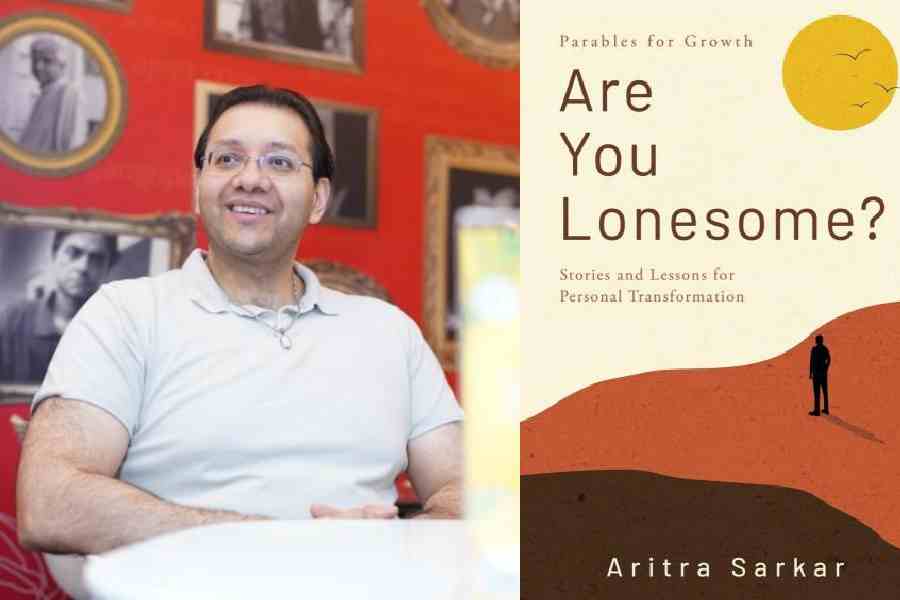
What is discernible about Aritra Sarkar right from the start is a certain quietness which is like a language that pervades the space around him. The first time we met was at one of those innocuous book launches at Oxford Bookstore. We began speaking as if we had been classmates, and as we stepped on the edge of the precipice of discussing his newest book, Are You Lonesome?, I was drawn into the overwhelming problem of how youth today are disabled from entering into just normal relationships. My sharing an incident about how some of my university students in Toronto and in Calcutta were afraid to go on a date and share an intimate conversation face to face or flesh to flesh, because they felt disempowered by not being able to use their delete button after saying ‘I love you’, put us on the same page. We both smiled at the deeply disturbing feeling of loneliness that pervades our lives today, whether we are teenagers, or twice divorced, or hedging into our 80th year, frightened of another night without someone to hold.
After I read Aritra’s book, Are You Lonesome?, I found he was, in the Jungian way, a total empath. Caring, analytical and uniquely receptive. I slowly began to discover his deep-rooted compassion, which almost borders on the ability to understand a fallen angel and understand what caused the fall. This is an author and storyteller based in Calcutta, an alumnus of New York University. He spent several years working in the media industry before turning increasingly to literary and reflective writing. His books include Goliath of Shenzhen (2016), an experimental dual-format novel told through prose and graphic narrative; Stress to Zest (Penguin Random House India, 2024), the first volume in his Parables for Growth series; Soulful Cal! (Wordphonics, 2025); and Are You Lonesome?, the second book in the same series.
His work brings together storytelling, psychological insight and spiritual reflection, with a strong interest in emotional life, human connection and personal transformation. Sarkar is also associated with the ABP Group’s educational initiative, Calcutta Media Institute, where he serves in an advisory role focused on nurturing the next generation of journalists. He continues to write across fiction and non-fiction, drawing on lived experience and acute social observation.
Excerpts from the chat.
A book like Are You Lonesome? can only be written by a person with an exceptionally high emotional quotient, the Jungian empath. Did this have something to do with your upbringing? Describe your childhood and what influences worked on you.
I think my upbringing had a great deal to do with it. I grew up in a warm joint-family where life was deeply communitarian, and that gave me an early sense of emotional closeness and shared existence. But as I entered my teens, many of my aunts, uncles and cousins moved out, and I began to experience loneliness for the first time. I was not naturally inclined to build friendships outside the home. There were a few friends in my immediate vicinity. So, that inwardness deepened. At the same time, my daily commute to school exposed me to the full spectrum of Calcutta’s social reality — from wealth to destitution — which quietly widened my emotional horizon. My schooling at St. Xavier’s, with its socially diverse student body, nurtured an egalitarian outlook, while the spiritual atmosphere of the Ramakrishna Mission also shaped my inner life. All these influences found their way, in different forms, into Are You Lonesome?.
Your smart and cogent way of juxtaposing case studies such as Jack with your lived experience makes for a powerful statement that encourages the reader to analyse why people are so cut off from a nurturing environment. Was this a conscious methodology to juxtapose the two?
While modern technology has undoubtedly amplified emotional isolation in many ways, my response to that condition was not a rigid methodology I imposed at the outset. It emerged organically as the book developed. I gradually realised that loneliness cannot be approached only as an idea, nor only as a personal confession. It needed both the distance of story and the intimacy of lived experience. The parable or case-study element allowed me to dramatise emotional truths in a way readers could enter imaginatively, while the more reflective passages grounded those truths in recognisable life. Over time, I saw that this juxtaposition was doing something important. It was helping readers move between observation and self-recognition. One can read a character like Jack Wilson and reflect on the culture that produces such emotional fracture, but one can also turn inward and ask where similar patterns exist within oneself. So while the structure arose organically, I came to understand it as central to the book’s design. The form itself became part of the inquiry.
It is very difficult to get people (of any age) to get counselling; the synchronicity with which we feel more secure in a positive environment can never be overstated. How would you suggest that those who are the batterers be reformed in their thinking and behaving that they would benefit from being more compassionate?
People who become batterers are often not merely “bad people”. They are frequently carrying unresolved hurt, distorted models of power, and a deep inability to encounter vulnerability — either in others or in themselves. That does not excuse harmful behaviour, but it tells us that reform must work on several levels at once. There has to be accountability, because compassion without responsibility becomes sentimentality. There must also be psychological work, because many such people have never examined the wounds, fears or ego structures that drive their cruelty. But beyond these, there is a moral and spiritual dimension — the cultivation of reverence for another human being. Compassion grows when a person stops seeing others as extensions of their frustration or entitlement and starts to see them as lives as real as their own. Families, schools, communities and spiritual traditions all have a role here. Lasting reform requires outer correction and inner awakening together.
Where and how do you think our institutions of learning, especially those ruled by colonial powers, must break the master-subject stratification and bring new ways of communication between teachers and students, and between students themselves?
I think the first change must be inward. We must stop treating education as a hierarchy of command and begin treating it as a living exchange. Colonial models of learning often rested on distance, fear, authority and imitation. They trained students to perform knowledge rather than inhabit it. To break that legacy, institutions must create environments where dialogue matters as much as instruction, where students are not simply recipients of information but participants in a shared search for understanding. That also means rehumanising the teacher’s role — not as an unquestionable authority, but as a guide, listener and catalyst. Between students, too, there must be more spaces for collaboration rather than competitive isolation. The classroom should not only sharpen intellect, it should expand emotional literacy, ethical sensitivity and mutual regard. In the end, education fails if it produces brilliant minds that cannot relate, listen or care. A truly modern institution must cultivate depth of personhood alongside excellence of thought.
Your work blends narrative power with psychological insight. Your debut Goliath of Shenzhen (2016) broke new ground using both prose and graphic formats. How did you succeed in this experiment?
I approached Goliath of Shenzhen with curiosity rather than certainty. I did not set out to “break new ground” in any grand sense. I simply felt that the story demanded more than one mode of telling. Some emotional movements could be explored more deeply through prose, with its interiority and reflective range, while other moments gained force through the immediacy and compression of the graphic form. What helped the experiment succeed, I think, was rhythm. I became attentive to visual pacing — when an image should strike quickly, when prose should slow time down, when the reader needed silence, and when they needed psychological depth. The two forms were not competing with each other. They were supporting different dimensions of the same narrative experience. I was also willing to experiment without being overly protective of convention. In that sense, the book taught me something valuable early on. Form should serve emotional truth, not the other way round.
This book is the second volume in the Parables for Growth series. Tell us about how you are spearheading an educational initiative to train the next generation of journalists.
Alongside my writing, I am contributing to ABP Group’s educational initiative, Calcutta Media Institute, as an advisor. The larger goal of the institute is to nurture the next generation of journalists so that they are professionally capable and meaningfully prepared for the demands of contemporary media. To me, journalism is not merely about information delivery. It is also about perception, responsibility and the quality of human attention one brings to the world. In an age of speed, noise and polarisation, I believe young journalists need more than technical skill. They need ethical grounding, sensitivity to people’s realities, clarity of thought, and the ability to tell stories without flattening human complexity. My own literary work and this educational role are connected by that shared belief: that storytelling, whether in literature or journalism, should deepen our understanding of life rather than reduce it. Good journalism, at its best, is a public form of empathy.
Julie Banerjee Mehta is the author of Dance of Life and co-author of Strongman: The Extraordinary Life of Hun Sen. She has a PhD in English and South Asian Studies from the University of Toronto, where she taught World Literature and Postcolonial Literature. She currently teaches Masters English at Loreto College, and curates and anchors the monthly Literary Circle discussion of the Rising Asia Foundation