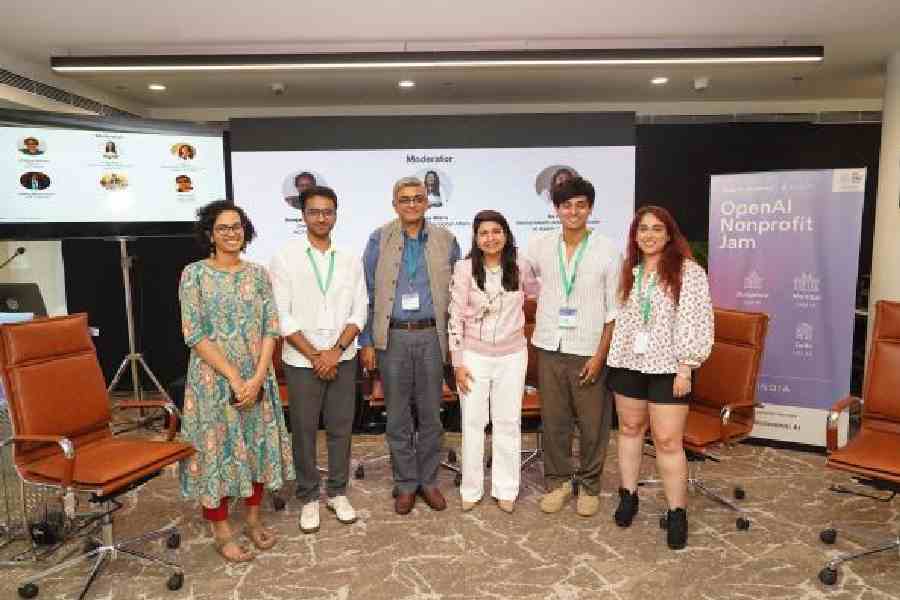
As artificial intelligence steadily moves from experimentation to everyday use, the challenge for the social sector is no longer whether AI can help, but how it can be applied in ways that are practical, responsible and grounded in real organisational needs. That shift in thinking underpins the Nonprofit AI Jam initiative by OpenAI, which has made its India debut this month as a multi-city series across Calcutta (held on January 19), Bengaluru (held on January 15), Mumbai and Delhi, bringing together nonprofit leaders and practitioners for hands-on working sessions.
For OpenAI, the emphasis is on practicality. As Pragya Misra, head of strategy and government affairs at OpenAI India, told this newspaper: “The biggest barriers are foundational: limited familiarity with AI concepts, lack of access to easy-to-use tools, and uncertainty about how AI fits into day-to-day operations.” Many nonprofits, she noted, are enthusiastic about AI but struggle to convert that interest into something deployable. “They’re eager to experiment, but translating curiosity into workflows that align with their mission, capacity and ethical considerations is where they often get stuck,” she said. This is exactly what the Jam is designed to address.
Delivered in partnership with Karya and supported by Wadhwani AI as the knowledge partner, the Nonprofit AI Jam is structured as an outcomes-led programme. Rather than a one-size-fits-all format, each city’s Jam is adapted to local nonprofit realities. “While the Jams share a common foundation in AI fundamentals, they are intentionally adapted to local nonprofit realities,” Misra said. “Mentors work directly with participating nonprofits to shape locally relevant problem statements and organisational workflows, ensuring AI use cases reflect on-the-ground priorities rather than abstract global examples.”
From curiosity to capability
The Jam, in short, helps nonprofits move from AI experimentation to real deployment. During the sessions, participants work directly with facilitators and technical experts to explore how tools such as ChatGPT can “streamline operations, improve outreach, strengthen programme delivery, and support better decision-making,” leaving with AI-powered workflows they can begin using immediately.
India’s nonprofit ecosystem, with its mix of large institutions and deeply embedded grassroots organisations, presents both an opportunity and a challenge for AI adoption. As OpenAI observed, nonprofits across education, healthcare, livelihoods, inclusion and community resilience operate in varied contexts, often with limited capacity. The Jam reflects a commitment to ensuring that advanced AI is accessible “not just to large organisations, but also to mission-driven teams working closest to communities”.
“OpenAI mentors, alongside partner experts, are directly involved during the hands-on portions of the Jam, helping nonprofits map workflows, prototype solutions, and understand how to responsibly apply AI tools,” Misra told this newspaper. This includes “co-developing prompts, templates, and simple automations, as well as advising on feasibility and responsible use,” with the goal of ensuring teams walk away with something they can run independently and refine over time.
Designing for local realities
The Jam brings together nonprofits working across education, public health, skilling, climate action and gender inclusion. Participants arrive with live operational challenges, ranging from improving beneficiary outreach to automating internal workflows, and spend the day collaborating to build practical AI solutions tailored to their organisations.
Expectations of outcomes are realistic. “A realistic outcome is one practical, repeatable workflow the team can start using immediately,” Misra said. This could be an outreach and follow-up playbook or an internal process automation that saves time each week. “A realistic outcome is one practical, repeatable workflow the team can start using immediately, such as an outreach and follow-up playbook, a reporting or documentation template, a volunteer communications toolkit, or an internal process automation that saves time each week. The aim is not a concept note or a demo, but a working workflow with clear steps and ownership so it can continue after the Jam.”
The role of partners has been central to shaping the Jam’s relevance. Karya, Misra explained, is “the primary ecosystem partner — helping bring in the right nonprofits and ensuring the Jam is grounded in real, current operating realities in India’s social sector.”
Wadhwani AI, as the knowledge partner, has helped sharpen the focus on what works in practice, “refining high-impact use cases, shaping relevant examples, and guiding discussions on what is feasible and responsible in real-world social impact settings.”
What happens after the Jam, Misra stressed, is just as important as the session itself. “Participants continue to get access to learning resources and practical guides through OpenAI Academy, so they can keep refining and implementing what they built,” she said. Eligible registrants are also provided one year of ChatGPT Plus, enabling them to continue testing and deploying workflows without immediately running into cost barriers.
Affordability, she said , remains a structural concern for many nonprofits. “Cost is a real constraint, so we’re approaching affordability through a mix of pricing pathways and practical enablement,” Misra said, pointing to the OpenAI for Nonprofits programme, discounted access to ChatGPT Business and Enterprise, and lower-cost options such as ChatGPT Go, including India-specific offers. Just as importantly, she added, the Jam is designed to reduce the “hidden cost” of adoption by ensuring nonprofits see immediate, sustainable value rather than remaining stuck in experimentation.