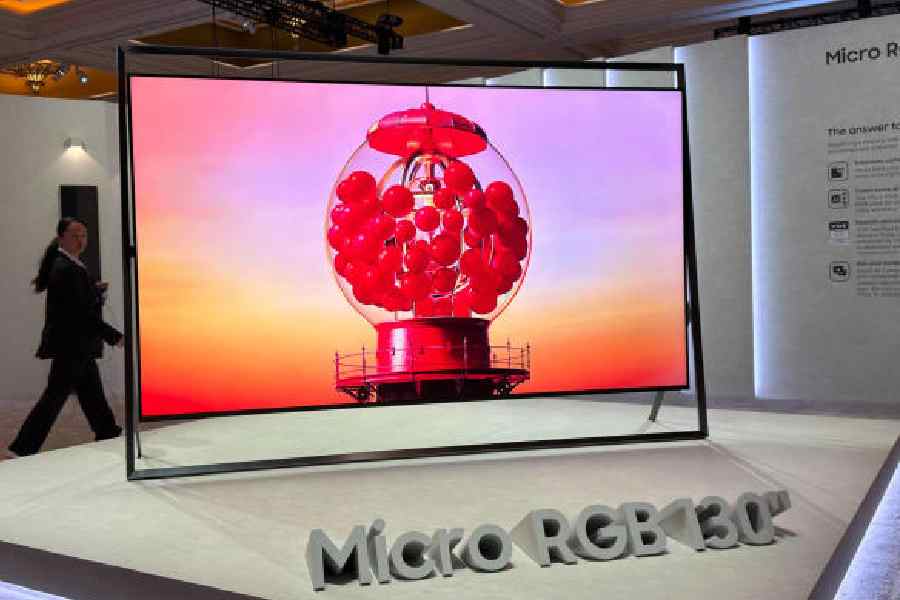
A couple of things have happened in the television market. First, more and more people are buying premium offerings. Second, many are upgrading from smaller sets to screens larger than 50 inches and, in the process, are gravitating towards high-end televisions. Now, 130 inches is not just “big” — it is built to be noticed. That is the size of the new Micro RGB TV from Samsung Electronics.
In fact, the sheer scale means the TV is suspended within a large metal stand that surrounds the display, also allowing the screen to be tilted slightly.
Unveiled at CES 2026, Micro RGB innovations include the Micro RGB AI Engine Pro, Micro RGB Colour Booster Pro and Micro RGB HDR Pro, which uses AI to enhance contrast and enrich colours. There is also support for Micro RGB Precision Colour 100, covering 100 per cent of the BT.2020 wide colour gamut, and certification from Germany’s Verband der Elektrotechnik for precise colour reproduction.
Micro RGB TVs use tiny red, green and blue LEDs to backlight panels, replacing standard white or blue backlights to improve colour accuracy and brightness. One look at the TV, and the accuracy on offer is immediately striking.
“Micro RGB represents the peak of our picture quality innovation, and the new 130-inch model takes that vision even further,” said Hun Lee, executive vice-president of the visual display business at Samsung Electronics. “We’re reviving the spirit of our original design philosophy introduced more than a decade ago to deliver an unmistakably premium display, engineered with technology for a new generation.”
A deep dive
Some of the new TVs from the South Korean company are larger than what was once considered standard, as “super big screens” continue to be a fast-growing segment, with the market expected to double.
The TV goes beyond size and picture quality. Added to the mix are HDR10+ Advanced technology and Eclipsa Audio — two terms you are likely to hear a great deal more about in the coming months.
The first new feature under HDR10+ Advanced is HDR10+ Bright. This is not an ambient-light compensation mode. Instead, it can be thought of as a form of HDR upscaling. Today’s most advanced TVs are capable of reaching 4,000 or even 5,000 nits of HDR peak brightness, alongside 100 per cent coverage of the BT.2020 wide colour gamut.
With HDR10+ Bright, extended statistical metadata is used to capture finer variations in image tonality. Compatible Samsung TVs then employ AI-driven algorithms to dynamically enhance brightness and colour based on the display’s capabilities.
Next is HDR10+ Genre, which introduces genre-based optimisation. Content creators can specify a genre, allowing the encoder to determine detailed classifications. This metadata is embedded into the HDR10+ Advanced video stream, enabling compatible TVs to apply optimised tone curves and picture processing tailored to each genre.
The third addition is HDR10+ Intelligent Gaming, which introduces an adaptive cloud-gaming mode. It allows tone mapping for cloud-based HDR10+ Advanced games to be adjusted in real time based on ambient lighting, delivering a more consistent and visually optimised gaming experience.
In 2023, the Alliance for Open Media (AOM) — a global consortium that includes Samsung, Google, Netflix and Meta — officially adopted Immersive Audio Model and Formats (IAMF) as the industry standard for 3D audio. Developed by Samsung and Google, the format is currently available to creators under the brand name Eclipsa Audio. It establishes a shared protocol between different types of media content and playback devices, delivering an immersive listening experience by optimising audio positioning, intensity and spatial reflections across environments ranging from cinemas and home theatre systems to gaming consoles and mobile devices.
Unsurprisingly, the TV also integrates Samsung’s Vision AI Companion for voice interaction, recommendations and access to AI-powered features such as AI Soccer Mode Pro, AI Sound Controller Pro, Live Translate, Generative Wallpaper, Microsoft Copilot and Perplexity.
Samsung is highlighting its ‘Companion to AI Living’ vision at The First Look, its CES event. From televisions to refrigerators, AI now runs through much of the company’s portfolio, alongside a growing emphasis on connected devices.
TM Roh, CEO and head of Samsung’s device experience (DX) division, said: “Samsung is building a more unified, more personal experience across mobile, visual display, home appliances and services. With our global connected ecosystem, and by embedding AI across categories, Samsung is leading the way to offer more meaningful everyday AI experiences.”
(The reporter is in Las Vegas to cover CES 2026)