The Rolling Stones got their kicks on Route 66 while the Beatles said you could drive their car. Music has always been a lifeline for anyone behind the wheel — and apparently a dangerous one at that. A study published in February found that traffic fatalities in the US increased by nearly 15 per cent on the same days as the biggest album releases from artistes like Taylor Swift and Bad Bunny. We are not listening to less music, and musicians are certainly not releasing fewer albums.
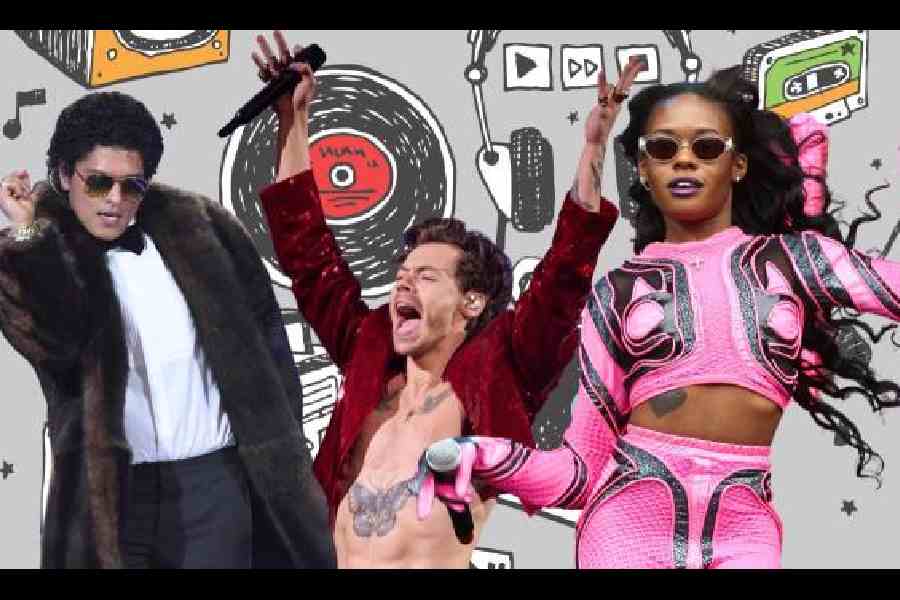
Which brings us, in a roundabout way, to Harry Styles. His fourth album, Kiss All the Time. Disco, Occasionally, is exactly the kind of record that reminds you what a human being with something to say actually sounds like. Disco-tinged and occasionally delightfully obtuse, it inspires communal listening while keeping you on your toes. The bass-forward electro-pop of Are You Listening Yet? delivers tough love, while Aperture is an open invitation to embrace whatever “lets the light in”. Breathing life into it all is producer Kid Harpoon, a man who approaches music-making with the spirit of a hobbyist and the instincts of a craftsman.
The pair shaped the album across Berlin’s Hansa Studios, London’s Abbey Road and Harpoon’s own Laurel Canyon studio, with no small contribution from his beloved modular synth racks. The result is the kind of album that could only have been made by people who have lived, argued, experimented and cared — which is precisely what makes it such a useful lens through which to examine what artificial intelligence can and cannot do. An AI, after all, could analyse every disco record ever made and still not know what it feels like to need the dance floor.
Keeping Styles company on the album release list is Azealia Banks with Zenzealia and Bruno Mars with The Romantic. Then there is Mumford and Sons, M.I.A., J. Cole and a very long list of musicians.
Meanwhile, AI is grabbing headlines, though not necessarily the patience of musicians. In March, the Recording Industry Association of America released its 2025 Year-End Recorded Music Revenue Report, which revealed that US wholesale annual revenue hit a record high of $11.5 billion. The US remains the world’s largest paid subscription market, with 106.5 million accounts generating $6.4 billion in revenue. Premium paid subscriptions grew by 6.8 per cent to $5.88 billion, and US vinyl sales grew for a 19th consecutive year, representing nearly 50 per cent of the format’s global value. The message is clear: people are still willing to pay for music. AI is yet to prove its mettle.
Slop, sceptics and strummers
A few weeks ago, we contacted a popular radio presenter after receiving a WhatsApp link to the music he had been making. Despite his mellifluous broadcasting voice, singing is emphatically not his strong suit — and yet music streaming services show that he has already released multiple albums. Whether anybody is actually listening to them is a harder question to answer.
He explained that he writes the lyrics himself and spends roughly seven days on each track. Over 20 months, he has built up a catalogue of 110 songs, releasing 20 to 25 a month via TuneCore, which distributes them to Spotify, Apple Music and other platforms. Industrious, certainly. Musical, (highly) debatable.
Real musicians are less easily impressed. Ray Dickaty of Light Star Guiding, a veteran of the jazz scene, did not hesitate when asked for his view. “I like machines in music, but not music made solely by machines,” he told us when he visited India to perform at Jazzfest. “Although, having said that, I recently heard some AI music that was truly good — and I hate to say that,” he added.
What concerns him far more is the volume. “The sheer amount of AI music choking up YouTube and Spotify is alarming. Playlists like ‘smooth jazz to study by’ or ‘relaxing hip hop’ have become ubiquitous on social media, and due to the algorithms, these are always the top hits. I worry for younger generations who absorb this as normal, not realising the difference between this and music made by real people,” said Ray.
The other issue keeping him up at night is copyright. “Battle lines are being drawn to protect against infringement, but AI is flourishing at an incredible rate and lawmakers are struggling to catch up. Once again, the creators of original music are being taken for granted and not being financially rewarded for their work,” he pointed out.
The numbers bear this out in a striking way. French streaming service Deezer recently announced that AI-generated tracks now represent 44 per cent of all new music uploaded to its platform — almost 75,000 tracks per day, and more than two million per month. Astonishing. But here is the caveat: actual consumption of AI-generated music on the platform remains between one and three per cent of total streams, and 85 per cent of those streams are detected as fraudulent and demonetised. AI is flooding the supply. It has not yet seduced the audience.
What AI actually is... and isn’t
If you are one of the millions of people who write music for fun, AI changes very little. You will continue to write music — just as the millions of people who bake regularly continue to make their own beautiful, wonky loaves, even though a supermarket could sell them something cheaper and quicker. Your music, like their bread, is filled with something no algorithm can replicate: passion, love and soul. Nobody can take that away from you.
That said, AI music tools are being adopted at a remarkable pace. Platforms like Suno and Udio have made it startlingly easy to “create” a song — Suno in particular has a clear popularity edge. Plenty of people are simply strumming an acoustic guitar, singing into their phone, then feeding it into an AI platform and arriving at something that sounds like a fully arranged, professionally produced track.
In Nashville, songwriters who once booked expensive demo sessions with pro session players are now running their ideas through these platforms before pitching to artistes — faster, cheaper and with surprisingly convincing results. Suno has even unveiled a feature called Hooks, which lets users pair short video clips with AI-generated songs to create shareable, music-focused content — a clear play for the Instagram-TikTok generation and the attention economy it inhabits.
Some people recoil at all of this — “I’ll never listen to AI music” — but that reaction is not unlike the initial scepticism around robot vacuum cleaners. Plenty of people thought the idea was absurd, an invasion of privacy dressed up as convenience. And yet a sizeable portion of the population decided they were perfectly happy to let a robot handle the hoovering. Attitudes towards AI music are likely to follow a similar arc.
It is worth being clear-eyed about what these tools actually are, though. AI music platforms have a singular focus — music and nothing else. They are not sprawling general-purpose systems requiring vast data centres and hundreds of billions of dollars to run. That narrowness is, in one sense, a strength. But it is also a hard ceiling. At their core, these systems are pattern recognisers. They retrieve and remix. They can only produce what they have been trained on, and they will not generate anything that genuinely lies beyond that boundary. Harry Styles and Kid Harpoon did not make Kiss All the Time. Disco, Occasionally by recognising patterns. They made it by breaking them.
It is important, then, to distinguish between AI slop — the generic, soulless output flooding the platforms — and AI as a genuine creative instrument in the hands of a skilled artiste. Established and emerging musicians alike are beginning to find their footing with these tools, and the conversation at the highest levels of the industry reflects that nuance.
Will.i.am, whose career rose alongside peak CD sales and who has navigated every seismic shift in the music business since, described AI as “a mixed bag” when speaking at Davos this year. “I love technology,” he said. “AI slop — this is the worst it’s ever going to be. At the same time, technology will continue to get better and better. It’s maths. So we’re going to move from prompting to prompt-less systems.”
The deeper question is whether an artiste can be genuinely credited for creating music with AI. Will.i.am drew a parallel with the birth of hip-hop. “Imagine it’s 1970 and we’re talking about jazz,” he said. “A jazz musician would say, ‘Hey man, what do you think about these samplers? People just sampling our stuff from the past — you think that’s music?’ Turns out that was the foundation of hip-hop: sampling, using technology to reimagine and reconfigure, doing poetry, tapestry, collage music. So I can’t be too critical of AI, because I have a career built on sampling.”
And yet he is unambiguous that a crucial distinction remains. Will.i.am is a human being who took existing creativity and added something of his own. When a machine does the same thing, the line between inspiration and theft becomes far harder to draw. “You’ve got to be careful,” he said. “At the core of AI music is some developer, and that is their art — you can’t discredit the artistry of creating an algorithm. But they did borrow. They trained on entire libraries of music made by human beings, and those people should be paid for it. The AI we are concerned about right now is not the AI that is actually coming.”
One thing Will.i.am is certain of is that live performance will become more valuable, not less, as AI advances. As generated content grows ever more convincing, trust in anything on a screen will erode. Where audiences once had an instinct for detecting a lip-sync, that ability is becoming harder to rely on. People, he argues, will increasingly crave something unmediated and verifiably real.
He is no stranger to AI. He was introduced to the many possibilities of AI by professor and AI expert Patrick Winston. He had a radio show on SiriusXM that he co-hosted with an AI called Qd.pi. He previously served as chip manufacturer Intel’s director of creative innovation.
“When I started my first company, we focused on natural language understanding, natural image processing and machine learning. The team I had put together had engineers from Bangalore and Chennai. We created a voice operating system. And played around with a Snapdragon chip to create a product called the Dial, which launched around 2014. It was pretty early to be talking to a watch,” said the musician during his visit to New Delhi last year.
He has used technology to give music a lovable twist. For the Black Eyed Peas’s 2010 music video for the song Imma Be Rocking That Body, it kicks off with a skit where Will.i.am shows off futuristic technology that can replicate any artiste’s voice, to the surprise of his bandmates. And that technology is readily available today.
The human composer is not going away
Think about what it actually takes to score a song. You are not just writing music — you are inhabiting someone else’s story, feeling your way through scenes that haven’t happened to you, finding the emotional frequency of a character’s grief or joy or rage and then translating it into something an audience will feel in their chest before they’ve consciously registered why. No prompt does that. No pattern-recognition engine knows what it is to sit with a director at midnight, watching the same four-minute sequence for the 40th time, trying to find the note that makes it true. That is the work. That is what composers do.
The same logic applies to novelists, and the comparison is instructive. AI can generate text — serviceable sentences, plausible plots — but a compelling novel is built from the inside out: from character, from earned emotion, from the writer’s own scar tissue. AI has none of that. It has data. The two are not the same thing, and no amount of processing power will close that gap, because the gap is not computational. It is human.
For composers, the path forward is therefore clear: double down on originality, excel at communication and collaboration, and work deeply on emotional insight and nuance. These are the three qualities at the very core of what composers do — and precisely where AI falls furthest short.
There are also significant legal barriers surrounding the commercial application of generative AI, not least the ongoing battle over training data. As a producer of, say, a children’s show, you can enter prompt after prompt and hope something useful comes back — but the model simply does not understand what children’s television music actually is. There is also the problem of AI-generated music not enjoying copyright protection. Without copyright, there are no royalties, and royalties matter enormously. Someone could take your AI-generated track and use it however they please, in whatever context they liked, and there would be nothing you could do about it.
The greatest fear is that AI will wipe out vast swathes of the music market — particularly at the lower end, where producers may opt to cut costs rather than commission a composer. But that corner of the market has already been largely hollowed out by royalty-free libraries like Pond5. What will likely follow is a cannibalistic war between generative AI and those very platforms. The rest of the industry — film, television, games — is a different matter entirely. In those spaces, producers want to communicate with their composers, give notes, push back, and ultimately commission something that unites a franchise around a single, wholly original creative idea. That is what composers do, and no prompt can replicate it.
There is, in fact, a strong case that AI will end up highlighting precisely what is special about human composers — making visible what machines cannot do. If the limit of your ambition is producing generic music or following a formulaic approach to composition, the market for that was already shrinking before AI arrived. It is even more constrained now.
The potential for composers to rise to this challenge, however, is enormous. Being a composer has always meant reinventing yourself — that is nothing new. For generations, every few years something has come along that required a fundamental rethink of how you write music and how the business works. This is simply the latest chapter in that story. The question, as ever, is not whether you can survive the disruption — it is whether you are interesting enough to make people glad you did.