 |
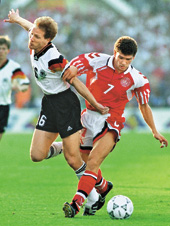
| Matthias Sammer (left) is challenged by Danish midfielder John Jensen in the Euro ’92 final in Gothenburg |
Denmark had finished second in group 4 eliminators but were subsequently called into the equation after Yugoslavia, who had finished first in the same group, were excluded because of their civil war. Then in an amazing twist and against all odds, the Danes went on to win the tournament beating world champions Germany 2-0 in the final.
The tournament took place in four principal cities (Stockholm, Gothenburg, Malmo and Norrkoping), and Euro 92 was the last time the competition utilised a format of eight teams in the final phase. After bringing major changes to European Cup competitions, notably with a new-format Champions League, the Uefa decided to spend more time and energy on the game at the national level expanding the tournament at Euro 96 in England, when 16 teams took part.
The tournament late-comers, coached by Richard Moller-Nielsen, managed to mark their progression in style, beating Marco van Basten and Ruud Gullit’s classy Dutch squad in a classic semi-final.
After the match finished 2-2 after extra-time, the Danes finally prevailed winning a dramatic penalty shoot-out 5-4.
Germany, coached by Berti Vogts, fell briefly under the spell of an exciting Swedish team but secured their place in the final as goals from Thomas Haessler and a brace of goals from Hans-Peter Riedle did the job in a 3-2 win.
With nothing to lose, Denmark came into the final against Germany and just played their natural game, one which was characterised by spontaneity, simplicity and enthusiasm — a formula which ultimately had resounding success.
Against all expectations, Brian Laudrup and Co. supported by a certain Peter Schmeichel who was brilliant under the bar throughout the tournament went on to hand Denmark its first-ever European title.
A devastating strike from John Jensen after 18 minutes, only his second goal in 48 internationals, and a second-half insurance marker from Kim Vilfort guaranteed Denmark’s place in history and sparked wild celebrations by Danes around the world.
THE STARS
 |
Few critics would argue that Danish legend Peter Schmeichel was during his prime the best goalkeeper in the world.
Schmeichel became famous at Manchester United where he was a pillar at Old Trafford during a trophy-laden eight-year spell, but he first came to international prominence at the 1992 European Championships, when Denmark stunned the footballing world with an unlikely victory after stepping in for the expelled Yugoslavs. Following his spell at United, the highlight of which was the 1999 treble winning season that included the Champions League, Schmeichel also added a Portuguese championship medal to his cabinet tending goal for Sporting Lisbon.
Standing 1.94m tall and weighing around 99kg, Schmeichel’s huge physical presence appeared to block all routes to his goal but he was surprisingly agile and his fierce will to win puts him alongside some of the great goalkeepers of all time including Lev Yashine, Gordon Banks and Dino Zoff. Denmark’s most capped player, Schmeichel was heavily influential in Manchester United’s re-emergence as a major force in English and European football during the 1990s.
He was spotted by United manager Sir Alex Ferguson and snapped up from Danish club Brondby in 1991 for just £650,000 (about $1 million) in what must go down as one of the transfer bargains of the decade.
Eight years and 398 appearances later, Schmeichel left United with a suitcase bulging with silverware.
Ferguson tried to persuade him to stay, but the giant Dane was determined that he wanted to finish with the club at the top.
 |
Along with older brother Michael, Brian Laudrup will remain an indelible memory in the minds of every Danish football fan as one of the country’s most elegant and most effective players. The talented offensive midfielder, whose threatening runs down the wing proved the bane of many a defender, enjoyed a prestigious career which began in Denmark and ended with one-time Kings of Europe, Ajax of Amsterdam.
Born in Vienna, Laudrup’s professional career began at Brondby as a fresh-faced 16-year-old. He won two Danish Championships and one Danish Cup and by 1990, the brilliant young midfielder had been voted Denmark’s best player two years running.
Taking his talents abroad, Germany was Laudrup’s first port of call — and the public were not disappointed. With Bayer Uerdingen and above all with Bayern Munich, he spent three fabulous seasons before falling victim to a knee injury. After an operation in the US, Laudrup rested a few months before being called up, surprisingly like the rest of the Danish squad, for Euro 92 after the political situation in Yugoslavia led to their last minute exclusion. An impressive display along with his Danish teammates led to the gatecrashers actually winning the competition outright and Laudrup once again winning top player award in his home country. After two seasons in Italy with Fiorentina and AC Milan, Laudrup headed north to Glasgow Rangers in 1994. Laudrup said goodbye to the national set-up during France ’98 when he scored three goals in Denmark’s run to the quarter finals. His next move took him to Chelsea, where he spent a few months before returning home to Copenhagen.
Side-Kicks
 |
| The Euro 92 mascot ‘Bernie’ the rabbit |
BLACK MARKET: With Uefa having only allocated 2,700 seats each to Denmark and Germany for the final, supporters of both teams had to start hunting for tickets around Gothenburg. On the black market a ticket could sell for 1000 Swedish Krona. Almost 6,000 Danes made the journey to Sweden, with around 3,000 Germans also arriving in the Swedish capital for the final.
GENEROUS: Danish supporters were handing out cans of Danish beer to passers-by in the capital’s main streets, even if, with the sunny weather, some of them were not just content to give their beer away. No ugly incidents were recorded between the Danes and their German counterparts as a result of their joviality.
HELLO: The Euro 92 necessitated a major effort on the part of the Swedish telecommunications industry. 833 plugs, 6,200 metres of cable, 3,000 telephone lines, without counting fax machines, were installed, allowing the media to make around 17,000 calls around the world from the main press centre in Gothenburg, installed in a former textile factory near Ullevi stadium.
REWARDS: As well as basking in glory, the Danish players also took the chance to lavish themselves with gold as well, winning 225,000 Danish Krone for their route through Euro 92, as well as a bonus of 75,000 Krone for their success against Germany. The Danish travel agent Spies and the sports company Hummel, the official team sponsor, also offered the team and their entourage a free week’s holiday in the European destination of their choice.
NORDIC CHARM: While the Stockholm public bore witness to an opening ceremony that had all the charm and fun of the village fair, spectators in Malmo were given something of a treat in the shape of lovely young, and somewhat underdressed, Swedish women, whose choreography routine momentarily took the breath away from the Danish and English supporters.
RABBIT: A box containing a Euro 92 mascot in gilded enamel and fine gold was received by the French team players and coach. The 15cm mascot represented a rabbit, called Bernie, and had been made by an Italian jeweller.
PRIDE: A German daily printed a rather presumptuous headline on the day of the final : “Sorry Danes, it’s us who are going to win today”. It went on, “undoubtedly, the Danes’ style of football, their combative nature and their amusing declarations have proved a breath of fresh air to Europe, but it will be Germany who wins the trophy today,” affirmed the daily.
INSPIRATION: The Community of Independent States (CIS) team, staying in a picturesque village called Hindas, 35 m from Gothenburg, stayed in the same hotel used by the famous Brazil team, in which a 17-year-old called Pele had made his debut, which won the World Cup in 1958. “I hope this will inspire us as much as it did the Brazilians,” said the CIS national team coach, Anatoli Bychovets.