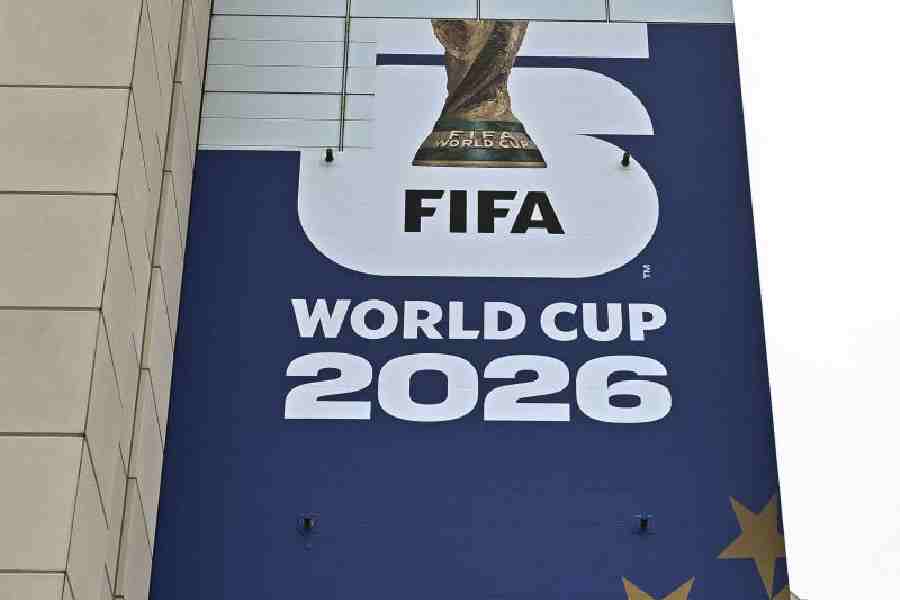
The underdogs have been speaking for quite a while. Now it’s time for them to set a new world order, breaking the ceiling, ending years of Cup hegemony enjoyed by the big guns of Europe and South America.
Cameroon in 1990, Senegal, Japan and South Korea in 2002, Ghana in 2010 and Morocco in 2022... Asian and African countries have been giving their European and South American counterparts a hard time for the last 36 years. But somehow the so-called underdogs have not been able to break the proverbial jinx.
“When you watch Rocky Balboa, you want to support him and we are the Rocky of this World Cup,” Morocco coach Walid Regragui had famously said during his team’s fairy-tale run in the Qatar World Cup.
Morocco were the first African team to reach the semis of a World Cup and caught the imagination of the fans worldwide. And in 2030, Morocco is one of the co-hosts along with Spain and Portugal.
“Unlike the Sub-Saharan African nations, where corrupt officials and administrators have ruined the game, Morocco have invested in youth and it’s paying off,” veteran Moroccan journalist Kunle Solaja had told The Telegraph in Doha.
Yes, most of the players in the Moroccan national team are based either in Spain or France, but it’s no secret that sustained support from the government has made a huge difference.
Then there is Japan. They spent two decades building one of the world’s most effective development structures. Players now move abroad at younger ages and arrive in Europe tactically prepared.
At the 2022 World Cup, Japan defeated both Germany and Spain, not through defensive resistance alone but through strategic adaptability. Japan’s development has been organic. Sample this. In the last four years, Japan have beaten Germany, England, Brazil and Ghana to name a few.
People say this is Japan’s football renaissance. But the Renaissance means a revival of something that once existed. What Japan have built is entirely new, and it did not come overnight. It happened over 30 years of deliberate, patient, structural work that most of the world completely ignored.
In 1992, Japan had no professional football league. Baseball was the national sport and football was an afterthought. The Japan Football Association looked at this and made a decision that would take decades to pay off. They decided to build from the ground up, not the top down.
The J.League officially kicked off on May 15, 1993, with just 10 clubs. It was modelled on Germany’s Bundesliga. Big names like Zico, Gary Lineker, Dunga played in the league. From the beginning, every club was required to be community-rooted rather than company-owned, a deliberate choice to make football a social institution rather than a corporate asset. Five years later, Japan qualified for their first World Cup, France ‘98.
“I saw a mid-table match of J.League and the pace, competitiveness blew away my mind. It’s out of the world,” former India captain and ex-Bengaluru FC head coach Rennedy Singh had said during an informal chat with this reporter three years back.
Japan’s stature in world football could be gauged from the fact that Rennedy was a big fan of Shunsuke Nakamura’s free-kicks. And that was a time when the world thought free-kicks were synonymous with David Beckham!
“The rise of Asian football and the recent success of African nations, including Morocco’s World Cup run, are not coincidences. They are the result of long-term investment in development and a clear strategic direction. Japan is one of the best examples of this,” says former India player Arata Izumi, who gave up his Japanese passport and gained Indian citizenship in 2012.
It’s true that the traditional powers still possess immense advantages. But dominance is no longer guaranteed. Europe remains the strongest football continent. But the gap is shrinking.
For much of football history, geography determined destiny. A talented child born in Buenos Aires, Rio de Janeiro, Madrid or Amsterdam had access to coaching structures, scouting networks and competitive ecosystems that were unavailable elsewhere.
Talent existed everywhere; opportunities did not. That imbalance is disappearing. The globalisation of football has flattened the landscape. For example, a teenager in Yaounde (capital of Cameroon) today may be tracked by scouts before his 16th birthday. A promising midfielder in Tokyo consumes the same tactical education videos as his counterpart in Barcelona. Elite coaching methodologies travel instantly. Data analytics ignore borders. Video analysis has become universal.
The knowledge monopoly once enjoyed by football’s traditional centres is on the wane. Global scouting has perhaps changed the game forever. For example, Shinta Nishiyama, a highly talented 11-year-old Japanese winger, is in Barcelona’s famed La Masia. Before that, La Liga club Real Sociedad winger Takefusa Kubo was in Barcelona’s academy too. Egypt have included 18-year-old striker Hamza Abdel Karim, who is on loan from Egyptian giants Al Ahly to Barcelona Atletic, the reserve side of the La Liga champions.
“But then the increase in information itself is no longer a competitive advantage. Because everyone has access, the difference lies in what you choose, how you understand it, and how effectively you apply it,” Arata argues.
Smaller nations are also making the most of dual nationality. They are tapping the diaspora and it’s giving them results. Most of Morocco’s players developed in European academies — Achraf Hakimi in Spain, Hakim Ziyech in the Netherlands, Sofyan Amrabat in the Netherlands, Bono in Spain.
Smaller nations benefit even more because the talent pool expansion is huge relative to the population size. Cape Verde, with a population of roughly 600,000, qualified for the World Cup with a squad largely drawn from diaspora communities in Portugal, France and the Netherlands. Ditto with Curacao, who used Dutch-developed players eligible through Caribbean family roots.
Arata lobs a different view. “In football, shortcuts do not guarantee success. To truly raise the level, it comes down to consistently developing your own players, educating your own coaches, and building your own football ecosystem. It is about how long and how consistently you can sustain this process,” he says.
“And if you ask me whether a non-European or non-South American nation can win the World Cup, I believe it is absolutely possible. But it will not be achieved by a single talented generation,” he makes his point.
And experience too. Japan were left heartbroken by a swift counter-attack by Belgium in 2018 in the second half injury time, and four years later could not hold their nerves in the shoot-out against Croatia.