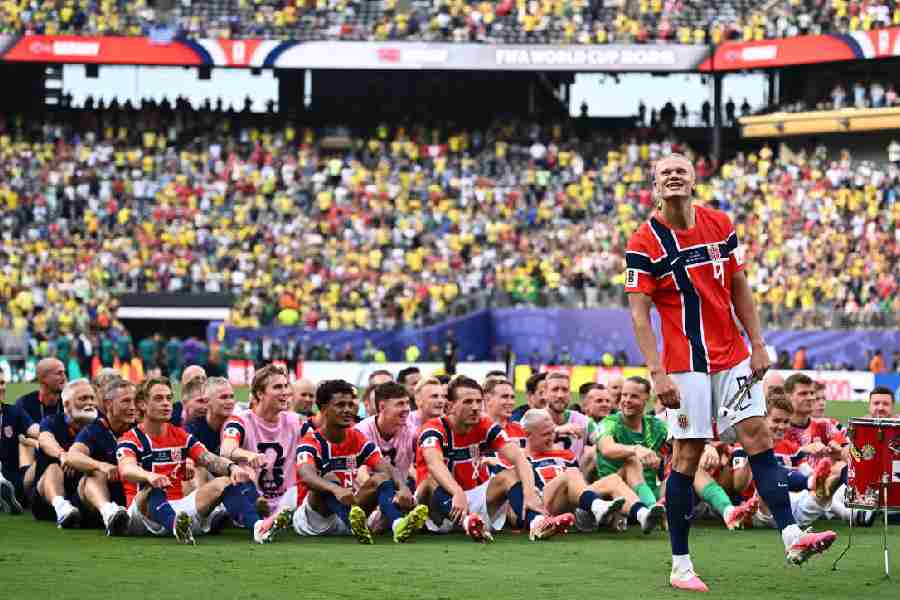
When referee Ismail Elfath blew the final whistle, the Brazilian players refused to leave the ground as if their World Cup was not over yet. Carlo Ancelotti's team was left stunned in wistful disbelief by the turn of events and Erling Haaland’s two goals seemed unreal to them.
Even the best from the incredibly talented and skilful Vinícius Júnior couldn't save Brazil. They watched in disbelief as the Norwegians performed the celebratory Viking row with their fans.
However hard the Brazilians try to ignore reality, a sixth World Cup title seems a long way off. Their performance told a familiar tale this time. It has been that way since 2006.
Brazil, the flag bearers of joga bonito, the exponent of flair and skill, have been faltering in the World Cup consistently.
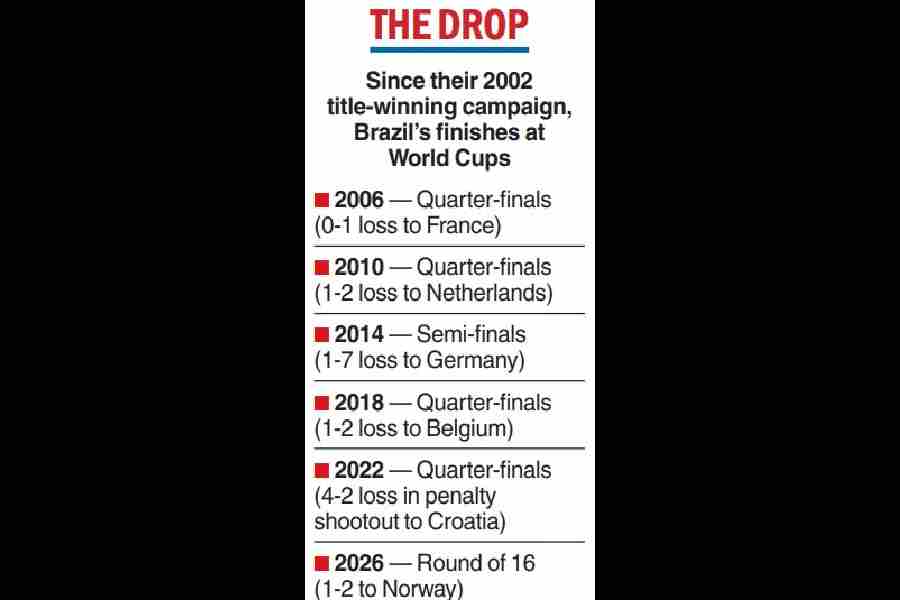
For the first time since Argentina forward Claudio Caniggia’s goal in 1990, Brazil failed to clear the last-16 hurdle. If it was Diego Maradona’s right-footed pass that found Caniggia 36 years ago, on Sunday against Norway, Erling Haaland’s marksmanship and a brilliant performance by goalkeeper Orjan Nyland showed Brazil the door.
The 2-1 defeat would be seen as a shock to many Brazil fans, but it's been long coming. Almost like it did in 2006, 2010, 2014, 2018 and 2022.
The reason is simple. Brazil have stopped producing world-class players like they used to in droves in the past.
Now a Vinicius or a Raphinha — he was not used after being injured during the second group-stage match against Haiti — may have dazzled for Real Madrid and Barcelona, respectively, but these two wingers do not have the wherewithal to carry a team on their own.
Bruno Guimarães' missed penalty, which was superbly anticipated by Norway goalkeeper Ørjan Nyland, piled the pressure on them. Bruno became the first Brazilian to miss an in-game penalty in a World Cup match (excluding shootouts) since Zico against France on June 21, 1986.
Brazil controlled the ball for spells against Norway but were invariably caught in no man’s land once in the opponent’s territory. It was as if the burden of expectations was weighing them down.
Norway, who are on the ascent in world football with players like Martin Odegaard and Haaland in their ranks, remained resolute and knew that their chance would come.
Two goals in 11 minutes (79th and 90th) by Haaland sealed Brazil's fate. Neymar slotted home a penalty deep into added time, but it was ultimately merely a consolation.
Brazil had brought in Italian Ancelotti hoping he will be able to revitalise the team. They were then in the middle of a horribly gone wrong qualifying campaign.
Ancelotti did manage to arrest the slide to some extent and took Brazil to the finals, albeit with a fifth-place finish. That was their worst-ever qualifying campaign.
The 67-year-old manager, who has a contract till 2030, refused to throw in the towel. “We must continue to work and improve, and find new ideas. I believe that this loss is not the end, but the beginning of a new cycle,” he said.
To begin the cycle, he now has to find the right players. Brazil’s cupboard is empty. Whether it’s coaching philosophy or players’ talent, Brazil are lagging behind Argentina and European teams.
Ancelotti’s decision to include Neymar is also not beyond question. Neymar wasn't free of fitness issues. He left the scene crying inconsolably and then announced his international retirement. Like Brazil, Neymar’s tearful exit also has become a familiar sight.
In four years' time another World Cup will come. Brazil’s fans will hope this time their team will not raise hopes of a false dawn. But unless Brazilian football undergoes a major transformation, chances of another failed campaign seem very much on the radar.