Chief Justice of India Surya Kant, during the recent hearing of a case from Tamil Nadu, asked why should people work if they are provided everything for free.
The bench questioned state governments’ tendency to dole out across-the-board “freebies” such as free electricity, particularly before elections, without distinguishing between the well-off and the poor.
“Why the people should work then? From where they are going to learn the work when they know everything I will get from one platform? Is it the nation-building we are doing?” the CJI reportedly asked during the hearing of a petition filed by the Tamil Nadu Power Distribution Company Ltd. .
The bench also orally observed: “Some people cannot afford education or basic life. Yes, it is the state’s duty to provide.”
The learned justices may or may not be aware, but the Bengal government of chief minister Mamata Banerjee provides for citizens going beyond its call of duty.
Dole, according to the dictionary, is the benefit paid by the state to the unemployed. Mamata Banerjee in her 15 years as Bengal chief minister has included doles to students and adults alike, in many of such schemes funds are directly transferred.
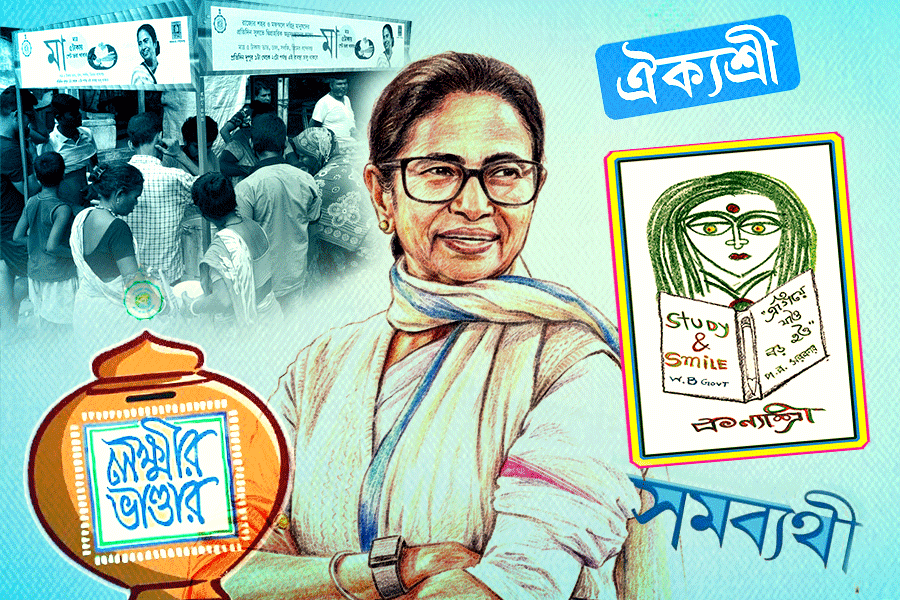
The Bengal government’s doles and schemes virtually cover a person’s lifetime from birth (covered under flagship Swasthya Sathi) to death (cremation and burial expense assistance under Samabyathi scheme.)
Here is a list of some of the schemes launched by the Mamata Banerjee government in the 15 years that she has been the chief minister. (To be fair, many other states are following her example, and economists are also talking about universal basic income).
Of course, there are eligibility criteria for the Bengal government’s schemes and doles. Still, there is room for everyone.
At birth
The Bengal forest department offers a sapling to every child born in the state, via Sabujshree, launched in 2016. Sorry, no direct benefit transfer here although the delivery is covered under the Swasthya Sathi scheme.
Every child is also covered under the Shishu Sathi Prakalpa that provides free surgery for children up to 18 years with congenital cardiac diseases, cleft lip and palate.
For students
Uniforms, books and school bags are provided by the state-run schools. The state also sponsors bicycles for students from classes IX to XII under Sabuj Sathi.
Girl students from classes VIII-XII receive an annual scholarship of Rs. 500 under the Kanyashree scheme. At the age of 18, the girl students if they continue to pursue higher education, they are given Rs 25,000 cash.
The male students have not been left out. Under Taruner Swapno, Rs 10,000 is provided to students of classes XI and XII for buying tablets, smartphones or personal computers.
Students from the minority communities can avail scholarships ranging from Rs. 11,000 to Rs. 33,000 from the junior classes till postgraduation under Aikyashree.
Sikshasree looks after students from the Scheduled Castes and Scheduled Tribes offering annual grants of Rs 750 (for classes V-VII) and Rs 800 (class VIII) each, and Rs 800 for the students from the SC category. Students from the ST category in classes V-VIII are provided Rs. 800 annually.
Students from the backward communities in classes V-VII get an annual grant of Rs. 750 and Rs. 800 in class VIII. Students from scheduled tribe families in classes V-VIII are paid Rs. 800 annually under the Sikshasree scheme.
Soft loans up to Rs 10 lakh are offered to students in colleges and universities via the West Bengal Student Credit Card Scheme.
Marriage
If a girl or her family still insists on getting her married, the state provides Rs 25,000 as a one-time financial grant, under Rupashree.
Meals
For the new householders, vegetables at a subsidised rate are provided for free. Maa Canteen, run by women self-help groups, provides a meal of rice, dal and egg curry at a nominal rate. The couples can also fulfil the dream of having their own house under the Nijashree scheme which gives affordable housing to those from the low and medium income groups through a lottery system.
For women
For women between the ages of 25 and 60, there is Mamata Banerjee’s flagship programme, Lakshmir Bhandar, which provides a monthly financial assistance of Rs 1,500 for women in the general and OBC categories, and Rs 1,700 for those from SC/ST households.
Jobs and career
Ahead of the 2026 Assembly polls, the Bengal government announced Rs. 1,500 monthly assistance for the unemployed between the ages of 18 and 40, till they find a job.
Young entrepreneurs looking for setting up projects in manufacturing, service and trade have the Bhabishyat credit card scheme for loans up to Rs 5 lakh.
Gatidhara under the state’s transport department offers financial assistance for those keen on setting up their own transport business.
Farmers have been covered under ‘Amar Dhan Amar Chatal’, ‘Amar Fasal, Amar Gola’, ‘Amar Fasal, Amar Gari.’
Health care
Irrespective of the size of the family, the Mamata Banerjee government provides a basic health cover for secondary and tertiary up to Rs 1.5 lakh per annum.
The insurance cover for cancer, neuro surgeries, cardiothoracic surgeries, liver diseases, blood disorders is Rs 5 lakh. The expense of the insurance premium is borne by the state government.
Other than the insurance there are free ambulance services as well in the urban and rural areas.
Religion
Ahead of last year’s Durga Puja, Mamata Banerjee announced Rs 1.10 lakh cash for the organisers, and free fire licence.
The registered imams and muezzins receive a monthly payment of Rs. 3,000 and Rs. 2,500 respectively, while purohits get Rs 1,500 every month.
Death
The Bengal government provides Rs. 2,000 for cremation and burial expenses, called Samabyathi.
Note: Every effort has been made to keep this list exhaustive, but because of the expansive nature of the Bengal government’s welfare measures, a few may have been missed.