Cricket's relentless shift towards power-hitting has sparked a quiet revolution far from the spotlight inside bat manufacturing units, where traditional willow craftsmanship is giving way to scientific precision as makers race to meet the demands of modern-day batters.
Driven by the high-stakes world of franchise cricket, where marginal gains can decide fortunes, manufacturers are now fine-tuning bats through moisture control, fibre analysis and personalised design to suit each player's strength, strokeplay and match situation.
The pressure to perform in an era of franchise valuations running into hundreds of crores of rupees, where every boundary can tilt match outcomes and justify massive team-building investments, has created an unprecedented demand for hyper-customised bats.
For now, manufacturers are already leaning heavily on scientific data, analyst feedback and player-specific profiling to design bats that can maximise performance. And the day is not far when the inevitable Artificial Intelligence will help engineers make the bats, they say.
From powerplay specialists to death-over finishers, many top batters now travel with eight to 10 bats, each calibrated for a particular purpose.
"Cricketers use different types of bats at different stages of the game, depending on the situation. On an average, they carry eight to 10 bats. They know each of their bats well and number them," Paras Anand, CEO of Sanspareils Greenlands (SG), one of India's leading bat manufacturers, told PTI in an interview.
The phenomenon underlines how cricket has evolved from the days when players often nurtured one trusted bat through entire seasons. Today's generation wants instant performance.
"Earlier batsmen used to prepare the bats by first playing in the nets and knocking them in. But today's generation wants a ready-to-use bat. Otherwise they say the bat is not good. Players say, ‘I have a match in the evening, send me the bat before that'," Anand explained.
That demand has transformed bat manufacturing into an exact science.
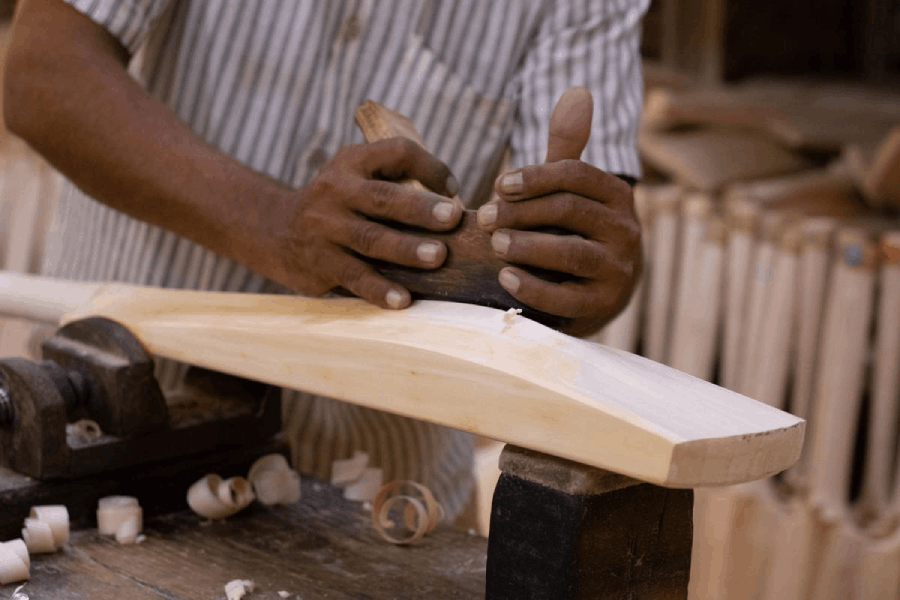
At SG's facilities in Meerut, imported English willow clefts undergo a carefully controlled air-drying process after reaching India.
"When the imported cleft reaches India, we do air drying. If you keep the wood in this hot and dry weather, it loses a little moisture, which helps reduce weight," Anand said.
The manipulation of moisture content has become central to modern bat-making. The challenge for the bat makers is quite daunting as players want bigger profiles, thicker edges and a larger sweet spot, but without additional weight "Now we are actively playing around with the moisture content to get the big profile. The batter wants the big mass in the bat, but he still wants the bat to be light," Anand said.
That marks a sharp departure from earlier eras.
"It is possible that there was more moisture in the bats Sunil Gavaskar used in the 1980s. Those bats were thinner and heavier," Anand said.
Gavaskar, the batting legend of the '70s and '80s, himself told PTI that he used bats weighing between 2.4 lb (1.08 kg) and 2.9 lb (1.32 kg).
The current generation of batters plays with bats ranging from 1.15 kg to 1.35 kg depending upon the format and nature of tracks.
"The weight of the bat is an individual preference. It depends on the comfort level," former India player and coach W V Raman pointed out.
Under current ICC regulations, a bat cannot exceed 38 inches in length, 4.25 inches in width, 2.6 inches in depth, and 1.56 inch in edge thickness, with the handle restricted to 52 per cent of overall bat length.
Additionally, every bat used at the professional level must be able to pass through a standardised bat gauge used by umpires. The laws leave no official weight cap, giving manufacturers room to innovate within dimensional limits.
With the advent of the slam bang T20 format, what has changed most dramatically is the degree of personalisation. Customisation now factors in a player's physical conditioning, hand size, stroke range, swing path and even psychological comfort.
"Depending upon the strength of a cricketer, his requirement may be different. If he is muscular, he may want a balanced bat. If he is not very strong, he may want a bat that feels lighter in the hand," Anand said.
Power hitters often prefer more weight concentrated lower down the blade for elevation.
"Batsmen want more curve in their bats to get the elevation. Power hitters prefer more weight at the bottom because they know they will get that lift, almost like a golfing concept," he added.
Then comes handle customisation -- an often overlooked but critical variable.
"Sachin Tendulkar always wanted a stiff handle. If there was flex in his handle it would impact him purely in his psyche. Sourav Ganguly wanted a lot of flex. If a player is not comfortable with the dimensions, it will impact his swing and follow-through," Anand revealed.
The customisation process itself is continuous, often mediated through player managers .
"It is the player's manager who interacts with us. We also have a fair idea of each player's requirements. It is a continuous process where you keep discussing and evolving," he said.
And increasingly, that process is shaped by technology.
"With analysts, cameras and computer experts constantly recording where a batter scores, where he struggles and what his strengths are, that data naturally feeds into bat design...a lot of science has come into bat-making and it is evolving. We are studying fibre flexibility, wood density and properties that were never considered 50 years ago," he added.
India, according to Anand, now accounts for nearly 70 per cent of global English willow consumption, underlining the country's dominance in the bat manufacturing ecosystem.
Trade estimates suggest India imports several hundred tonnes of English willow clefts annually from the UK, with demand continuing to rise as T20 leagues expand globally.
Industry reports also indicate increasing pressure on premium willow supply as manufacturers seek larger-profile clefts. A willow tree generally takes 15 years to mature and about 40 bats can be produced from a single tree.
Yet, former India off-spinner Harbhajan Singh believes the obsession with ever-changing willows should not obscure cricket's fundamental truth.
"The skill of the batter matters most. Virat Kohli scored his century with one bat that he used through and through," Harbhajan told PTI, referring to the veteran batsman's 105 off 60 balls in the IPL match between Royal Challengers Bengaluru and Kolkata Knight Riders in Raipur on May 13.
He fondly recalled scoring his two Test hundreds with bats gifted by Sachin Tendulkar.
"Paaji (Tendulkar) had gifted me five or six bats and I played with them till the end of my career. During our playing days, the man who changed maximum bats in a match situation was Dada (Sourav Ganguly)," he said.
Still, even Harbhajan acknowledged the role of "lucky bats" and evolving preferences.
As cricket's data revolution deepens, the next logical leap appears inevitable. The bat-maker of tomorrow may no longer rely solely on a craftsman's experienced hands. AI and other technology capable of decoding every nuance of a batter's game will also play key roles.
For manufacturers already studying fibre flexibility, wood density and player-specific performance metrics, the next logical progression could well be artificial intelligence.
"As far as AI is concerned, I think that will be the next step. We have engineers in our team who are AI-trained, so it will happen. It is not happening at the moment but it is part of our long-term plan. At the moment we are understanding what we are doing and then we will use artificial intelligence also," Anand said.
For a sport where milliseconds and millimetres increasingly separate success from failure, an AI-designed willow may soon become cricket's newest competitive edge.
"While technology will play a big role in customisation of bats, the player himself has to have absolute clarity of what he needs. But if a player is confused in his head, nobody can help him with the bat," Anand added with a laugh.
Except for the headline, this story has not been edited by The Telegraph Online staff and has been published from a syndicated feed.