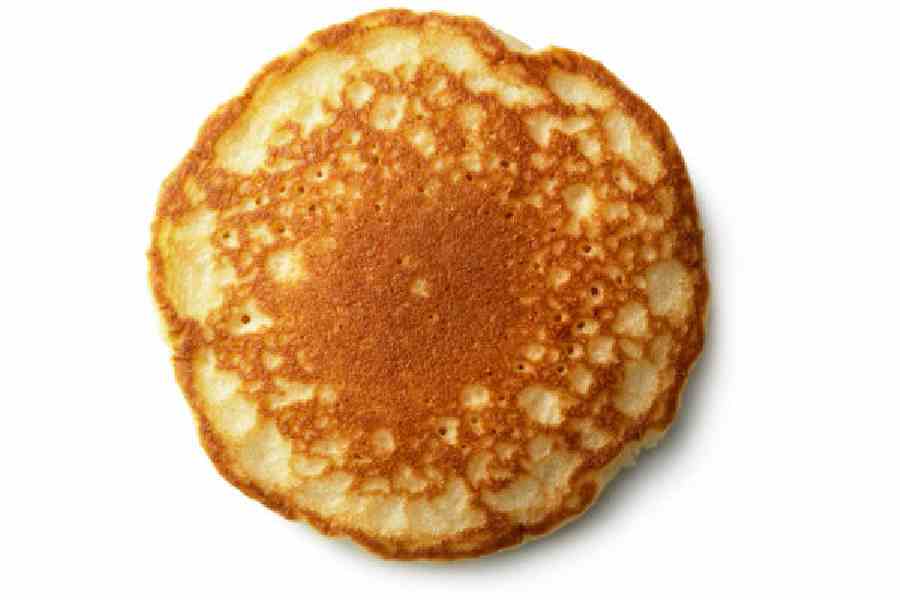
Cutting a Pancake with an Exotic Knife might seem an unusual title for a piece of academic research. But that was the focus of the paper posted online recently by two mathematicians.
The investigation’s challenge — cut a pancake into as many pieces as possible. Simple enough. But there were a few caveats — the pancake was infinite, spreading endlessly in every direction. And the simplest case involved an infinite, straight knife.
The mathematicians, the founder of the On-Line Encyclopedia of Integer Sequences Neil J.A. Sloane and the aptly named David O.H. Cutler, an undergraduate at Tufts University, US, engaged in a lot of trial and error to negotiate the tricky task of optimally placing not just a straight knife but also a series of weirdly shaped knives on the pancake.
The pancake problem was famously discussed a few decades ago in a classic book Concrete Mathematics: A Foundation for Computer Science based on a Stanford University course of the same name. The notion of “concrete mathematics” was meant as an antidote of sorts to new trends in “abstract mathematics” (aka new maths).
Sloane, who is a longtime visiting scholar at Rutgers University, US, debuted the pancake problem research at an online experimental mathematics seminar run by Doron Zeilberger, a mathematician at the university.
The general philosophy is when you make a cut, you try to intersect all the previous lines, Sloane said during the seminar.
The knives deployed by Sloane and Cutler were bent — by the whims of their geometric curiosity — into unknifely shapes. And with these exotic knives, “any protruding arms or legs are made infinitely long”, Sloane said.
For instance, one of the many proposed cutting instruments was shaped like a lollipop with an infinite stem. Another was the capital letter A, with some rigid design requirements. It was a “constrained A” knife with the crossbar fixed horizontally such that when considered together with the A’s tip, it forms the base of an isosceles triangle. Cutting a pancake with one constrained A produces three pieces. Two constrained A knives in just the right configuration produce 13 regions.
The experimental aspect of this kind of research, Zeilberger said, involves no scientific laboratory per se. “The lab of mathematicians is a computer,” he said.
The computer is essential in figuring out how to manoeuvre the theoretical knives around the theoretical pancake in just the right way so as to find optimal configurations for the maximum number of pieces.
With the help of a few friends, Cutler put together a “quick, sloppy piece of software” that searches for such configurations. One key ingredient in the program was a formula for polyhedra derived by Leonhard Euler in about 1750.
The program also used an optimisation algorithm that generated a random initial arrangement of, then jiggled and wiggled the positions in small, random ways to find the maximum number of pieces.
Jean-Paul Allouche, a mathematician and an emeritus senior researcher at the National Centre for Scientific Research of the Sorbonne, France, digested the paper with “gourmandise”, as he described in an email to Sloane. “The subject itself is surprising,” Allouche said in an interview. Mathematicians sometimes pose questions that others would not ask, he said.
For Allouche, the visual aspect of the research brought to mind a dictum often quoted by mathematicians, which he paraphrased as “geometry is the art of true proofs starting from wrong pictures”. It is typically attributed to French mathematician Henri Poincaré, who wrote, “Geometry is the art of correct reasoning from incorrectly drawn figures.”
What lent certainty and rigour to the investigation, he said, was the fact that a multitude of resulting number sequences matched entries, originating from other contexts, that were already on record in the On-Line Encyclopedia of Integer Sequences. The paper cited the encyclopaedia 38 times.
Allouche said it was “almost magic” — a phenomenon that in a sense provided justification for the research. It reminded him of “when a new theory in physics both contains the previous theory and explains new experiments not covered by that previous theory,” he said. For example, relativity theory explains things that Newton’s laws could not explain, but it contains Newton’s laws.
“Finding the unexpected connections, that is the fun of maths,” Allouche said.
For the researchers, a notable surprise arrived when they tried an exotic knife in an elongated “A” shape — not the constrained version but rather an “A” that could have a crossbar skewed at any angle.
Three of these “long-legged” As generated 34 pancake pieces, the same number of regions generated by three Wus and three nunchucks. Wu is another knife that looks like a three-armed V. One Wu knife produced three pancake pieces; two Wu knives produced 14 pieces; and three Wu knives produced 34 regions. The mathematicians named still another knife shape “nunchuck” after a martial arts weapon.
All elicited the same integer sequence: 1, 3, 14, 34, 63, 101… “This triple coincidence was in fact not just a coincidence, it became a particularly nice theorem,” Sloane said.
The investigation continued with other “long-legged” letters, namely E, H, L, M, T, W and X, among other shapes.
Sloane called the alphabetical configurations “long-legged letters” because the pursuit brought to mind two lines from a poem by William Butler Yeats, which serve as an epigram at the beginning of the paper:
Like a long-legged fly upon the stream
His mind moves upon silence.
NYTNS