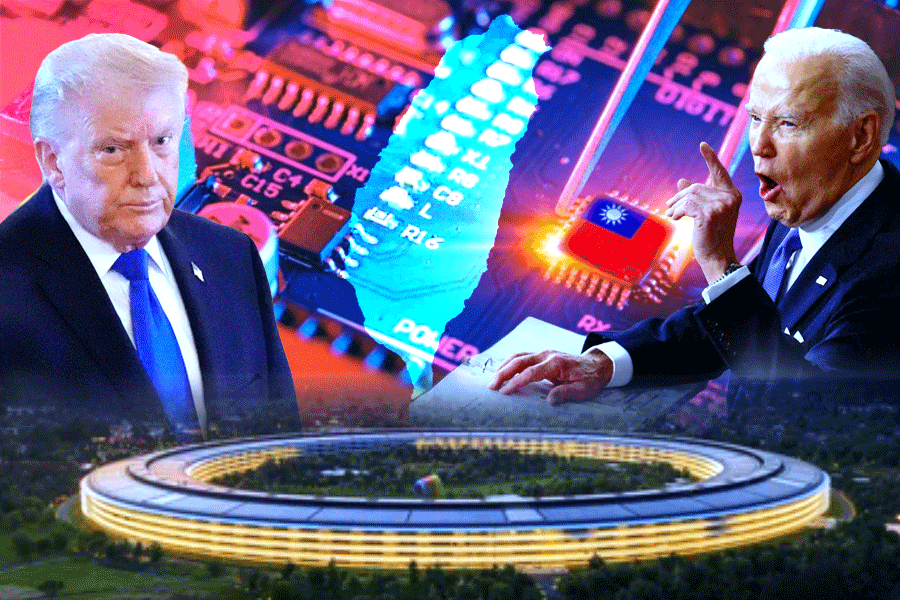
Federal officials have for years tried to wean Silicon Valley from its dependence on Taiwan, an island democracy roughly the size of Maryland that makes 90% of the world’s high-end computer chips.
In secret briefings held in Washington and Silicon Valley, national security officials warned executives from companies like Apple, Advanced Micro Devices and Qualcomm that China was making plans to retake Taiwan, which Beijing has long considered a breakaway territory. A Chinese blockade of Taiwan, the officials said, could choke the supply of computer chips made on the island and bring the U.S. tech industry to its knees.
Two presidents have tried persuading the industry to change. President Joe Biden offered financial grants worth billions to improve the domestic production of chips. After that didn’t work, President Donald Trump threatened billions in tariffs to essentially accomplish the same thing.
But warnings, gifts and threats have made little difference. The U.S. tech industry has stubbornly refused to shift where it gets most of its chips, which power things like smartphones, laptops and the giant data centers that run artificial intelligence.
Now, there is increasing concern that inaction by some of Silicon Valley’s most important companies risks destabilizing the global economy. Those worries, drawn into focus by recent live-fire drills conducted by the Chinese military in waters surrounding Taiwan, have prompted dire warnings from White House officials.
“The single biggest threat to the world economy, the single biggest point of single failure, is that 97% of the high-end chips are made in Taiwan,” Treasury Secretary Scott Bessent said last month at the World Economic Forum in Davos, Switzerland, slightly overstating industry estimates. “If that island were blockaded, that capacity were destroyed, it would be an economic apocalypse.”
If Taiwan is lost, the tech industry won’t be able to say it wasn’t warned. A New York Times investigation found that executives were so focused on winning in their hypercompetitive markets and maintaining big profit margins that facing up to the Taiwan problem was an afterthought. And now it will be years before the steps some companies are finally taking make a difference.
A confidential report commissioned in 2022 by the Semiconductor Industry Association for its members, which include the largest U.S. chip companies, said cutting the supply of chips from Taiwan would lead to the largest economic crisis since the Great Depression. U.S. economic output would plunge by 11%, twice as much as the 2008 recession. The collapse would be even more severe for China, which would experience a 16% decline.
Many of the biggest U.S. tech companies would have enough semiconductors to operate for several months before their businesses broke down, according to the report, which was reviewed by the Times and has not been previously reported.
The report, which was written at the encouragement of Biden administration officials, illustrated how Washington has been forced to reconsider its position on Taiwan. For decades, the U.S. commitment to the island was based on geopolitics, respect for democracy and containing China. It was viewed as a lopsided arrangement that was good for Taiwan and risky for the United States.
But now, more than ever, it’s become clear that Taiwan is critical to the United States’ economic survival, especially as artificial intelligence — which is built using chips made in Taiwan — drives the U.S. stock market and fuels economic growth.
The Trump administration has been cleareyed about the risk. While some of Trump’s tariffs have appeared to be driven by impulse or retribution, he has persistently used the threat of tariffs on semiconductors to bully tech companies to buy more of their chips from U.S. factories.
That arm-twisting recently led Nvidia, the world’s most valuable company, to commit to buying chips from new plants in Arizona being built by Taiwan Semiconductor Manufacturing Corp., a Taiwanese company that is the world’s dominant chip manufacturer.
It was a step toward solving an intractable problem: New plants won’t be built in the United States unless companies agree to buy the chips produced in them, which would be more expensive and cut into profits. It has been a Catch-22 that federal intervention has struggled to solve.
“Reshoring manufacturing that’s critical to our national and economic security is a top priority for President Trump, and the Trump administration is implementing a nuanced and multifaceted policy approach to deliver,” said Kush Desai, a White House spokesperson.
Other new commitments to U.S. chipmaking are trickling in. The United States is on track to spend $200 billion on semiconductor plants through 2030, enough to increase chip production capacity 50%, according to SEMI, a global chip industry association.
But with Taiwan, China and other countries also pouring billions into semiconductor plants, the United States would still account for only 10% of the world’s semiconductor production in 2030 — much as it did in 2020 when the government stepped up its calls for change.
“The whole industry has to say, ‘We’re all going to do this,’” said Bill Wiseman, global co-leader of the semiconductor practice at McKinsey, the consulting firm. Instead, he said executives think: “If we’re screwed, everyone else is screwed,’ so they don’t take action.”
The countdown begins
In March 2021, Adm. Philip S. Davidson, delivered a warning to the Senate Armed Services Committee about geopolitical conflict over Taiwan.
“The threat is manifest during this decade,” said Davidson, who was commander of the United States Indo-Pacific Command, which is responsible for the Asia-Pacific region. “In fact, in the next six years.”
It was the first time a senior U.S. military official had told Congress that the armed services believed President Xi Jinping of China wanted his army to be ready to take Taiwan by 2027, though many defense planners are skeptical such a move could happen that quickly.
Jake Sullivan, Biden’s national security adviser, ranked the U.S. reliance on Taiwan for semiconductors as one of the nation’s greatest vulnerabilities. He wanted the industry to recognize the risk and support construction of U.S. manufacturing plants. Biden also wanted to provide $50 billion in government subsidies to build semiconductor plants domestically.
“We were saying, ‘This is crazy. We have to do something about it,’” Sullivan said in an interview.
Change required uprooting a deeply entrenched business. Taiwan spent 50 years turning itself into the world’s semiconductor factory and becoming a leader in semiconductor research and development. It became a manufacturing hub for the chips in every iPhone and a third of the basic chips that power cars, tractors, cellphone towers and pacemakers.
There were clear business reasons for the industry’s hesitation to shift from Taiwan. Chips made in the United States were more than 25% more expensive, industry executives said, because of higher material, labor and permitting costs. TSMC was widely considered better at building cutting-edge chips than American companies like Intel. And U.S. businesses were more focused on quarterly profits than geopolitical threats.
In the fall of 2021, the White House summoned top semiconductor executives to Washington for a classified briefing on Taiwan, said seven people familiar with the gathering.
Pat Gelsinger of Intel and other CEOs filed into a White House briefing room and listened as officials warned that a blockade or invasion could halt chip manufacturing.
The executives were skeptical. Media outlets had previously reported much of the information the government shared. They also questioned why Xi would take Taiwan, since it would damage China’s economy.
By February 2022, that argument had been undermined by Russia’s invasion of Ukraine. During a White House call with executives about new rules limiting chip sales to Russia, Sullivan said Russia’s action showed countries would seize territory even if it harmed their economy.
“If you had doubts about autocrats taking on water for adventures, you may want to reconsider,” he said. He encouraged the industry to study its Taiwan risk.
After the call, the Semiconductor Industry Association hired McKinsey to take a look. They started with a basic question: What would happen if companies couldn’t get chips from the island?
A summary of the resulting report opened with a map of Taiwan detailing how integral the island is to the global economy. Taiwan enabled roughly $10 trillion of the world’s gross domestic product. It made chips for iPhones and more than half of so-called memory chips for cars, and it led in assembling AI chips.
The island’s semiconductor manufacturing is mainly in Hsinchu, an area where Taiwan’s government discouraged manufacturing after World War II because it is next to the sloping beaches that are the best place for an amphibious assault against the island.
If Taiwan’s factories were knocked offline, the impact would be immediate, the roughly 20-page report said. Economies would flounder. In China, the gross national product would fall by $2.8 trillion; in the United States, the drop would be $2.5 trillion.
Other reports, including one by Bloomberg Economics, a research service, estimate a conflict would cost the global economy more than $10 trillion.
Build it and hope they will come
In August 2022, Commerce Secretary Gina Raimondo beamed on the White House South Lawn as Biden signed into law the CHIPS Act. It gave Raimondo $50 billion in subsidies for semiconductor investments and factories.
But Raimondo still needed to persuade chip manufacturers to build plants, and persuade tech companies to have their chips built in them.
The first part was easy. TSMC committed more than $50 billion to building a second and third plant in Arizona, two years after announcing its first facility during Trump’s first term. Intel promised to expand in Arizona and invest as much as $100 billion in an Ohio campus. Samsung pledged $45 billion for two factories in Taylor, Texas.
Raimondo said the plants would give the United States the capacity to produce a fifth of the world’s advanced semiconductors by 2030. But she needed tech companies to pay for U.S. chips.
TSMC had commitments from Apple, Nvidia and others to buy enough chips to justify building three factories in Arizona. But the company hadn’t secured enough orders to build its planned complex, which would include three additional plants, said three people familiar with the plans. Customers were reluctant buy chips that cost more than 25% more and were a generation behind those made in Taiwan, where the government has an unofficial rule requiring TSMC to put its most cutting-edge technology on the island first.
Intel and Samsung, despite their pledges to expand production, didn’t have any commitments. Their technology had fallen behind TSMC, and the industry doubted they could catch up.
Raimondo and her staff struggled to persuade companies to buy chips from Intel or Samsung. Without those plants, the U.S. share of global chip production would drop short of the administration’s goal of as much as 20% of global capacity by 2030.
Frustrated, Raimondo asked William J. Burns, the head of the CIA, and Avril Haines, the director of national intelligence, to give a classified briefing with the latest intelligence about China and Taiwan, said five people familiar with the briefing, which has not been reported.
In July 2023, three prominent CEOs, Tim Cook of Apple, Jensen Huang of Nvidia and Lisa Su of Advanced Micro Devices, entered a secure briefing room in Silicon Valley. Cristiano Amon, the CEO of Qualcomm, joined by video. They listened as Burns and Haines said China’s military spending could mean a move on Taiwan in 2027.
Afterward, Cook told officials that he slept “with one eye open.”
But the companies still didn’t place significant new orders for U.S. chips, six people close to the industry said. Their lack of interest meant Intel and Samsung couldn’t fulfill their CHIPS Act contracts, which required them to have customers. The government reduced Intel’s and Samsung’s grants by a combined $2.3 billion.
The setback came as Intel, the last U.S. manufacturer of leading-edge chips, grappled with falling sales and profits. In December 2024, Gelsinger, its CEO, was forced out.
Worried about Intel’s future, Raimondo sent Intel and TSMC a letter before she left office saying the U.S. government would support their working together, which might help Intel survive, said two people familiar with the letter.
Then she warned her successor, Howard Lutnick: Intel needed help.
Too reliant on Taiwan
In Washington’s Foxhall neighborhood along the Potomac River, Lutnick, a former Wall Street bond broker, welcomed Trump’s decision to name him commerce secretary in November 2024 by buying a $25 million French-style estate.
Two months later, he received Intel’s leadership team there. The group, which included Frank Yeary, the company chair, and David Zinsner, its finance chief, wanted help with their ailing business, said three people familiar with the meeting.
The tech industry’s reluctance to buy more U.S.-made chips was shaping up to be one of Lutnick’s biggest challenges. He would have to persuade chipmakers and customers to spend more.
The Intel team said it hoped to separate the company’s manufacturing operations from its business designing and selling chips. But Intel needed $50 billion to $70 billion and suggested the federal government provide about $25 billion, perhaps through a loan. The remainder would come from tech and finance companies.
Lutnick turned that idea into a bargaining chip with other companies.
Late that month, he met TSMC’s chief executive, C.C. Wei, in the office of his New York financial firm, Cantor Fitzgerald, said two people with knowledge of the meeting. Lutnick gave Wei a choice: TSMC could invest in Intel and operate Intel’s chip factories, or it could build more TSMC plants in the United States.
Getting TSMC to increase its U.S. production was essential. While Nvidia had become the world’s most valuable company because of its AI chips, it does not make those chips. That work is done by TSMC, mostly in its Taiwan plants.
Lutnick’s proposal occurred as Trump welcomed Huang of Nvidia to the White House for the first time. In an Oval Office meeting, the president told Huang he planned to put tariffs on semiconductors because making them in Taiwan was risky, two people familiar with the meeting said.
Trump told Huang that when he spoke with Xi about the island, China’s leader would breathe heavily, said one of these people who was briefed on the conversation. The president didn’t like it. He urged Huang to make chips in the U.S.
Wei and Huang, who are close, spoke with each other about their companies’ dilemmas, said two people familiar with their conversations. For Wei, Intel’s operations would be burdensome. For Huang, tariffs would hurt profits. They agreed the solution was for Nvidia to buy more chips made in Arizona, which would let TSMC build additional plants.
TSMC and Nvidia declined to comment.
Within a few weeks, Wei told Lutnick that TSMC would increase its U.S. investment by $100 billion and build four additional chip factories by 2028, two years ahead of its plans.
‘Horrible, horrible thing’
With TSMC’s commitment in hand, Trump turned up the pressure on the semiconductor industry.
He called the CHIPS Act “a horrible, horrible thing” in his State of the Union address last year and urged Congress to get rid of it. He wanted to replace subsidies with tariffs that could penalize the tech companies. It was a reversal of Biden’s approach, and the start of major market interventions.
In April, Trump announced tariffs for every country. The rate for Taiwan was 32%. The administration said it would exclude semiconductors, which would have tariff rates set separately.
Soon after, Taiwanese officials visited Washington to find out how to reduce their tariff rate, said a former U.S. official who later met with the group. Lutnick suggested that Taiwan encourage TSMC to further increase its U.S. investments or operate Intel’s plants.
The request showed Lutnick wasn’t satisfied with TSMC’s $100 billion commitment in Arizona. He intended to squeeze the company for additional concessions.
The Taiwanese group balked because TSMC is a private company. But when Lutnick persisted, Taiwanese officials met with TSMC executives and asked the company to help, two people familiar with the conversations said.
TSMC was open to investing more. But it wanted nothing to do with Intel.
By last summer, the Trump administration decided to directly intervene in the chip market.
Intel’s problems provided an opening. In July, it reported a $2.9 billion loss. Then, the U.S. government said the company’s new CEO, Lip-Bu Tan, had previously led a company that illegally sold chip technology to a Chinese university with military ties.
The following month, Trump demanded Tan’s resignation on social media, saying Tan was “highly CONFLICTED.” He then turned the attack into a negotiating tool.
Trump met with Tan days later and suggested that Intel give the United States 10% of Intel’s business. The CEO agreed to the unorthodox request, even though some argued it was on shaky legal ground. Intel gave the government equity in exchange for the $8.9 billion it had been promised from the CHIPS Act.
The deal helped Intel secure its federal subsidies, without having to meet financial benchmarks to qualify for the money.
Intel’s business predicament looked worse after Samsung signed a deal in July to manufacture chips in Taylor, Texas, for Tesla, the plant’s first customer. Elon Musk, Tesla’s CEO, had pursued the deal after leaving the Trump administration because he was concerned about a potential attack on Taiwan, said three people familiar with the deal.
“People maybe are underweighting some of the geopolitical risks that are going to be a major factor in a few years,” Musk later said in a call with Wall Street analysts.
After the Trump administration’s investment, Intel began making headway. Nvidia invested $5 billion in Intel and agreed to partner on AI chips. Apple began holding all-day engineering meetings with Intel to evaluate its manufacturing, said three people familiar with the discussions.
Sophie Metzger, an Intel spokesperson, said the company had been “encouraged by early feedback” from potential customers and shared the Trump administration’s goal to have “a leading American semiconductor manufacturer.”
Last summer, Cook visited the Oval Office and promised to invest another $100 billion in the United States, which would support TSMC and other chip manufacturers. Su of Advanced Micro Devices and Amon of Qualcomm also promised to manufacture more chips in the U.S.
Lutnick is eager for more deals. His goal is to have 40% of Taiwan’s semiconductor manufacturing in the United States.
In September, he arrived on the ninth floor of the Hay-Adams Hotel in Washington with a plan to persuade companies to give U.S. chip factories more business.
He told top chip executives, who had gathered for a Semiconductor Industry Association meeting, that the administration wanted them to buy 50% of their semiconductors from American plants, said four people who attended. Companies that didn’t would pay a 100% tariff.
Afterward, Lutnick used those same tariff threats to squeeze Taiwan and TSMC for more investments. He struck a deal to let Taiwanese chip companies avoid some U.S. tariffs, provided the companies planned to produce in the United States.
TSMC agreed to buy land in Phoenix for at least five more plants, roughly doubling its Arizona plants, as part of a commitment by Taiwanese semiconductor and tech companies to invest an additional $150 billion in the United States. And Taiwan committed to $250 billion in credit guarantees to help move semiconductor and technology manufacturing to the U.S.
“We are unquestionably in a better position now than we were a few years ago, but this was never going to be solved overnight given the time it takes to get new chip manufacturing facilities up and running,” said John Neuffer, CEO of the Semiconductor Industry Association
In October, Huang flew to Phoenix to visit TSMC’s factory, which had made Nvidia’s first AI chip in the United States. He called it a “historic moment” and a major step for U.S. manufacturing.
Huang didn’t mention that the chip wasn’t finished. To become a leading AI chip, it needed to be connected with other chips. The process, known as packaging, requires shipping the American-made chip to a factory in Taiwan.
The New York Times News Service