Home to around 1.5 billion people, India’s appeal to artificial intelligence investors and engineers is immense, something that is not lost on OpenAI CEO Sam Altman. He believes that the advancement of the technology may offer solutions to climate change, potentially develop treatments for many ailments, have a transformative effect on the educational needs of students around the world and, of course, solve repetitive tasks.
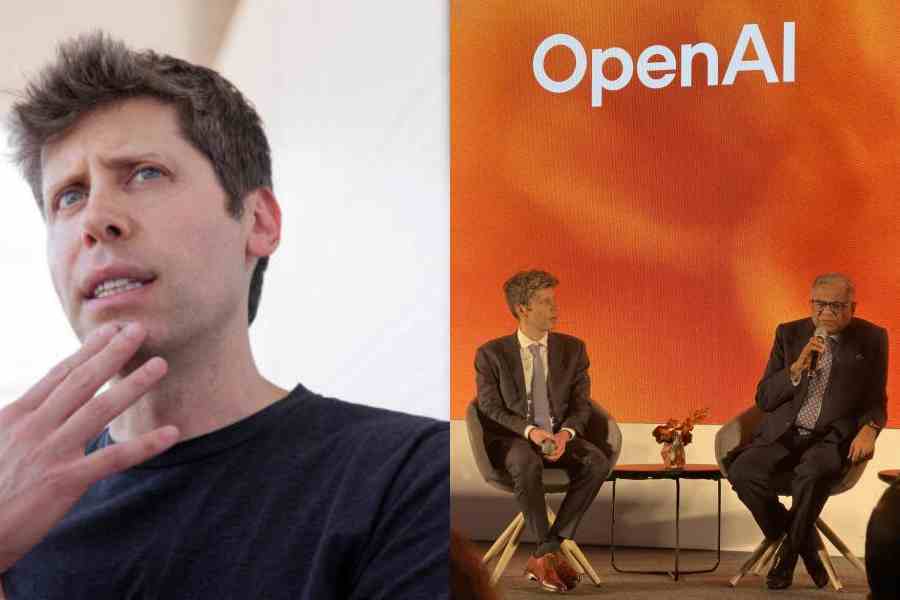
He has enormous resources at his disposal. “Parents ask us all the time what their children should study. I don’t know the specifics that will matter. But the traits that will matter are ambition, conviction, growing up in a world where they can engineer better things, rapid adaptability, and a focus on what’s working, what people want and care about… these are things that the Indian start-up community is focusing on; they can benefit greatly from the adoption that is happening around AI,” the 40-year-old said to a select audience at Travancore Palace, New Delhi, last week.
India already has over 100 million weekly ChatGPT users, cutting across fields, from students and teachers to developers and entrepreneurs. That scale alone underlines why the country has become central to OpenAI’s global ambitions.
There is also a broader cultural hesitancy about AI’s implications. In Silicon Valley, Altman is largely seen as a trustworthy figure when it comes to guiding the future of AI. He has quickly become a power broker of an AI-powered society. A large portion of the US economy now piggybacks on the success of his larger AI vision. OpenAI, Reuters reports, is targeting roughly $600 billion in total compute spend through 2030, as the ChatGPT maker lays the groundwork for an IPO that could value it at up to $1 trillion.
Corporate India is ready
Be it Natarajan Chandrasekaran, chairman of Tata Sons and Tata Group, or Deepinder Goyal, founder of Eternal, they believe that the adoption of AI is going to be fast.
“Anything to do with individuals, anything to do with societies, the adoption is going to be fast. So you have to move fast. Anything to do with enterprises, things have to be well thought out. You have to think of security, think of the whole ecosystem, the context of the company, customer sales service and the supply chain network… the whole thing. Take your time to prepare yourself and create a playbook. I generally don’t believe in a change of programme or any programme that makes half-hearted commitments. ‘Let me also do this because… just in case’. Well, a ‘just in case’ strategy is not going to work. So take your time and prepare,” said Chandrasekaran.
Altman’s advice to big companies or smaller start-ups dabbling in AI is simple. “Figuring out the right approach to security, privacy, safety and data access is important. I think it is critical. The companies that want to grow faster will figure out these things. If you are a big company with real customers and data, you must work out how comfortable you are with deploying agents within the company and having them share data appropriately,” he said.
The co-founder of OpenAI spent a considerable part of last week in India, meeting Prime Minister Narendra Modi, government officials, leaders of large companies and start-ups, and, of course, attending the AI Impact Summit. His company announced the launch of ‘OpenAI for India’ to attract partners in India, starting with Tata Group.
‘OpenAI for India’ aims to accelerate enterprise adoption, invest in workforce upskilling, and strengthen India’s thriving AI ecosystem. As part of its global Stargate initiative, OpenAI and Tata Group are partnering to develop local, AI-ready data centre capacity designed for data residency, security and long-term domestic capability. OpenAI will become the first customer of Tata Consultancy Services’ HyperVault data centre business, beginning with 100 megawatts of capacity and with potential to scale to one gigawatt over time.
This infrastructure will allow OpenAI’s most advanced models to run securely in India, delivering lower latency while meeting data residency, security and compliance requirements for mission-critical and government workloads, the company said.
During his tenure as Prime Minister, Narendra Modi has not hesitated to project the power of technology to transform the lives of the masses. His allies distinguish India’s AI potential from the American approach, which has primarily helped the private sector, and China’s, which strengthens state control. It gives OpenAI a
unique opportunity to invest further in India. The company has been expanding its presence through partnerships with JioHotstar, Eternal, Pine Labs, Cars24, HCLTech, PhonePe, CRED and MakeMyTrip.
At the same time, the company must keep in mind government rules to make AI content labelling mandatory and protect against deepfakes and other abuse.
There is also underlying anxiety about how India’s students will compete for good jobs in the AI age. The San Francisco-based company has announced collaborations with several Indian higher education institutions as part of an initiative offering structured use of AI across campuses. The first cohort includes the Indian Institute of Technology Delhi, Indian Institute of Management Ahmedabad, All India Institute of Medical Sciences New Delhi, Manipal Academy of Higher Education, University of Petroleum and Energy Studies and Pearl Academy. According to OpenAI, the initiative will support more than 100,000 students, faculty members and staff over the coming year.
“The rate of adoption is extremely fast. It’s very interesting coming here and seeing the energy of companies willing to go all in on AI. There are things that need to be worked out and safety issues need to be considered seriously. Mostly, we are going to make sure that we are creating value for companies and for people with the services we create,” said Altman.
The growing-up years
Though most of us have become familiar with Altman only in recent years, after the launch of ChatGPT, he has been at the forefront of Silicon Valley and the tech world for much longer. He has been a serial technology entrepreneur and, as president of Y Combinator, the Silicon Valley start-up accelerator and seed investor, from 2014 to 2019, he advised a slew of new companies, while personally investing in several that became household names, including Airbnb, Reddit and Stripe. His superpower lies in recognising when a technology is about to reach exponential growth.
When other children were busy playing, he was trying to understand the system behind area codes in nursery school, and learned to programme and disassemble a Macintosh at eight. The Mac became part of his world.
As a student at John Burroughs, he persuaded teachers to post “Safe Space” signs on their classroom doors as a statement in support of gay students like him. He came out during his senior year.
He attended Stanford University, where he spent two years studying computer science, until he and two classmates dropped out to work full-time on Loopt, a mobile app that told your friends where you were.
Making money has not been Altman’s biggest motivator. His longtime mentor, Paul Graham, founder of Y Combinator, explained Altman’s motivation to The New York Times a few years ago: “Why is he working on something that won’t make him richer? One answer is that lots of people do that once they have enough money, which Sam probably does. The other is that he likes power.”
After selling Loopt, he joined Y Combinator as a part-time partner and later became its president. He also began working on projects outside the investment firm, including OpenAI, which he founded as a non-profit in 2015 alongside a group that included Elon Musk, who left in 2018.
Altman’s charm and foresight helped bring in the capital that OpenAI needed. In 2018, while attending the Sun Valley Conference in Idaho, he met Microsoft CEO Satya Nadella in a stairwell and pitched him on a collaboration. Within a year, Microsoft had announced an investment of a billion dollars in OpenAI. The figure quickly grew. Nadella later played an important part in OpenAI’s journey, intervening to end the brief 2023 coup after which Altman was swiftly reinstated as CEO.
What next?
As investors warn that the AI industry is a bubble, with excessive investment in tech infrastructure without a clear picture of payoff, Altman has continued to emphasise that OpenAI remains on steady ground. His message aligns with a sentiment he has expressed for years — that technological progress is inevitable.
“We should understand that as a consequence of technology and an economy of ideas, the gap between the rich and the poor will likely increase from its already high-seeming levels,” he wrote in a blog in 2013.
“There is good and bad to this, but we should be careful not to legislate against it, which will hurt growth. Technology magnifies differences in innate ability; start-ups provide a framework to get compensated for it. But GDP growth ought to improve the quality of life for everyone, and no growth will reduce quality of life for everyone except the very rich. A safety net for legitimately poor people is a good thing, and probably becomes more necessary in a world with this sort of divergence. Quality of life should improve for everyone; the bigger issue will likely be that people are very sensitive to relative fairness.”
In a post on X/Twitter in November, Altman defended OpenAI against accusations that it was becoming “too big to fail”.
“In a world where AI can make important scientific breakthroughs but at the cost of tremendous amounts of computing power, we want to be ready to meet that moment. And we no longer think it’s in the distant future. Our mission requires us to do what we can not to wait many more years to apply AI to hard problems, like contributing to curing deadly diseases, and to bring the benefits of AGI to people as soon as possible. Also, we want a world of abundant and cheap AI. We expect massive demand for this technology, and for it to improve people’s lives in many ways,” he wrote.
And coming up? Last year, OpenAI paid $6.5 billion to buy IO, a one-year-old start-up created by Jony Ive, a former top Apple executive who designed the iPhone. The all-stock deal is intended to bring in “a new family of products” for the age of artificial general intelligence, or AGI.
During his visit to India, Altman said the company could be in a position to talk about the product by the end of this year. It is expected to change the arc of devices, which has remained relatively unchanged.
Altman takes competition seriously, as there are several players in the AI space, including Anthropic, founded by former OpenAI members and siblings Dario Amodei and Daniela Amodei, as well as Google’s Gemini. Last year, the Google chatbot was advancing quickly enough that Altman issued a company-wide “code red” to refocus on ChatGPT.
He believes that ChatGPT is “growing very strongly and I feel great about the current models”. He has particular faith in Codex, built by OpenAI to write computer code in much the same way that chatbots generate text in plain English. “The strength of Codex in the coding market has been fun to watch.”
The real challenge now is to make money. Altman and his lieutenants have had major success raising funds in recent years, but to pay for raw computing power it is never enough. His company has started showing adverts inside ChatGPT, though these do not disrupt the overall experience as they do on Google Search. The company plans to generate more revenue by selling technology to businesses. Of the more than 800 million people who use ChatGPT, around six per cent pay at least $20 a month for more advanced versions of the chatbot. That is a substantial sum, and adverts can generate additional revenue from the free version.
It is all dynamic, much like the future of OpenAI. “People love the fact that they can generate their own content. People love the fact that they can put themselves in a character. They want to place themselves in an image, a video… whatever. The future will be a bit more dynamic,” said Altman.
To better serve users and partners in India, OpenAI plans to open new offices in Mumbai and Bengaluru later this year, alongside its existing presence in New Delhi.