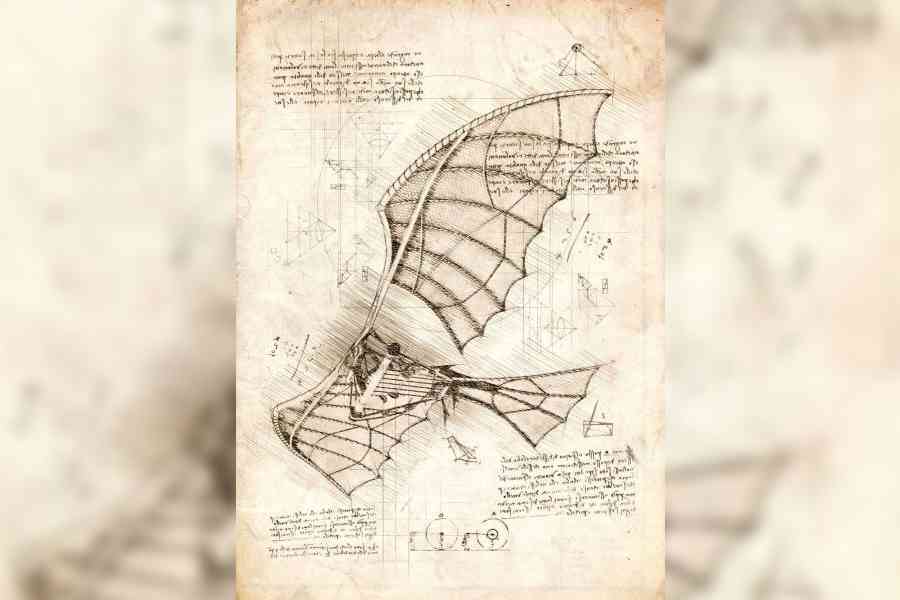
For centuries, engineers have turned to nature for inspiration. Today, the close study of animals and plants is leading to inventions such as soft batteries and water-walking robots.
Cassandra Donatelli, a biologist at the University of Washington, Tacoma, US, and an author of a recent review of the burgeoning field of “bioinspiration”, credits the trend to sophisticated new tools as well as a new spirit of collaboration.
“It’s huge,” she said. “We have a biomechanics lab here where we have six or seven engineers and 10 biologists. We’re all physically in the same building, together doing work.”
Despite its promise, the future of bioinspiration is cloudy. The Trump administration has proposed cutting the research budget of the National Science Foundation by 55 per cent, directing remaining funds to a few fields such as artificial intelligence and quantum computing. Bioinspiration, which has thrived on this funding, may lose out.
“That work will suffer with NSF’s new priorities,” said Duncan Irschick, a biologist at the University of Massachusetts, US. “I sincerely worry about handing the mantle of bioinspired research to China.”
Here are some inventions, both new and historical, that have drawn inspiration from nature’s creativity.
NATURE’S VELCRO
- Tiny hooks on the burrs of Burdock plants help the seeds spread on fur and clothing.
- This discovery led an engineer to invent Velcro.
In 1941, Swiss inventor George de Mestral went on a hunting trip. Along the way, burdock burrs stuck to his pants and to the fur of his dog. Curious about their power to cling, de Mestral put the burrs under a microscope. He saw thousands of tiny hooks. The sight led him to imagine a new kind of fastener, one that wouldn’t rely on knots or glue.
A few years later, de Mestral discovered a substance that could make that idea real: nylon. The synthetic fibre could be permanently bent into a hook. De Mestral found that nylon hooks readily attached to fabric and could be peeled away. In 1955, he filed a patent for his invention, which he called Velcro, a combination of the French words velour (velvet) and crochet (hooks).
WHALE FLOW
- Knobs on the edges of whaleflippers help the animals swim in tight circles.
- Whale-inspired knobs improve the design of ship hulls and wind turbine blades.
In the 1990s, Frank Fish took a close look at the massive knobs that stud the leading edge of humpback whale fins. Fish, a biologist at West Chester University in Pennsylvania, US, and his colleagues discovered that these tubercles significantly improve the whales’ performance by keeping water flowing smoothly over their fins, generating extra lift.
Fish and his colleagues patented their discovery, which has since been adopted by engineers to improve a long list of devices. Tubercles extend the lifespan of wind turbine blades, for example, and make industrial ceiling fans more efficient. They can even be found on surfboard fins and truck mirrors.
GECKO ADHESIVES
- Geckos can scramble up smooth surfaces, thanks to their amazingly sticky toes.
- This inspired the creation of adhesives that bind tightly and then peel away without causing damage.
A gecko’s foot is covered by a half-million tiny hairs, each of which splits into hundreds of branches. When a gecko slaps its foot on a wall, many of the branches push tightly against the surface. Each branch creates a weak molecular attraction to the wall, and together they generate a powerful force, yet the gecko can easily pull its foot away in a millisecond.
Irschick and his colleagues created a fabric that mimics these forces, which they called Geckskin. A piece the size of an index card can hold 317.5 kilos to a glass surface and be moved without leaving a trace behind.
GREEN REPELLENT
- Pitcher plants have slippery rims that capture insects.
- The same physics led to metals and plastics that resist dust and other contaminants.
Pitcher plants are carnivorous, feeding on insects that crawl onto the rim of their pitcher-shaped leaves. The rim is exquisitely slippery, causing prey to lose their footing and fall into a pool of digestive enzymes.
Researchers discovered that when rain and dew collect on the plant, microscopic bumps and ridges pull the water into a film that sticks to the legs of insects. The bugs struggle for traction and end up swimming — and falling.
In 2011, Joanna Aizenberg, an engineer at Harvard University, US, and her colleagues created materials with pitcher-plant patterns on their surface, and these turned out to be slippery as well. A company co-founded by Aizenberg sells coatings that keep sticky fluids from clogging pipes and paints that repel barnacles from ship hulls.
RIPPLE BUG BOTS
- Ripple bugs zip around on the surface of streams, thanks to fanlike hairs on their feet.
- Following a similar principle, engineers have designed a robot that walks on water.
Ripple bugs are about the size of a grain of rice. They float on the surface of streams by spreading out their legs across the water — but they can also move with astonishing speed, roughly 120 body lengths each second. At a human scale, that would translate to 644 kmph.
The secret lies at the end of the middle pair of legs. When a ripple bug dips them into the water, surface tension causes stiff fronds at the ends to fan out in just 10 milliseconds, and the fans become oars. At the end of each stroke, when the insect lifts these oars from the water, the fans snap shut.
In August, Victor Ortega-Jiménez, a biologist at the University of California, Berkeley, US, and his team announced that, following these principles, it had built tiny robots that walk on water, make rapid turns and brake sharply. And because the water forces the fans open and closed, the Rhagabots — after Rhagovelia, the Latin name for ripple bugs — require little energy from their onboard batteries.
NYTNS