About 15 years ago, George Olah, a conservation ecologist at the Australian National University, was conducting research in the Amazon, dangling from the rainforest canopy and collecting blood and feather samples from macaws for his doctoral thesis. Between field seasons, he often explored the archaeological sites along the coast of northern Peru, which was unforested and had a dry climate.
One day, at a field museum hundreds of miles from his study site, he spotted macaw feathers tucked inside a reconstruction of an ancient tomb. He was perplexed. “It’s all desert. It’s the other side of the Andes. There’s no rainforest,” he said. How did the feathers get there?
The question led to a years-long side project. In a study published a fortnight ago in the journal Nature Communications, Olah and his colleagues concluded that live parrots were traded far and wide across the Andes for their plumage. The feathers that Olah saw, which were originally recovered from a tomb dating back 600 to 1,000 years, point to a complex trade network that predates the Inca Empire.
For the ancient cultures of coastal Peru, parrot feathers held a high value. Their colours, ranging from bright red to deep blue, represented elite status and power. In recent decades, many feathered artefacts have emerged from ancient tombs, raising questions about which species they came from and whether the birds were brought to the coast alive.
Feathers would have required little maintenance if they had merely been plucked and traded as goods. But live birds captured in the rainforest would have required food, water and protection during the journey — and such trade would probably have relied on a vast network of operation.
To retrace the journey, Olah and his colleagues studied at least three funerary bundles from an ancient tomb that belonged to the Yschma culture, a society that inhabited the central coast of Peru between 1000 and 1470 CE, before the Inca arose.
The scientists began by extracting ancient DNA from 25 feathers to identify the bird species. Then they compared the results against modern feather samples, including some that Olah collected during his doctoral fieldwork in the Amazonian rainforest.
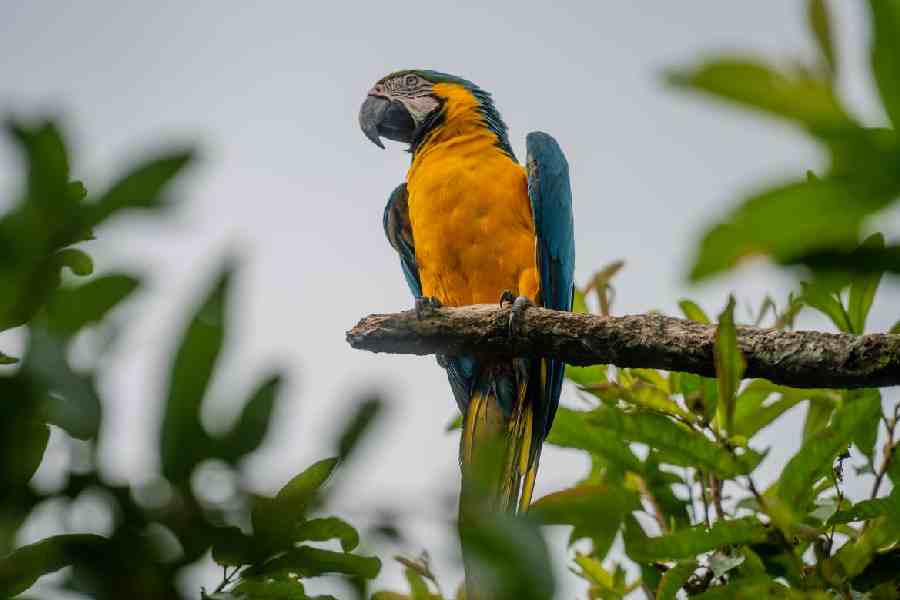
They identified four distinct parrot species native to the Amazon — the scarlet macaw, the red-and-green macaw, the blue-and-yellow macaw and the mealy Amazon. These species were genetically diverse, suggesting that the birds were captured in the wild and not bred in captivity, which would have led to inbreeding.
The diets of modern macaws are rich in rainforest plants. But chemical analyses of the ancient feathers found a diet rich in plants that thrive in hot and sunny environments, possibly corn or maize.
Macaws regrow their feathers through a natural moulting process that can take up to a year. The study’s results suggest that the ancient birds, captured and transported across the Andes to the coast, were most likely kept in captivity long enough to grow new feathers while eating a completely different diet. These feathers were an integral part of sacred ritual practices and were treasured artefacts. A live bird that could produce them year after year would have been immensely valuable, said José Capriles, an anthropologist at the Pennsylvania State University, US, who was not involved with the research.
After conducting the DNA and chemical analysis, scientists used landscape modelling to understand how the birds were transported. They studied the region’s topography, river systems, known archaeological centres and trade hubs contemporary to the Yschma, then calculated which routes might have been less costly for transporting birds from the Amazonian lowlands to the coast. Two main routes stood out; both aligned with well-travelled trade paths for which scientists have archaeological evidence. One was through the north; the second took a more direct, central path. The Yschma culture must have depended on intermediaries to source and trade the parrots.
Olah saw the research as an extension of his parallel work on the modern, illegal and highly lucrative wildlife trade.
NYTNS