
Someone recently asked me how I saw books being read in the next twenty years. Would there be any paper left? Would it all be digital? Would kids born today, when they start reading seriously, thank their stars they had escaped the archaic luggage of paper-books? The discussion went on for a bit, circular, bumpy, with all of us present agreeing that for us, books printed on paper would remain the benchmark, the asal, the genuine book, while all this other stuff would be newfangled, not fully satisfying. In this, I suppose, I give away the age of the people involved in the discussion, which - you've already guessed it - averaged around forty-five.
How people will access books in the near future, whether the printed book will make a comeback, whether everybody will read on their mobile phones, with even computers and tablets considered too cumbersome, is, of course, a common topic nowadays. To my mind, it goes hand in hand with thinking about how people access films, both fiction and non-fiction, both short and long. There was a time when, for serious cinephiles, the movie theatre was no less sacred than a temple, with strict rules that would give competition to any place of worship. You went silent when the hall darkened, you watched while also listening intently because this was an audio-visual medium and not just a visual one, you paid attention to the passage where there was minimal sound on the soundtrack, you paid attention to the scale of the screen and your own relationship to it and there was certainly no question of talking through a film, or shining your bright mobile phone screen into the eyes of the people behind as they tried to watch the film.
Yes, a few decades ago you could smoke freely in the cinema but other than that, or even in that act, there was a sense of worship. The VHS, DVD and computer changed the business of watching cinema, just as the computer screen has altered how we digest large tracts of text. Things such as the importance of tactility in books and the haptic quality of cinema have suffered and become frayed as a result. Now, even while looking at art, or at least at what art professionals call 'flat work' - that is, paintings and drawings - we tend to think it is acceptable if we can see a pixel-rendered facsimile of a work on the screen; the relationship of the body to the scale of the actual work, the experience of seeing something from both perfect and imperfect angles, alone or in the company of others are all becoming secondary. While it's remarkable that a mere internet connection can take us 'into' the Louvre or the Hermitage, where we can 'see' a sculpture on a flat computer screen, one wonders if this will be seen by people as an adequate replacement for the actual experience.
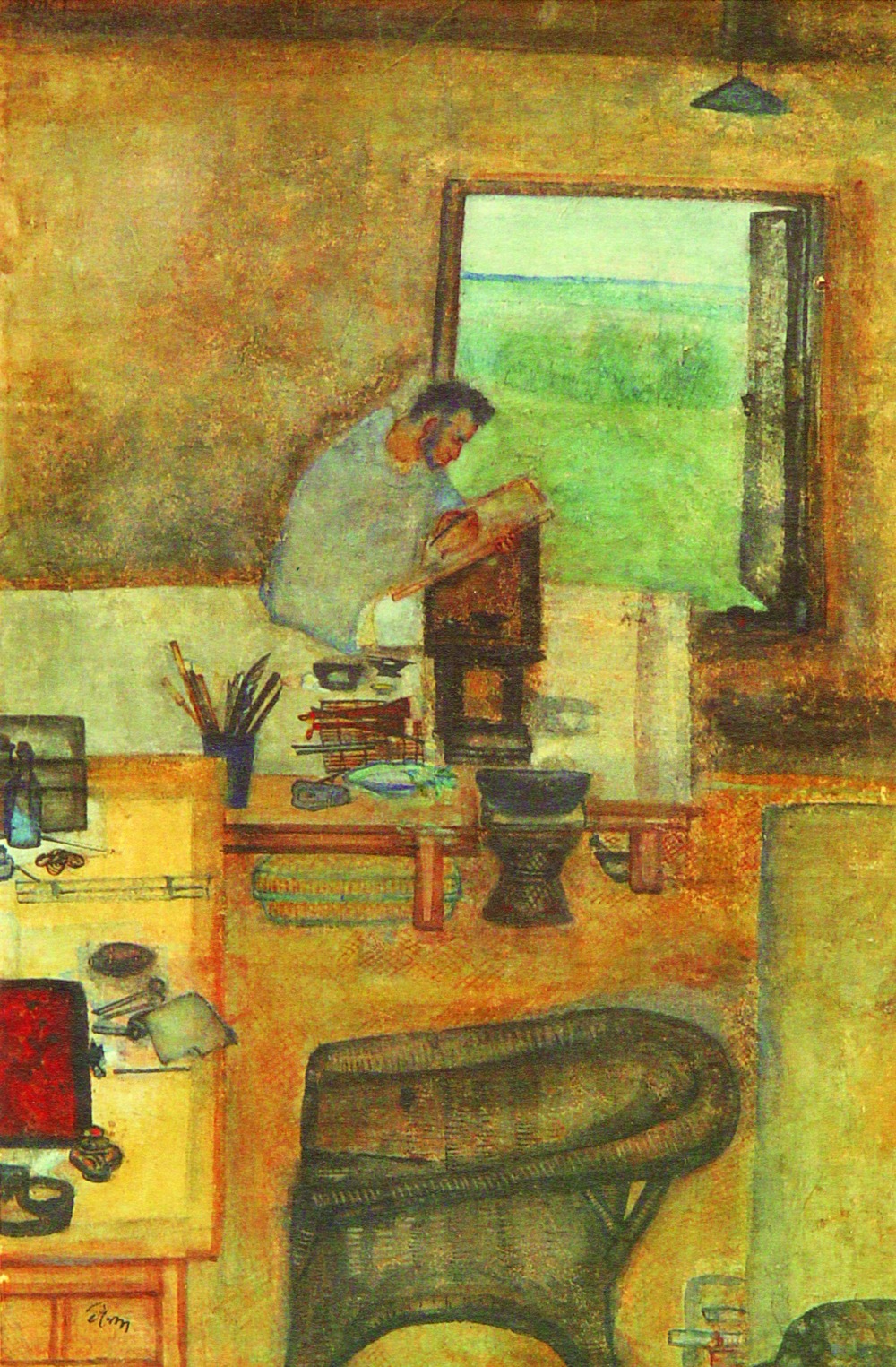
All of this could start one thinking, not just about where and how a particular work is received but also about how and where it is produced. So, again, imagine the classic image of the writer, the scribe, laboriously dipping her or his quill into an inkpot, then later the fountain-pen, and, still later, tapping on the typewriter. Imagine the desk, or the dining table or the small table in a tavern or café, imagine the cross-legged writer sitting in the shady uthon of a hut and holding the notebook on her lap or on a low desi-style desk. Imagine the papers and notes spread around the study or the shed at the bottom of the garden, or on the floor of one of those cubbyholes of north Calcutta, or even a gaddi in Barabazar.
The work takes a certain amount of time, it takes a particular kind of physical labour, it surreptitiously demands that you make certain mirroring demands on the person who receives the fruits of your labour. Imagine the finished slim volume, or heavy stack of notebooks, making their way to the printer where someone will sit and transcribe the whole thing into some system of type, number the pages and divide them into folios, after which, with the inked letter-blocks rattling slightly, the whole thing will be handprinted. The time taken to 'make' the book also asks in return for some time from the reader; this means the effort of lifting the book and turning its pages back and forth is part and parcel of the whole cycle of writing and reading - and then, sometimes, writing further yourself, based on that reading.
Think also of the painter's studio, the etcher's press, or the sculptor's atelier, the space required, and the time and the labour, to produce the work that will ultimately be displayed in a temple, church, palace or gallery. Think of the place where the musician does her or his riyaaz, the composer his composing, and the effort put into producing (and in the case of live music repeatedly producing) the work. Till recently, the shrota, the recipient or audience of this work, would also have been acutely aware that they were receiving the distillation of many different kinds of artistic labour and craft.
Something new enters the mix with the advent of the mechanically moving image and especially with the spread of commercial cinema. Serious film clubs and cineaste gatherings aside, cinema is the one form that asks the least recognition for the labour involved. The movie comes out at the end of a huge process, the most complicated collective process, and yet its usual aim is for the viewer to have as little sense of that process as possible, in fact the aim of popular fiction cinema (and one criteria of its success) is to efface any traces of labour from the final product. On the one hand, commercial cinema instills a ridiculous sense of awe, of the sacred, but on the flip side it constantly attempts to erase all traces of the crime, so to speak, as it wipes out our awareness of the process of production. Perhaps one could posit a slightly risky argument, ignoring the great advantages of the web, and say it is this shrinking of awareness that begins to affect or, if you like, infect our interactions with the other arts, aided and abetted by the computer, the tablet, the mobile phone and the internet.
With the spread of the digital media a more serious question niggles - does the recipients' shrinking sense of the appreciation of the actual labour involved in the different arts, and of respect towards the processes, send back a reverse infection to creators? Are people now making movies quietly designed to be seen while people multitask, talk to each other incessantly, laugh and party as they watch? If every movie is inevitably - say by the second or third viewing, its inevitable 'demotion' from the big screen to TV to mobile screen - just wallpaper-in-waiting, can the same thing not be said of all visual art? Has music at its core, not become Muzak with different degrees of filtering? Similarly, once the written book fragments into bite-sized chunks of screen-text, or into spoken text with all the bleeding into the area of music and film that it implies, will the writer realize that s/he is writing nothing other than a kind of narrative wallpaper, a sort of plotted lift music?