All unquiet on the northwestern front
The first casualty in any war situation is truth; the second is factual accuracy. We find ourselves in this predicament in our military confrontation with Pakistani sponsored insurgency in Kargil. Angry denunciations continue to be hurled by New Delhi to Islamabad, and returned with compound interest. All we know for certain is that Pakistani infiltrators entered our territory more than four months ago without their presence being detected.
What kind of intelligence services do we have? Mr defence minister, you who are never short of words on matters that do not concern you enlighten us on this development which took place under your nose. And how is it that people visiting the region did not give timely warning of the presence of armed aliens on our territory? However belated our response, not even the Pakistanis can deny we had every right to take the action we did.
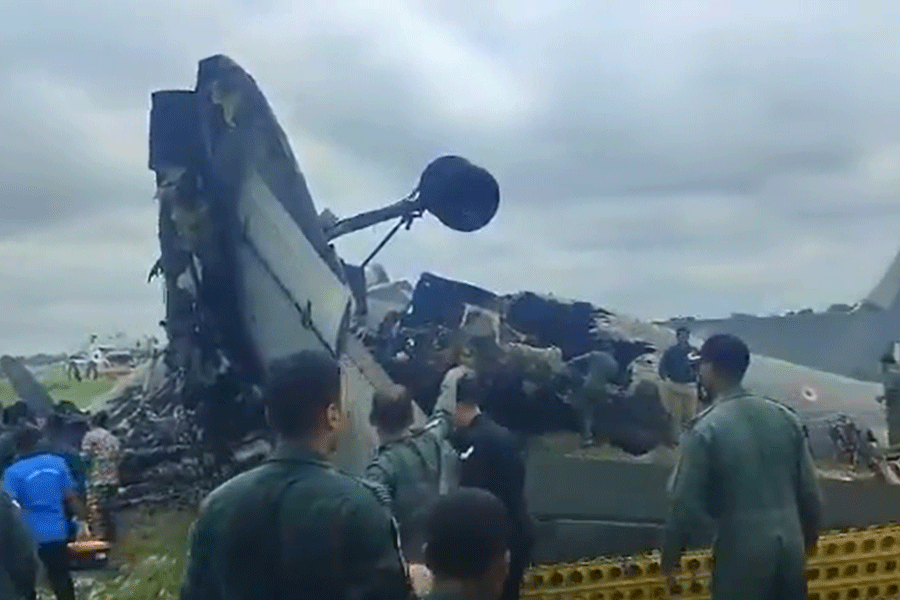
Did our aircraft invade Pakistan?s air space as Pakistani commanders maintain? Or did our air force strictly limit its action to our side of the line of control? We have intelligence reports of the United States, not always friendly towards us, to support our claim that the action was confined to Indian territory. The ground-to-air missile which brought down one of our aircraft was fired either from Pakistani-occupied territory or by an infiltrator who had entered ours. Where this plane fell or the second one crashed is of little consequence, as our planes were operating over a very narrow strip of land separating the two countries and fighter aircraft flying at supersonic speeds can fell many miles away from where they are hit.
The question Pakistan must answer is: do you or do you not recognise the LoC in Kashmir ? Assuming its answer is in the affirmative, it must answer another which follows logically: if you do accept the LoC, can you deny India?s right to rid its territory of unwelcome aliens by whatever means it has at its command?
We do not want yet another war with Pakistan. Both of us have nuclear capability to wipe out each others? major cities and towns. Driven to desperation either country will be driven to resort to this kind of all-destroying war rather than risk defeat in conventional warfare. And border clashes, unless de-fused with dispatch, can escalate into a no-hold-barred full-scale war.
The situation demands that prime ministers of the two countries meet each other face to face either in New Delhi or Islamabad with their military commanders and arrive at a settlement whereby intruders into our territory are either persuaded to withdraw India is allowed to expel them by force without objection from Pakistan.
Taking a leaf out of his book
It is a crying shame that India, despite the size of its book reading population, has very few bookstores. Apart from the metropolitan cities and a few big towns, virtually all that exists are shops selling textbooks. For other books we have to go to railway station bookstalls where you may be able to pick up a trashy paperback to read during the journey. Whenever in my column I refer to a book I enjoyed reading, I get letters from distant towns asking me how they can come by it. I advise them to go to a public or a university library if they have one nearby or write to the publishers. It is a sorry state of affairs.
At long last India Today has come out with a solution. It has launched a book club which regularly issues Books Today, a catalogue of books available with them with their market prices and a hefty rebate available to members. Just about every Indian author?s works is in this catalogue. The scheme is the brainchild of Ashok Chopra who has worked with houses like Vikas. He is much the best pusher of books I have ever met. My own books, which had been dead as a dodo for many decades, were picked up by him to be re-published. He sold them like proverbial hot potatoes.
My translation of Japji was first (and last) published in London in 1951. It went out of circulation many years ago. Chopra decided it should be revived for the tercentenary of the Khalsa and produced a lavishly illustrated edition with a picture of a historical gurudwara on every page with the original in Gurumukhi and Devnagri and its English translation. It worked like a magic. Bibi Jagir Kaur took one look at it and placed a bulk order.
Thankful for big mercies
At the last meeting of the All India Small and Medium Newspapers Federation, its president, Harbhajan Singh, claimed that 75 per cent of Indians rely on papers and journals with small or medium circulations. I am not sure he is right. Newspapers and magazines published in English and regional languages enjoying large circulations reach out to towns and villages across the country. They are usually lower priced. And since they do not depend on government advertising, they can be critical of the administration.
Small and medium newspapers, because of their limited circulation, rely heavily on state patronage and cannot go beyond the Lakshmanrekha prescribed by the government in their criticism. The best example of this is the Indian Observer whose editorship Harbhajan Singh took over from his father. Well produced and well written though it is, it always supports the party in power until it is teetering on the brink.
Like his father who rose from a newspaper hawker to an editor of Urdu and English papers, Harbhajan Singh has hauled himself by the bootstraps to become editor, has written half a dozen books and is a member of over a dozen government and non-governmental organisations. And like his father he is always dapperly dressed in spotless white from head to foot, wears a variety of gold rings on his fingers and carries an aroma of expensive ittar about him. He is the modern Sikh version of a baanka nawab of the latter Mughal period.
BY ARRANGEMENT WITH THE HINDUSTAN TIMES
 Saturday, 13 June 2026