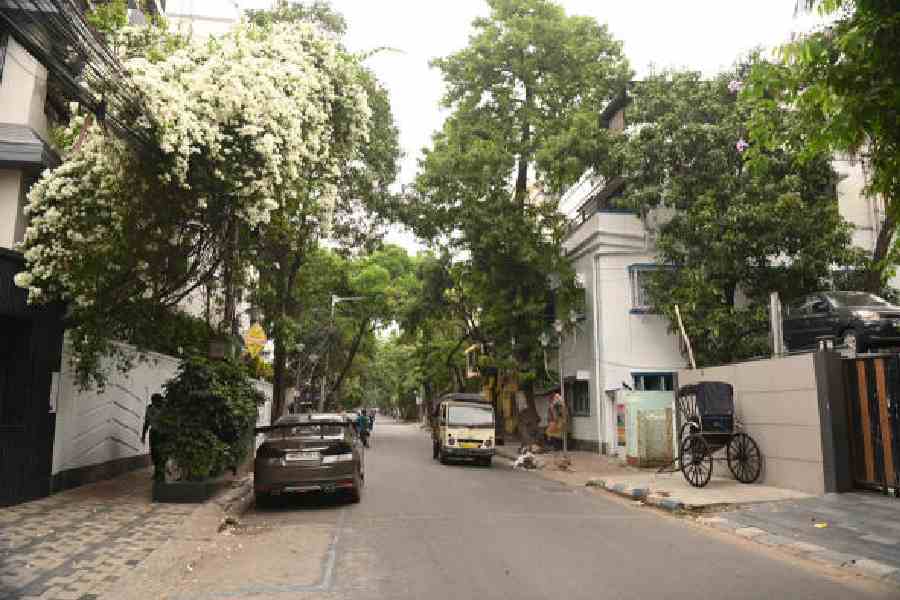

The Cima Awards show, spread over four venues and with collateral events on the sidelines - like school activity, workshops and addas - probably aims not only to promote talented young artists but also urge a shift in perception about art. Because people need to be reassured that art's not esoteric abracadabra for an ivory tower elite but is meant for the enjoyment of all in very public spaces. Whether conventional galleries such as the Academy of Fine Arts (where a majority of the prints were seen till March 22), Studio 21 and Cima; or an unconventional site like the aged mansion and its junky, dilapidated garage at Ramdulari Park that lends the gravitas of a much lived-in, memory-laden counterpoint to spick-and-span but anonymous gallery walls.
Whether your taste exactly matches the jury's or not, one conclusion is inescapable from the 159 works selected out of nearly 2,000 entries: that a certain sangfroid marks art practice among the young, largely wiping away earnestness. But is the baby, ask the sticklers for meticulous craft, also being thrown away, as Conceptual Art claims more adherents? In fact, the top award has gone to Mansoor Ali Makrani's neat assemblage where his creative eye and ideas rather than skill predominate. Including the ability to refer back to art history casually. But another awardee, Banomali Das, shows that craft can never go out of fashion (both at Ramdulari Park, henceforth RDP).
Another trend apparent in many a work is the sly, winking ploy of slipping in allusions so that the quoted images/ideas, like in-house jokes, are wont to be taken at face value by those outside the blessed circle. Makrani, for example, goes back to Joseph Kosuth's chair - and maybe van Gogh's? - which also inspires Avinash Motghare (RDP) and Shitanshu Maurya's lively colloquialism (Studio 21/S 21). Makrani's semantic game throws you into medical terminology even as the aged, rotting 'bones' of the chair are laid out like instruments in an OT. Or like the finds of an anthropological dig, with wry reverence. Das, returning to a weighty tradition in art and family photographs, makes the portrait of his parents conspicuously banal, as its deadpan enquiry of a class/cultural ambience reminds you of Hockney in Portrait of Ossie and Celia, down to the dog.
No doubt, competition anxiety sometimes tells on artists and may result in overkill. The works of Sarathi Das, Jayanta Naskar (RDP), Anirban Saha (Cima) and Mangesh Rajguru (S 21) come readily to mind in this context. But the rigorous screening ensures a certain standard. Award-winner Das perceptively chooses string cots and rush mats for an installation to protest the barbarity of a tribal panchayat's ruling of punitive rape on an independent-minded woman in Labhpur, Bengal. But its excess only results in diminishing returns when, in fact, the dimly-lit niche, stark and vulnerable, hidden behind a mountain of material, including preachy texts and AV presentations, was all that was needed to recall a nightmare that's beyond words.
The other installations and sculptures at RDP: Arpita Dey's has a chilling resonance that's as much about overpopulation devaluing life as about brutality against the infirm. In Durbananda Jana's installation, enquiry and empathy converge as he reminds viewers that public Forgetfulness is responsible for avoidable mishaps from fires. Pallab Das has a quaint sense of form, while Prithviraj Mali chooses a teasingly laconic tone in contrasting the giant brush of a 'great artist' with that of an 'old master' that's too satiny-smooth. And a terse prescription for Peace comes from Shibram Das.
Devesh Upadhyay's figures are disturbing both for their Baconesque grotesquerie and their everyday act of riding a rickshaw. You can imagine it toppling over, sending the couple into a Tyab Mehta tumble. Unnerving in a surreptitious way is Nilanta Das's pretty piece with its insidious suggestion of a serpent inside your mosquito net. Tapan Moharana's Arrangement, resembling the disintegrating carcass of a whale, is equally arresting. Those who wish to be reassured of traditional skill will be happy with Tapas Biswas, Sujan Samanta, Saurav Roy Chowdhury, Anup Mondal and Snehasish Maity.
Pragyan Chakma's carving yields fluent, spiralling sashes of wood. But for a disarmingly winsome resonance of folk imagination, you have Surajit Pal's playful idiom. Finally, Reshmi Bagchi Sarkar's Paint Your Pain - a wall sculpture and assemblage at once, crafted with things found in nature like ulu grass and guggul - is a sensuous, sensitive, thoughtful earth story, with its woven strings of concentric circles suggesting a timeless timeline.
The show, on till April 12, will be reviewed next week also.