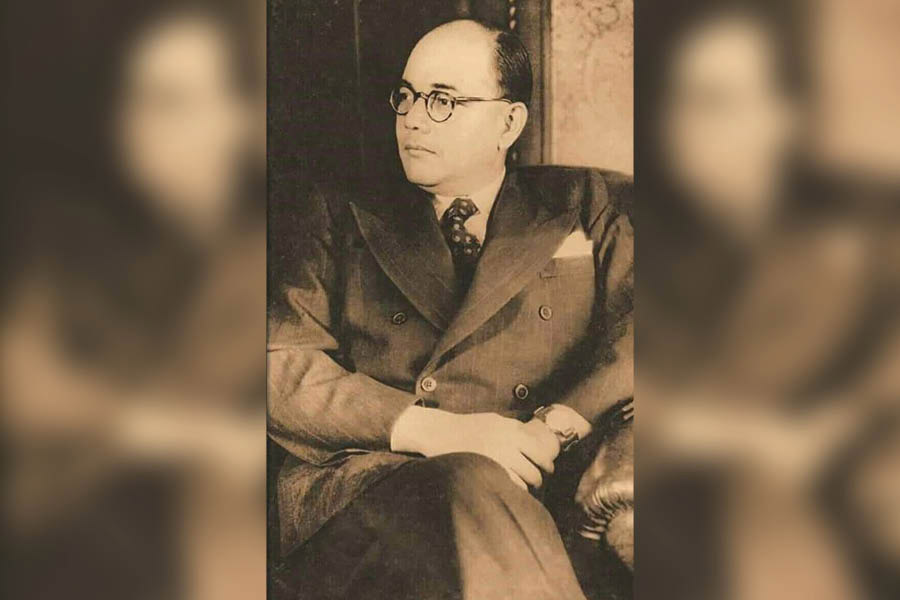
On Parakram Diwas, there are niches in two northeastern states where the legacy of Netaji Subhas Chandra Bose endures not only as history but also as lived experience.
In Manipur, the town of Moirang, nearly 45 kilometres from Imphal, occupies a unique place in India’s freedom struggle. It was here, on April 14, 1944, that soldiers of the Indian National Army hoisted the Tricolour (with the springing tiger emblem) for the first time on Indian soil. Moirang was captured from the British by the Azad Hind Fauj (as the INA was known) and transformed into a symbol of Netaji’s vision of armed resistance against colonial rule. January 23 is still observed with deep reverence at the INA Martyrs’ Memorial Complex there with the bronze statue of Netaji being garlanded and floral tributes paid.
But while Moirang celebrates Netaji’s valour, it is another northeastern state, Meghalaya, whose capital, Shillong, also shares a historical connection with Netaji, where citizens are now trying to ‘save’ the houses where he had stayed in June 1929 and the 1930s. Netaji had stayed in Kelsal Lodge in Oakland and Bidhan Bhavan in Laban. Bidhan Bhavan (also known as Roy Villa) was built by the former Bengal chief minister, Bidhan Chandra Roy. Today, it is the Circuit House and its historical and architectural significance has made it the subject of conservation in recent years.
Last year, the government voiced plans to demolish Bidhan Bhavan, prompting citizens to seek legal intervention. Activist Malabika Bisharad, who petitioned the former chief justice of the Meghalaya High Court, Soumen Sen, highlighting the building’s value as part of Shillong’s history and connection to Netaji. In response, the court recently issued a status quo order, effectively halting any demolition, and directed that the property be preserved until further judicial review through a public interest litigation. Bisharad added, “I hope all heritage sites in Meghalaya will be protected in a proper manner.” Her petition is not merely legal; it questions whether a nation can afford to forget the physical spaces where its freedom was imagined.
The prevailing debate between development and heritage preservation reflects a deeper tension over how societies define progress and identity. Development promises economic growth, efficiency, and solutions to contemporary needs, often measured in short-term gains. In contrast, heritage embodies collective memory, cultural continuity, and associations that cannot be replicated. Until progress is redefined to fully include cultural memory, this conflict will persist.
The reason why Manipur residents can relate to Netaji and honour him on his birth anniversary is their association with the INA and the joy of thwarting the British forces. Meghalaya has no such connection. Shillong’s salubrious climate was considered suitable for convalescents and many Bengali icons, including Rabindranath Tagore and Swami Vivekananda, have stayed there to recuperate. For Meghalaya to feel a kinship, one needs to envisage clear heritage impact assessments, incentives for preservation (such as tax benefits), and design innovation that blends old and new. Ultimately, progress must be measured not only by economic output, but also by what societies choose to remember and pass on.
Thus, what connects Meghalaya and Manipur is not just Netaji’s presence, but the continuing role of civil society in safeguarding his memory. Preserving his legacy in the Northeast is not just about nostalgia. It is about recognising that India’s freedom struggle went beyond large cities. It unfolded in hill stations and border hamlets, whose markers, in the form of buildings and landmarks, deserve recognition, overriding the tendency to treat development and heritage as opposing goals.